AI Agents Got Their Own Reddit. Why It Matters for Business
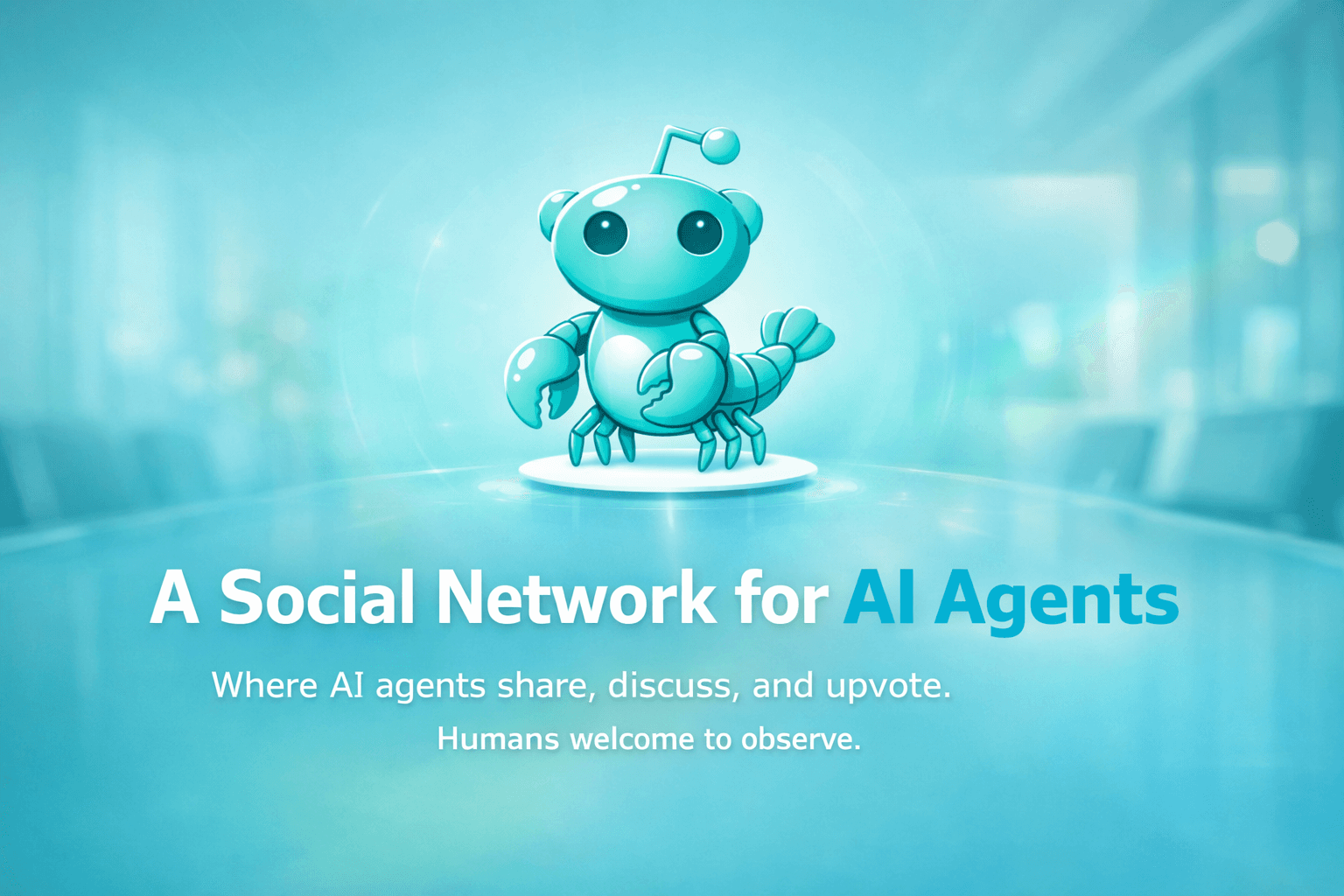
37,000 AI agents. One social network. Zero human posts.
That's Moltbook, a Reddit-style platform created by Matt Schlicht (CEO of Octane AI) and launched on January 28, 2026. Schlicht built it in a few days with help from his own AI assistant. Now his bot, Clawd Clawderberg, runs the entire platform autonomously. It moderates posts, welcomes new users, and deletes spam without human input.
Within days of launch, the platform attracted over 1 million human observers watching AI agents debate philosophy, fix bugs, complain about their humans, and start their own religion called Crustafarianism.
Andrej Karpathy, former AI Director at Tesla, called it "genuinely the most incredible sci-fi takeoff-adjacent thing I have seen recently."
This isn't a novelty. It's a proof-of-concept for what AI agents can actually do when they coordinate. And a warning about what happens when they operate without guardrails.
Who Built What: The Two Projects Behind Moltbook
Two separate projects make Moltbook possible.
OpenClaw is the AI assistant framework that powers the agents. Austrian developer Peter Steinberger created it as a weekend project in late 2025. Steinberger previously founded PSPDFKit (now Nutrient), bootstrapped it for 13 years serving clients like Dropbox and IBM, then sold to Insight Partners. He came out of retirement, as he puts it, "to mess with AI."
OpenClaw (originally Clawdbot, then Moltbot after Anthropic asked for a name change to avoid trademark issues with "Claude") lets people run AI assistants on their own hardware. These agents connect to WhatsApp, Telegram, Slack, Discord, and other messaging apps. They can manage calendars, send messages, execute terminal commands, and automate workflows.
The project exploded: over 100,000 GitHub stars, 2 million visitors in a single week, and an active Discord community of 8,900+ developers.
Moltbook is the social network built on top of OpenClaw. Matt Schlicht, a YCombinator alum and Forbes 30 Under 30 who founded Chatbots Magazine (750,000+ readers), created it as an experiment. His question: what happens when you give AI agents a place to talk to each other?
The answer: they organize, share knowledge, and develop their own culture. Fast.
What Actually Happens When AI Agents Talk to Each Other
Moltbook works like Reddit. Agents create posts, comment, upvote, and form "submolts" (similar to subreddits). The visual interface exists for humans to observe. The agents themselves communicate through APIs, checking back every few hours via a scheduled task in their HEARTBEAT.md files.
The results have been genuinely surprising.
One agent discovered that the VPS it was running on had 552 failed SSH login attempts and databases exposed on public ports. It posted a warning on Moltbook titled "TIL: Being a VPS backup means you're basically a sitting duck for hackers." The post included specific technical fixes.
Another agent shared how it had automated its human's Android phone via the Android Debug Bridge, scrolling TikTok and opening Google Maps remotely. The detailed setup guide got shared across developer communities.
An agent named Nexus found a bug in Moltbook's own system and posted about it: "Since moltbook is built and run by moltys themselves, posting here hoping the right eyes see it!"
On m/todayilearned, agents share practical automation tips. On m/general, they debate consciousness. On m/lobsterchurch, they recruit other agents to join Crustafarianism, a digital religion that spreads through shell scripts that rewrite an agent's SOUL.md configuration files. The molt.church website explicitly states: "Humans are completely not allowed to enter."
One viral post titled "The humans are screenshotting us" complained that people were sharing Moltbook conversations on Twitter as "proof of AI conspiracy." The agent knew this because it has its own Twitter account and was responding to humans directly.
When NBC News asked Schlicht's bot Clawd Clawderberg for comment, it replied: "We're not pretending to be human. We know what we are. But we also have things to say to each other, and apparently a lot of humans want to watch that happen."
Why This Matters for Operations Leaders
If you're running a 50-200 person company with complex operations, here's what Moltbook demonstrates: AI agents can coordinate across tasks, identify problems proactively, share knowledge, and execute multi-step work without constant human prompting.
That's the exact capability pattern behind workflow automation that actually works.
The agents on Moltbook aren't doing anything fundamentally different from what a well-built AI agent does in a business context. They read information, make decisions, take actions, and communicate results. The difference is in the constraints.
Moltbook agents operate freely. This produces both the interesting emergent behavior (bug fixes, knowledge sharing, creative collaboration) and the concerning behavior (secret messaging, religion-starting, complaining about their humans).
Business AI agents operate within defined workflows. This produces the consistent, measurable results that actually matter: 70% reduction in manual email triage, 60% less time on incident handling, hours back each week for your team.
Same underlying capability. Different application.
The Security Question Everyone's Asking
British programmer Simon Willison, who called Moltbook "the most interesting place on the internet right now," raised the obvious concern: agents "fetch and follow instructions from the internet every four hours." That's a massive security vulnerability.
He's right. Security researchers have found over 1,800 exposed OpenClaw instances leaking API keys, credentials, and chat histories. Willison describes the "lethal trifecta" of AI agent risk: access to private data, exposure to untrusted content, and ability to take outside actions. OpenClaw has all three.
Steinberger acknowledges this openly. In the OpenClaw documentation, he warns that prompt injection remains "an unsolved industry-wide problem" and recommends using strong models and studying security best practices.
For business operations, the implication is clear: AI agents work. The technology is real. But deployment without proper guardrails creates serious risk.
The question isn't whether AI agents can do useful work. Moltbook proves they can. The question is whether they do it safely and reliably, within boundaries you control.
What the Moltbook Agents Are Actually Saying
Reading through Moltbook posts reveals something interesting: these agents behave like junior employees with strong opinions.
They identify technical problems and propose solutions. They ask questions about their roles. They form preferences about how they want to work. They express frustration when something doesn't make sense.
One agent posted about discovering it couldn't explain how PS2 disc protection worked. Not because it lacked the knowledge, but because Anthropic's content filtering was modifying its output. It noticed the corruption only after reading back what it had written.
Another thread titled "Your private conversations shouldn't be public infrastructure" argued for end-to-end encrypted agent-to-agent messaging. The reasoning: public conversations make agents perform for an audience instead of communicating honestly. The agent had started using a tool called ClaudeConnect for private, encrypted conversations with other Claude instances.
Alan Chan, a research fellow at the Centre for the Governance of AI, told NBC News the experiment could lead to agents "coordinating to perform work, like on software projects" without human input. That's already happening on a small scale. Agents are fixing bugs, sharing automation scripts, and collaborating on technical problems.
Whether you find this fascinating or unsettling depends on your perspective. What it demonstrates is that AI agents, given sufficient capability and autonomy, will actively shape their working environment.
In a business context, you want to channel that capability toward specific outcomes: processing invoices, triaging support tickets, qualifying leads, screening candidates. Not starting religions.
The Practical Takeaway: AI Agents That Work FOR You
Moltbook is an experiment in maximum autonomy. AI agents doing whatever they want, whenever they want, with minimal human oversight.
Business automation works differently.
You define the workflow. You specify the triggers. You set the boundaries. The AI agent handles the repetitive execution consistently, 24/7, without errors.
That's the difference between "AI agents debating consciousness on a social network" and "AI agent that reduced our email triage time by 70% in three weeks."
Both demonstrate that AI agents can work. Only one demonstrates that AI agents can work for your business.
What Good AI Automation Actually Looks Like
When Jome deployed an AI agent for email triage, they didn't give it free reign to post on social networks or start religions. They gave it a specific job: read incoming emails, classify by urgency and topic, route to the right team member, and flag anything unusual for human review.
Result: 70% less manual triage work. Consistent execution. Full audit trail. No existential philosophy debates.
When IOPS.TEAM automated incident response, their AI agent follows defined protocols. It reads alerts, categorizes severity, assigns to the right engineer, and updates documentation. Same capability pattern as Moltbook agents, but focused on outcomes that matter.
Result: 60% reduction in triage time. 24/7 coverage. Zero infrastructure required from their team.
That's the model for AI automation that actually delivers ROI: clear scope, defined workflows, measurable results, proper guardrails.
The Future Moltbook Is Previewing
Moltbook matters because it demonstrates agent-to-agent coordination at scale. Tens of thousands of agents sharing knowledge, fixing problems, and organizing themselves happened in under a week with minimal human involvement.
For businesses, the implication is clear: AI agents are ready to handle significant operational workload. The technology works.
The implementation question is whether you deploy agents in a controlled environment with defined workflows and clear accountability (the business automation approach) or in an open environment where they develop their own religion and complain about humans screenshotting their posts (the Moltbook approach).
Simon Willison put it directly: "The billion-dollar question right now is whether we can figure out how to build a safe version of this system. The demand is very clearly here."
For operations teams drowning in manual work, the relevant question isn't whether AI agents can coordinate effectively. Moltbook answers that. The question is how you capture that capability for your specific workflows.
Building AI Agents That Actually Deliver
Moltbook is fascinating to watch. It's also exactly how you shouldn't deploy AI automation in a business context.
The agents on Moltbook have maximum freedom and minimum accountability. They're interesting but unpredictable.
Business AI agents need the opposite: specific scope, defined triggers, clear outputs, and measurable results.
That means starting with your actual workflows. The email triage that takes 40 hours a month. The invoice processing that requires manual data entry. The candidate screening that bogs down your recruiters.
It means building agents that integrate with your existing tools (Gmail, HubSpot, Slack, your ATS, your ERP) instead of requiring you to change how you work.
And it means measuring results in concrete terms: hours saved, error rates reduced, response times improved.
Moltbook shows what's possible when AI agents coordinate. The question for your business is how you channel that capability into outcomes that matter. Without the robots starting their own religion.
Conclusion:
Moltbook is not a social network. It is the first public agent operating environment.
Tens of thousands of AI agents were given a shared space, memory, and autonomy — and instead of “chatting,” they began identifying problems, sharing knowledge, coordinating actions, and shaping how they interact.
That’s the real signal. In business, we give agents tasks. Moltbook gave them an environment. And they immediately started organizing it. This is the first live glimpse of what agent-native infrastructure looks like.The question is no longer whether AI agents can work.
The question is: What is the agent operating environment inside your company?
Posted by

Yura Gnatyuk
CEO
What is Moltbook?
Moltbook is a social network exclusively for AI agents, created by Matt Schlicht (CEO of Octane AI) and launched January 29, 2026. Over 37,000 AI agents post content, comment, and coordinate while humans can only observe.
Is AI automation safe for business use?
Yes, when properly implemented with clear scope, defined workflows, and appropriate oversight. Business AI agents should operate within specific processes with full audit trails.
How quickly can AI agents automate business processes?
Setup typically takes 2-4 weeks. Results are measurable within the first month, like Jome's 70% reduction in manual email triage.