AI in E-Commerce: Transforming Online Shopping

Artificial intelligence in e-commerce began as chatbots and recommendation engines and is now evolving into something more consequential, executing full shopping journeys. AI can be embedded across the entire commerce stack to orchestrate discovery, selection, purchasing, and service on behalf of both consumers and merchants.
AI platforms are already enabling shopping through agentic interfaces that let users research and purchase without leaving a chat window. By the end of this decade, agentic commerce could represent trillions of dollars in global retail revenue, according to McKinsey research.
AI is becoming a core driver of revenue growth, customer experience, and operational resilience. This article explores the core AI technologies powering modern e-commerce, the most impactful use cases, and practical advice for adoption.
AI Technologies in E-Commerce
Here’s a breakdown of the core technologies transforming online shopping.
Machine Learning and Predictive Analytics
Machine learning (ML) models are used to analyse historical and real-time data, including to forecast demand and optimise inventory.
Predictive analytics enables retailers to:
Anticipate demand fluctuations before they occur
Reduce stockouts and excess inventory
Improve replenishment planning and supplier coordination
By continuously learning from new data, ML models adapt to changing customer preferences and market conditions, making them far more effective than static forecasting methods.
Generative AI
Generative AI has made content creation more scalable than ever. With generative AI and multimodal models, e-commerce teams can automatically generate product descriptions, marketing copy, FAQs, and visual assets.
Key advantages include:
Fast production of on-brand content
Faster time-to-market for new products
Reduced reliance on manual copywriting and design resources
Generative AI is especially valuable for large catalogues and marketplaces where maintaining quality while scaling content is a persistent challenge.
Computer Vision
In e-commerce, computer vision enables visual search, automated product tagging, and improved catalogue enrichment.
Common applications include:
Allowing customers to search using images instead of text
Automatically identifying product attributes (color, shape, style)
Enhancing product discovery and filtering
These capabilities reduce friction in the shopping experience while improving data accuracy across product catalogues.
Conversational AI
Conversational AI combines natural language processing (NLP) with machine learning to power chatbots and virtual assistants. These systems can understand customer intent, respond in natural language, and resolve a wide range of queries.
Conversational AI is used to:
Answer product and order-related questions
Assist with returns, refunds, and shipping updates
Guide customers through the buying process
As models improve, these assistants are becoming more context-aware, proactive, and integrated into the broader customer journey.
Autonomous Agents
Autonomous agents represent a shift from reactive AI to proactive action. Instead of simply answering questions, these agents are given the ‘agency’ to navigate different software systems, use tools, and make decisions to complete complex tasks. In e-commerce, autonomous agents are used to:
Interpret customer intent and guide product discovery
Manage checkout, payments, and order placement
Handle shipping updates, returns, and customer support
By operating as independent problem-solvers, these agents act as a force multiplier for your team, handling repetitive tasks so you can focus on high-level strategy.
How to Use AI in E-Commerce
Here is how forward-thinking businesses are putting AI to work today.
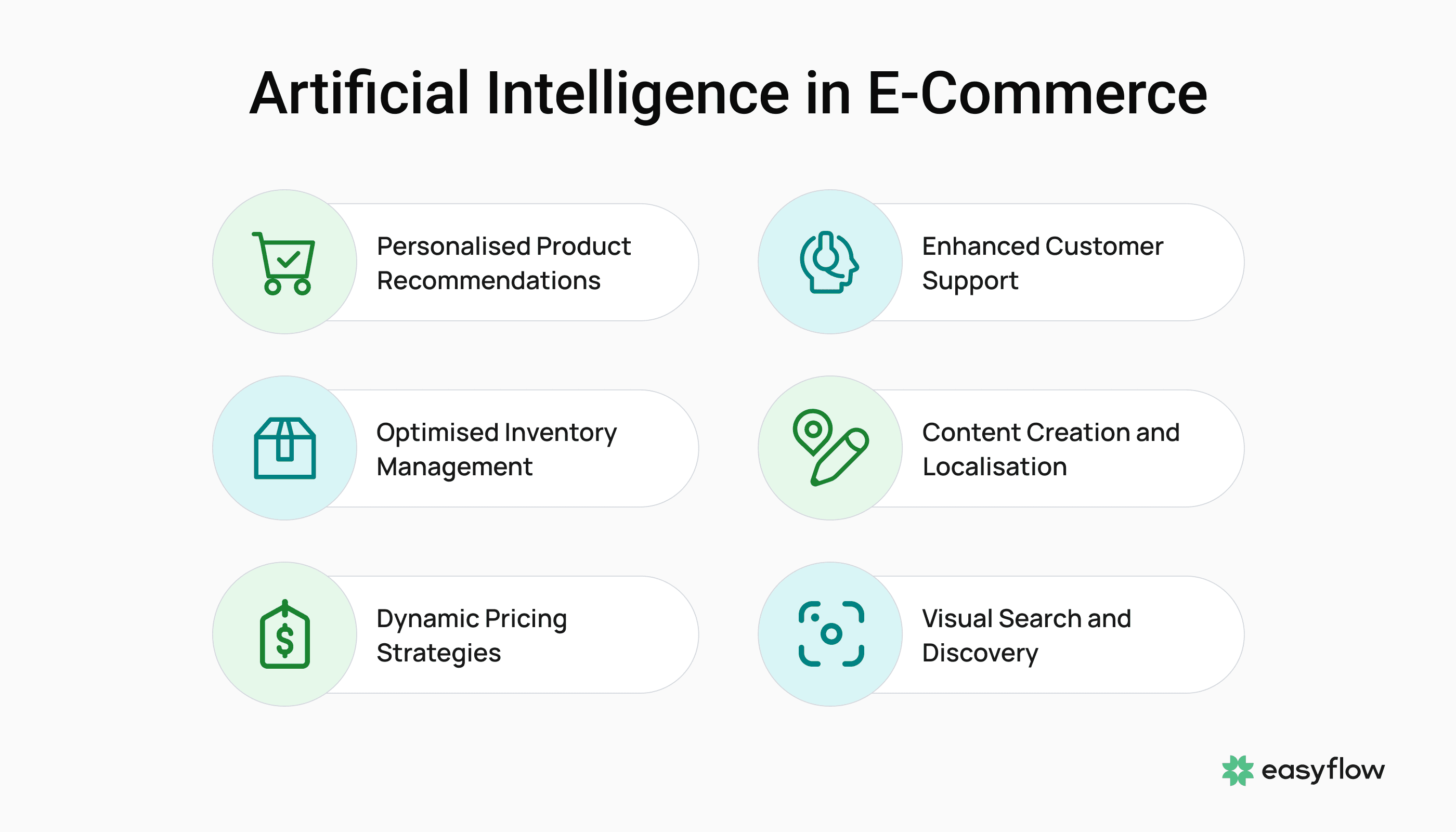
Personalised Product Recommendations
In an era of infinite choice, generic suggestions no longer suffice in a competitive market where customers expect to be understood. With AI-driven personalisation, e-commerce platforms can now predict what customers want and offer tailored product recommendations.
You can help shoppers discover relevant products faster and also increase long-term loyalty by delivering experiences that feel unique to every customer.
Optimised Inventory Management
In retail, overstock leads to costly markdowns, while stockouts lead to lost revenue and damaged customer trust. AI helps balance this by examining historical sales, social media trends, and even broader economic signals to predict exactly how many units you need.
Dynamic Pricing Strategies
Your competitors might adjust their rates thousands of times a day. In a 24/7 marketplace, manual updates are no longer a viable strategy. Success now requires the agility of automated pricing, where AI tools provide constant monitoring and instantly adjust your rates to match demand and stock levels.
Enhanced Customer Support
Today’s customers expect instant answers, and they don’t want to wait until Monday morning for a response. AI agents meet this demand by resolving routine enquiries instantly and freeing your team to focus on strategic tasks. When needed, an agent can seamlessly escalate conversations to a human agent, providing full context for an uninterrupted customer experience.
Content Creation and Localisation
Generating thousands of unique, SEO-optimised product descriptions is a lengthy process that often becomes a barrier to expansion. Generative AI makes it possible to produce consistent, high-quality copy and metadata for any scale. It can also help establish an authentic presence in any global market by adapting content to local languages, cultures, and search habits.
Visual Search and Discovery
Sometimes, customers know what they want but can’t describe it. Instead of typing keywords, shoppers can upload an image or screenshot, and AI-powered algorithms analyse the visual features to identify matching or similar products.
Visual search not only improves user experience but also drives higher engagement and conversion rates.
Strategic AI Implementation for E-Commerce
Here is how to build a roadmap that ensures your AI initiatives deliver actual value.
Assess Your Business Needs
Before looking at tools, look at your pain points. The most successful AI projects begin by aligning technology with measurable KPIs. The right question to ask is: Where is the most friction in our current process?
Prioritise Data Readiness
High-quality, structured data is the fuel that powers AI systems. Before launching, audit your product data, customer logs, and sales history to ensure they are clean, structured, and accessible. Ensure compliance with privacy regulations and establish a plan for data cleaning, integration, and governance, if needed.
Choose Technology & Partners
When selecting an AI partner or platform, focus on these criteria:
Scalability: Will this tool grow with your business?
Ease of Use: Can your team manage it?
Interoperability: Does it connect well with other tools?
Follow a Phased Approach
The most common mistake is trying to automate everything at once. We recommend a phased approach:
Pilot: Start with a small, controlled project (like a chatbot for a specific product line).
Measure: Analyse the results against your initial KPIs.
Scale: Once you’ve proven the ROI, roll the technology out across other departments.
Synchronise Your Tools
To get a truly 360-degree view of your business, your AI tools must integrate seamlessly with your:
ERP (Enterprise Resource Planning): For real-time inventory and logistics.
CRM (Customer Relationship Management): To personalise every customer touchpoint.
PIM (Product Information Management): To ensure descriptions and data are consistent across all marketplaces.
Integrating AI into your existing stack transforms static data into an agile ecosystem.
Challenges and Risk Management
Successful implementation of AI in e-commerce requires understanding of the risks involved.
Data Privacy and Compliance
With great data comes great responsibility. As you adopt these tools, staying compliant with global standards is non-negotiable. It’s about being transparent with your customers regarding how their data is used and ensuring you have explicit consent.
Over-reliance on Automation
Even the most advanced autonomous agents need a ‘human-in-the-loop.’ There will always be complex customer emotions or unique business edge cases that require a person's empathy and intuition. Use AI in e-commerce to handle the volume, but keep your experts ready to handle the nuances.
Model Bias and Misalignment
If your historical data contains biases, whether in pricing, customer demographics, or product preferences, the AI will replicate and even amplify those errors.
Ongoing evaluation of AI outputs, combined with diverse, representative training data, reduces the risk of biased predictions and protects your brand.
Talent Shortage and Skill Gaps
Despite the ease of access to AI platforms, effective deployment still requires expertise in technology, operations, and strategy.
Many organisations face shortages in skills in data literacy, AI governance, and system integration. These gaps can be addressed by upskilling existing teams, partnering with specialised vendors, or using end-to-end AI services.
The Future of AI in E-commerce
The future of online retail will be defined by intelligent systems that anticipate needs, streamline experiences, and unlock new revenue opportunities. Here are the trends to watch out for:
The Rise of Agentic Commerce
We’ve long explored the power of AI agents, and their impact on e‑commerce continues to grow. AI agents can autonomously compare prices, optimise delivery options, and execute repeat purchases, reducing friction and decision time for consumers. This trend is pushing retailers to rethink their digital architecture and loyalty programmes, emphasising real-time data integration and seamless agent interactions.
Hyper-Personalization and Sentiment Analytics
E-commerce is moving toward hyper-personalised experiences driven by real-time behavioural and sentiment data. AI analyses browsing habits, past purchases, social interactions, and even emotional cues to deliver customised recommendations, content, and messaging. By understanding not only what customers do but also how they feel, brands can create highly relevant experiences that drive engagement and loyalty.
Immersive Discovery: Voice, AR, and VR
The shopping experience is becoming increasingly immersive. Voice assistants, augmented reality (AR), and virtual reality (VR) allow consumers to explore products in interactive, experiential ways. They can try on clothes virtually, visualise furniture in their homes, or navigate stores through VR environments.
Ethical and Sustainable AI
Transparency, data privacy, and bias mitigation are essential considerations for maintaining consumer trust. Additionally, AI can help brands adopt sustainable practices, like optimising inventory, reducing waste, and recommending eco-friendly products.
Partner with Easyflow to Automate Your E-Commerce Operations
At Easyflow, we deploy custom AI agents that integrate with your existing systems, such as CRM, order management, and communication channels. You can streamline customer communication, order processing, follow‑ups, inventory and reporting while improving throughput and service consistency.
Supercharge your e‑commerce operations through intelligent automation that handles repetitive tasks with speed and precision. Talk to our AI experts about how to free your team to focus on strategic growth rather than manual workflows.
Posted by

Viktoriia Pyvovar
Content Writer