AI Inventory Management: What Top-Performing Supply Chains Do

Poor inventory management costs global retailers $1.7 trillion every year in out-of-stocks and overstocks. That's tied-up capital, missed sales, and customers who find what they need somewhere else.
Retailers embedding AI into inventory operations are delivering profit growth more than two times higher than peers on legacy systems, reinforcing a structural performance advantage.
AI inventory management is what separates those two groups, as it replaces manual forecasting, reactive reordering, and spreadsheet-bound planning with automated workflows that act on signals the moment they appear.
Where Manual Inventory Management Fails
Most operations teams inherit inventory processes built for smaller volumes: a spreadsheet here, a weekly reorder review there, and safety stock rules that haven’t been touched in years. These approaches break down fast when SKU counts grow, seasonal demand shifts, or a supplier disrupts your lead times.
Netstock's 2024 Benchmark Report, drawing on data from 2,400+ SMBs worldwide, found that excess stock accounts for an average of 38% of SMB inventory, and nearly 80% of SMBs suffer from a combination of insufficient forward planning and overstocking. That excess ties up working capital, inflates storage costs, and ages into obsolescence.
Manual systems simply cannot process enough signals fast enough. But AI inventory management goes even further than speeding up the old process. It replaces it with one that reads real-time sales data, supplier lead times, weather signals, and market trends, then acts on them automatically.
Benefits of AI Inventory Management
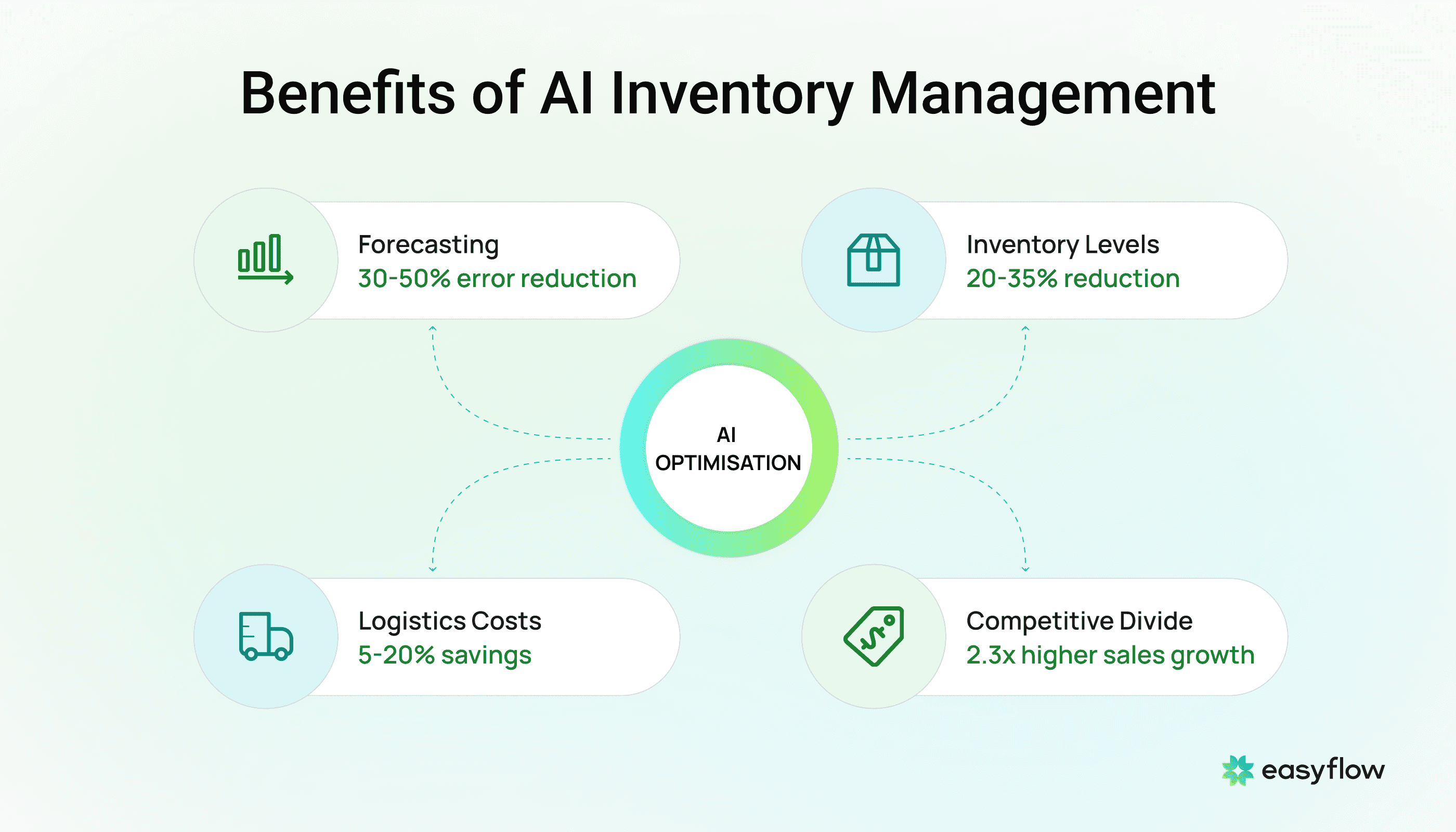
Operational outcomes from AI-driven inventory are already outperforming traditional methods. Companies deploying these systems report consistent, measurable improvements across these dimensions:
1. Leaner Inventory
AI improves demand forecasting accuracy and dynamically adjusts replenishment parameters by product, region, and velocity segment. Instead of applying static safety stock rules, the system recalculates risk in real time.
Organisations implementing AI in distribution operations frequently report inventory reductions in the 20–30% range, with some early adopters achieving even greater gains. Precision is the key difference: AI lowers inventory where risk is overestimated and increases it where demand volatility justifies it.
2. Lower Logistics and Procurement Costs
When forecasts stabilise and replenishment becomes more precise, downstream costs decrease. The savings stem from fewer emergency shipments, fewer last-minute production adjustments, and less over-ordering.
The same research on AI-enabled distribution operations shows logistics cost reductions commonly ranging from 5 to 20%, with procurement spend improvements following similar patterns.
3. Forecast Error Reduction
Traditional statistical forecasting struggles with volatility, promotions, and multi-variable demand signals. AI models incorporate broader datasets, including historical sales, seasonality, macro trends, and external signals, and continuously retrain as patterns shift.
Supply chain planning benchmarks demonstrate that AI-driven demand forecasting reduces forecast error by 30–50% when compared to conventional methods.
4. Growing Competitive Gap
As AI becomes standard practice, the gap between automated and manual inventory management continues to widen. But leading supply chain organisations aren't just using AI more; they're using it more deliberately. A Gartner survey found that only 23% of supply chain leaders have a formal AI strategy, meaning the majority are running disconnected projects that Gartner warns can block long-term transformation.
That's where the real divide sits: not between companies using AI and those that aren't, but between those with a deliberate automation roadmap and those without one.
The businesses seeing the biggest gains aren't those that automated the most; they're the ones that automated the right things deliberately.
Key Use Cases for AI in Inventory Operations
The value of AI in inventory spans the full lifecycle, not just one workflow:
Demand Forecasting
AI agents use historical sales, seasonal patterns, promotions, weather data, and external market signals to generate accurate demand forecasts at the SKU level. Retailers like Walmart use this approach to align shelf stock with demand across thousands of locations, avoiding both stockouts and costly overstock.
Automated Replenishment
Rather than waiting for a planner to review reorder points, automated replenishment AI agents trigger purchase orders the moment predefined conditions are met, adjusting dynamically for lead times, supplier reliability, and current sell-through rates.
Anomaly Detection
AI monitors inventory transactions in real time, flagging discrepancies, shrinkage patterns, and data integrity issues that manual audits catch weeks too late.
Multi-Location Stock Balancing
For businesses with warehouses across multiple regions, AI allocates inventory based on real-time demand signals, preventing the scenario where one warehouse holds excess while another is out. McKinsey found that a major building products distributor improved fill rates by 5–8% with an AI-enabled supply chain control tower.
Supplier Performance Tracking
AI agents continuously score suppliers on lead time, fill rate, and accuracy, surfacing underperformance before it creates downstream inventory problems. This is particularly relevant given that 72% of SMBs report inconsistent delivery times as a major supply chain challenge.
How Easyflow Builds AI Inventory Management Systems
Off-the-shelf inventory software gives you another dashboard. What it doesn't give you is automation that fits your existing ERP, your supplier relationships, or the specific reorder logic your ops team has refined over years.
Easyflow builds custom AI inventory management workflows as agentic automations. That means an AI agent that connects directly to your inventory data, monitors the signals that matter to your business, and takes action in the systems you already use.
Specific workflows Easyflow deploys for inventory teams:
Demand Forecast Agents
Pull sales history, promotional calendars, and external data inputs into a forecast model that updates continuously and pushes reorder recommendations into your ERP or purchasing system automatically. The AI Inventory Analyser we created for one of our clients does exactly this — automating product ranking, forecasting, and procurement planning, cutting emergency reorders by 45%.
Automated Reorder Triggers
Define the logic once (min/max levels, lead time buffers, supplier constraints), and the automated reorder workflow handles execution without human review for standard replenishment cycles. For example, the AI Inventory Management Agent we built continuously monitors stock levels, detects reorder needs based on sales velocity and inventory trends, and flags recommendations to the right person before a stockout occurs.
Supplier Alert Workflows
AI agents monitor supplier lead times and fill rates, escalating exceptions to the right person with full context rather than a raw data alert that requires manual investigation.
Inventory Reconciliation Automation
Rather than weekly manual counts, AI agents cross-reference system records against IoT sensor data or scan inputs to flag discrepancies in real time.
The result is an ops team that stops spending hours on reorder reviews and redirects that time to exceptions that actually require human judgement.
Conclusion
Rather than simply improving forecasts, AI inventory management rewires inventory decisions to happen automatically and at scale. Leading businesses swap manual review cycles for workflows that continuously monitor key inventory and supply signals, act on triggers, and involve humans only when necessary.
With the AI inventory management market growing at 29.8% annually, the competitive gap between early adopters and everyone else is widening every quarter. So, there’s no better moment than now to unlock the benefits of custom automation.
Ready to automate your inventory and replenishment workflows?
Let's build AI agents that connect to your ERP, monitor your demand signals, and trigger replenishment automatically.
Posted by

Viktoriia Pyvovar
Content Writer
What is AI inventory management?
demand forecasting, stock replenishment, anomaly detection, and supplier tracking. Unlike static ERP rules, AI systems update continuously based on real-time data: sales trends, lead times, and seasonal signals. They take automated action without requiring manual review at every step.
What's the difference between AI inventory management software and a custom AI agent?
Off-the-shelf inventory management software provides configured dashboards and standard replenishment rules that apply generically across industries. A custom AI inventory management agent built by a firm like Easyflow connects directly to your existing systems, applies your specific reorder logic, and automates execution in the tools your team already uses. Custom agents eliminate the configuration overhead and produce recommendations calibrated to your actual operations.
How long does it take to implement AI inventory automation?
For focused workflows like automated replenishment or demand forecast alerting, Easyflow deployments typically run 4–8 weeks from scoping to production, depending on data availability and ERP integration complexity. Broader supply chain AI initiatives covering multi-location balancing, supplier tracking, and reconciliation run longer, typically 3–6 months.