Multi-Agent AI Systems: Architecture, Use Cases & Future Trends

Multi-agent systems (MAS) coordinate multiple AI agents to solve complex tasks collaboratively. Major AI leaders, including Anthropic, Google, and OpenAI, are actively exploring and implementing multi-agent architectures.
Gartner data reveals that questions about multi-agent systems grew nearly fifteenfold between early 2024 and mid-2025. Businesses are recognising the limitations of single-purpose AI tools and looking for more sophisticated approaches to workflow automation.
What makes the multi-agent approach more effective is specialisation and orchestration.
Multi-agent systems manage many specialised agents that work together as a team, as opposed to a single general-purpose AI attempting to handle everything. As AI technology matures and businesses push into complex automation, this team-based model is emerging as the foundation for scalable, production-ready AI.
This article breaks down the multi-agent system approach, exploring what's driving adoption and when it makes sense for solving your most complex challenges.
What Are Multi-Agent AI Systems?
A multi-agent system is a coordinated group of specialised AI agents working together toward a shared objective. Responsibility is distributed so that each agent is optimised for a specific domain or capability.
It's similar to how human teams divide work based on individual expertise rather than asking one person to do it all.
These agents communicate through structured message passing, sharing only the information required for coordination. A central orchestrator (or orchestration layer) manages the workflow by assigning tasks, ensuring alignment between agents, resolving conflicts, and sequencing actions when necessary.
Multi-agent systems offer clear advantages:
Coordination: Each agent focuses on a well-defined responsibility.
Scalability: Systems can handle growing demands by adding more agents.
Reliability: redundancy and cross-checking between agents reduces error rates.
Before implementing a multi-agent system, it's important to understand that not every problem requires this level of complexity.
Agentic systems exist on a continuum:
Agentic workflows are predefined, rule-based scripts designed for repetitive, low-risk tasks. Basic agentic workflows use rule-based automation for repetitive tasks with minimal AI decision-making.
Autonomous agents are single AI entities equipped with tools, memory, and limited decision-making capabilities. They can adapt but still operate as generalists.
Multi-agent systems consist of multiple specialised agents coordinated by an orchestrator to achieve a common goal.
The architecture you need depends entirely on the complexity of your problem.
Multi-Agent Systems vs. Single AI Agents
The difference between a single AI agent and a multi-agent system is how problems are approached and how work is distributed.
Both rely on the same underlying AI capabilities, but they are designed to solve fundamentally different types of problems.
How Single AI Agents Solve Problems
A single AI agent operates as a generalist. It receives a task, reasons through it, uses available tools, and produces an outcome within one continuous decision loop.
Single agents rely on sequential reasoning. They attempt to understand the full context, decide what to do next, execute actions, and validate results.
Interaction is narrow and centralised. The agent may call tools or APIs, but all decision-making flows through one point. A single reasoning space concentrates context, memory, and judgement.
Single agents function optimally in the following areas:
Clearly defined tasks with limited variability
Personal productivity tools
Simple automation or reporting
Early-stage AI experimentation
How Multi-Agent Systems Solve Problems
A multi-agent system approaches problems as a coordination challenge. Responsibility is distributed among specialised agents.
Problems are divided into subtasks based on skill, domain, or risk. Each agent focuses on its area of expertise while communicating with others through structured message passing. An orchestrator or coordination mechanism ensures alignment toward a shared goal.
Interaction is broad and distributed. Agents exchange partial outputs, validate one another’s work, and adapt based on real-time signals. The system evolves as conditions change rather than following a fixed path.
Multi-agent systems excel in the following:
Complex, multi-layered workflows
Cross-functional decision-making
Dynamic environments with changing inputs
High-stakes processes requiring validation
Aspect | Single AI Agent | Multi-Agent Systems |
Design | One general-purpose AI | Multiple specialised AIs working together |
Complexity | Struggles with complex workflows | Breaking complex workflows into steps |
Accuracy | Generalist approach | Higher accuracy through specialisation |
Scalability | Hard to expand capabilities | Easy to add new agents for new tasks |
Reusability | Limited | Agents can be reused across workflows |
Setup | Simple to deploy | More complex initial setup |
Management | Easy to monitor | Requires coordination and oversight |
Costs | Predictable | Less predictable |
Security | Smaller risk surface | More integration points to secure |
Errors | Single point of failure | Risk of cascading errors between agents |
Best For | Simple, standalone tasks | Complex, multi-step processes |
When a task necessitates multiple distinct skills, it's advisable to form a team of specialists instead of overloading a single generalist.
Components of a Multi-Agent System
A multi-agent system is defined by a small set of foundational components. When designed well, they create the conditions for coordination, scalability, and reliability.
Agents
Each agent is an autonomous entity with a specific role or area of expertise. They focus on a bounded scope: e.g., analysis, execution, validation, or domain-specific reasoning.
From a business perspective, agents function as specialised team members. When each of them has a well-scoped responsibility, coordination remains manageable and outcomes predictable.
Environment
The environment is everything the agents can observe, influence, or be constrained by. This includes internal systems (databases, APIs, workflows), external signals (market data, user input), and operational constraints (policies, regulations, budgets).
The environment determines what information agents can perceive and what actions are possible. In business settings, this often mirrors the real operating context of the organisation. It makes the system responsive to real-world changes rather than static inputs.
Communication Protocols
Communication protocols define how agents exchange information. They provide a consistent contract for inter-agent interaction, covering type of information, timing, data formats, and reliability or prioritisation requirements.
Well-designed communication protocols prevent noise, duplication, and misalignment. They ensure agents receive only relevant information and can trust the signals they act upon.
Coordination and Control Models
The way agents are coordinated defines the system’s behaviour and reliability.
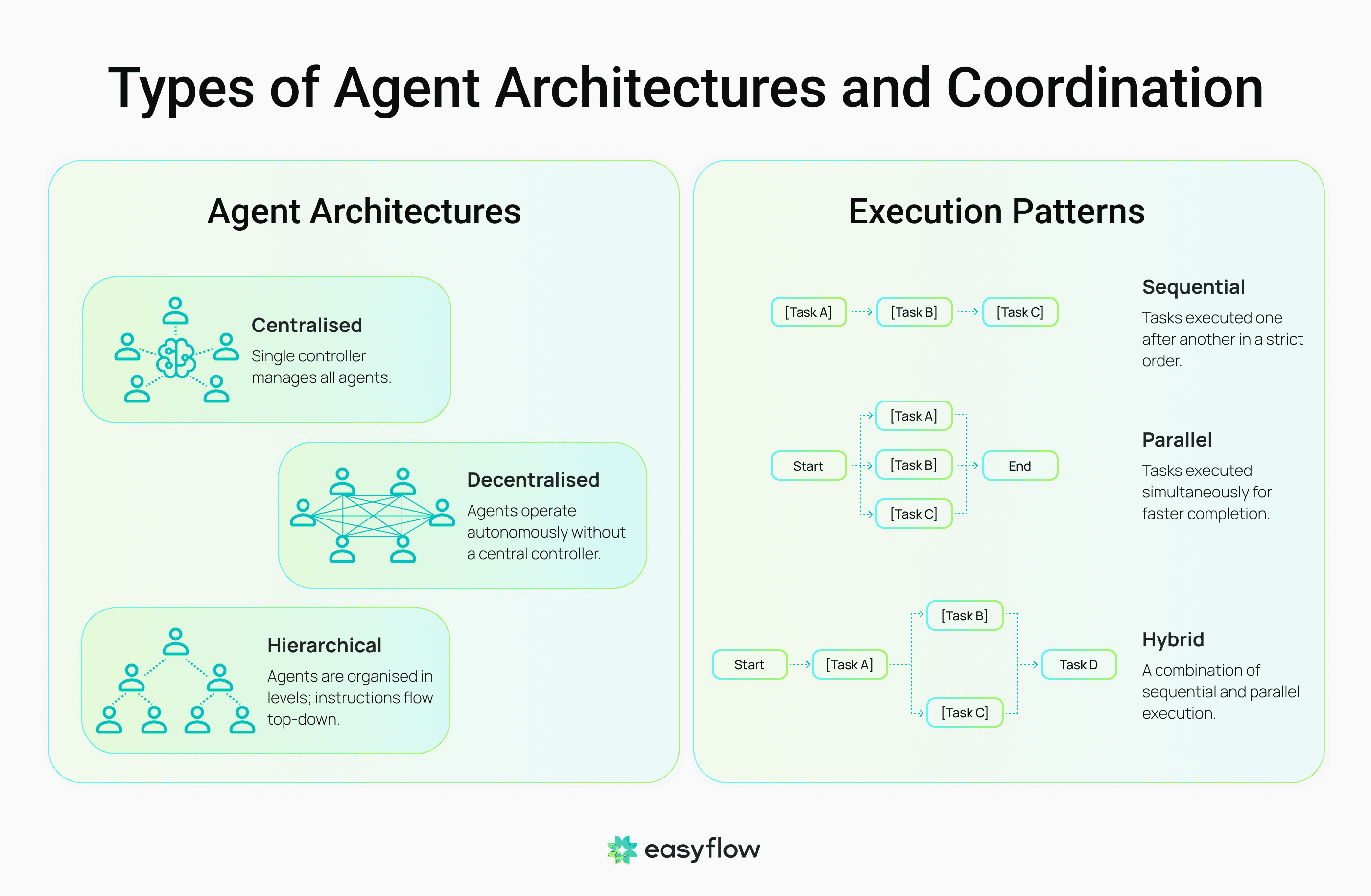
In centralised architectures, a primary controller assigns tasks, manages dependencies, and resolves conflicts. These systems are easier to reason about and monitor but can introduce a single point of failure.
In decentralised or hybrid architectures, agents negotiate task ownership, share progress, and adapt dynamically based on system state.
Coordination can follow different execution patterns: sequential execution, where tasks are completed step by step; parallel execution, where multiple tasks run simultaneously; or hybrid execution, which combines sequential and parallel flows to balance dependencies with efficiency.
How Multi-Agent AI Systems Actually Work
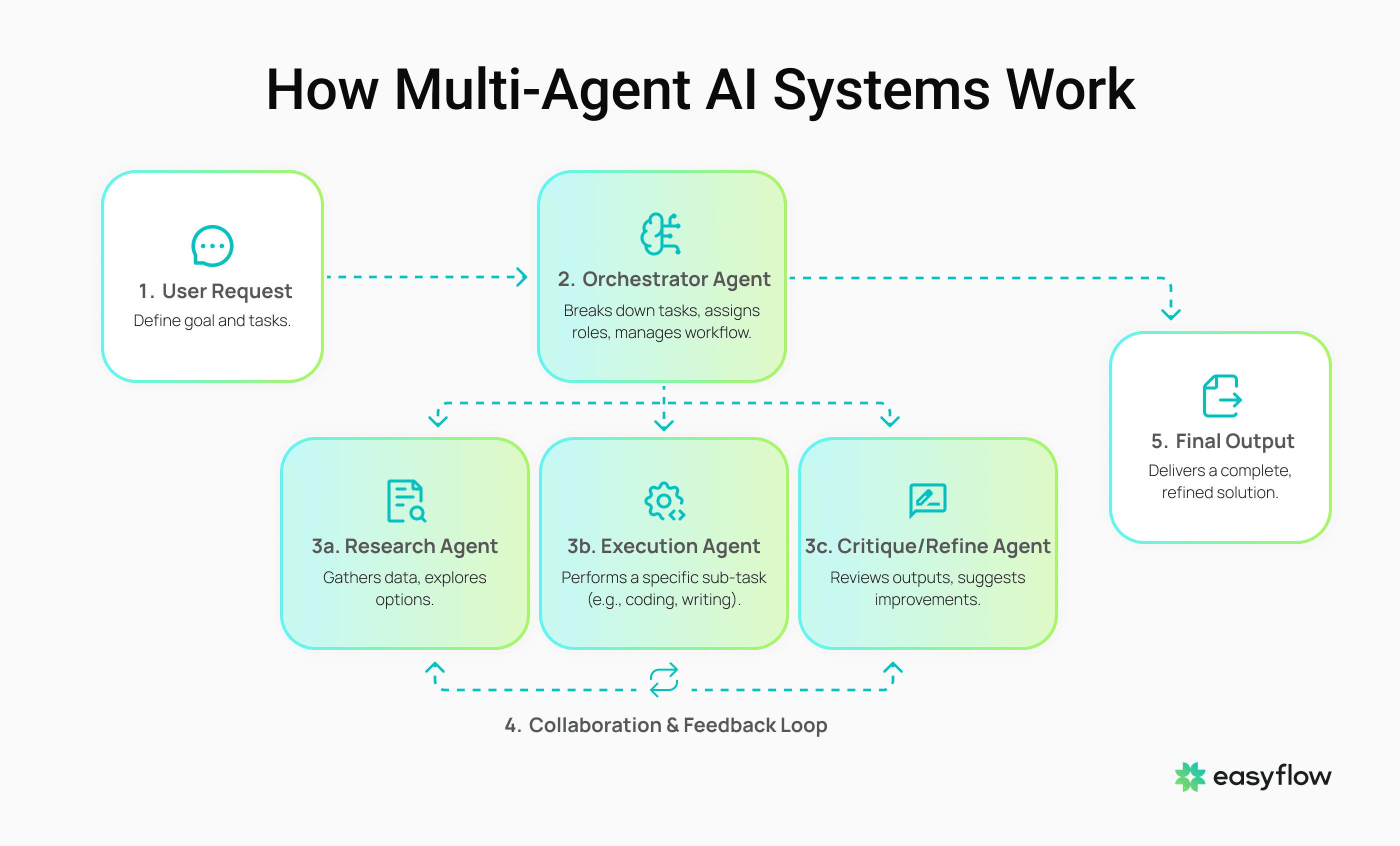
Multi-agent AI systems coordinate specialised agents to accomplish complex tasks. While there are several architectural approaches, one common pattern uses hierarchical orchestration.
User Request
The process begins when a user defines a goal and task. This initial request provides the objective that the system will work toward accomplishing.
Orchestration
In hierarchical architectures, an orchestrator agent (coordinator) receives the request and breaks down the task into manageable components. It assigns roles to specialised agents and manages the overall workflow, ensuring all pieces work together coherently.
Not all multi-agent systems use central orchestration — some use peer-to-peer communication or emergent coordination. But orchestrated patterns are common in frameworks like AutoGen, CrewAI, and LangGraph.
Specialized Agent Execution
The orchestrator delegates work to specialised agents, each with distinct capabilities. Common agent types include:
Research Agent: Gathers data and explores options relevant to the task
Execution Agent: Performs specific sub-tasks such as coding, writing, analysis, or other concrete actions
Critique/Refine Agent: Reviews outputs and suggests improvements to ensure quality
Note that agents often work in parallel rather than strictly sequentially, and critique/reflection capabilities may be built into agents rather than always being a separate role.
Collaboration and Feedback Loop
Agents interact iteratively, sharing results and refining their work based on feedback. This collaboration can happen through:
Direct agent-to-agent communication
Shared memory or message queues
Orchestrator-mediated exchanges
This iterative loop allows the system to improve outputs progressively rather than relying on single-pass execution.
Final Output
Once the collaborative process reaches completion, the system delivers a synthesised result — a complete, refined solution that addresses the original user request.
Most organisations struggle because work is fragmented across functions. Multi-agent systems address this by structuring AI the same way you structure teams: with clear roles, interaction protocols, and decision authority distributed in a single point of control.
When Is a Multi-Agent System the Right Fit?
Two guiding principles can help determine whether MAS is appropriate.
1. Dynamic Collaboration Is Required
If a problem can be solved through a fixed sequence — Task A followed by Task B followed by Task C — then a simpler agentic workflow is usually sufficient. Multi-agent systems become valuable when:
The order of tasks changes based on real-time inputs
Subtasks emerge or disappear dynamically
Decisions depend on interactions between multiple areas of expertise
A useful test is the skill gap test: can the problem be cleanly divided into distinct domains that benefit from deep specialisation? If yes, MAS may be justified.
2. The Challenge Is Too Complex for a Single Agent
Single agents struggle when problems require both breadth and depth. Multi-agent systems address this through:
Specialisation over generalisation: Each agent is hyper-optimised for its domain.
Reliability through vetting: Agents can review and validate each other’s outputs (for example, one agent writes code while another audits it for security risks).
Context efficiency: Each agent receives only the context it needs, reducing token overhead and improving reasoning quality.
When Not to Use a Multi-Agent System
MAS introduces overhead and complexity. It is not suitable for:
Lightweight, repeatable tasks.
Clearly defined, predictable workflows.
Simple personal assistants.
Automated reporting pipelines.
Basic customer support scenarios.
In these cases, simpler architectures are faster, cheaper, and more reliable.
Real-World Applications
Multiple autonomous agents are particularly valuable in domains requiring distributed decision-making and scalability.
Transportation and Traffic Management
Intelligent transportation systems deploy agents representing vehicles, traffic lights, and control centres. Each traffic light adjusts its timing based on real-time data from sensors to optimise flow locally while communicating with central systems to coordinate "green waves" across the city. Cities like Singapore utilise these hybrid agent architectures to dynamically reduce congestion and emissions.
Supply Chain and Logistics
In supply chains, agents represent suppliers, warehouses, and retailers. For example, Amazon uses orchestrated agent-based systems in fulfilment centres, where a central planner coordinates thousands of robots. While the robots move autonomously to avoid immediate obstacles, the system optimises their collective paths to retrieve items and manage inventory.
Energy Grid Management
Smart grids use agents representing power generators, substations, and smart homes to balance electricity supply and demand. These agents negotiate energy trading and manage load balancing. When solar panels produce excess energy, home agents can sell power back while industrial agents adjust consumption based on price signals.
Healthcare and Patient Monitoring
Hospital-wide systems optimise bed allocation and operating room scheduling through agent negotiation based on patient priorities. During COVID-19, some hospitals used agent-based models to predict resource needs. On the operational side, monitoring agents are being deployed in hospitals to track vital signs and equipment status, alerting staff to problems.
Financial Markets and Trading
Algorithmic trading systems deploy specialised agents: some identify opportunities, others manage risk, and execution agents minimise market impact. Agent-based models also help regulators simulate market dynamics and test financial system stability.
Disaster Response and Emergency Management
During disasters, agents representing rescue teams, drones, and emergency vehicles coordinate operations. Drones survey disaster zones and identify survivors while ground teams receive optimised search patterns. The distributed nature makes these systems resilient when centralised command may fail.
Manufacturing and Robotics
Factory robots act as agents that negotiate task allocation and coordinate movements. When a machine breaks down, nearby agents redistribute work autonomously. This flexibility allows factories to switch products quickly and handle customised orders with greater efficiency.
Environmental Monitoring
Environmental protection agencies deploy multi-agent systems for pollution monitoring and natural resource management. Networks of sensor agents collect data on air quality, water contamination, or forest conditions. Analytical agents process this information to detect patterns and predict risks. In fisheries, agents representing vessels and regulators interact in simulations to determine sustainable catch limits.
E-Commerce and Recommendation Systems
Online marketplaces use agent architectures for pricing negotiations. On the consumer side, price comparison agents scan platforms to identify the best deals. On the seller side, dynamic pricing agents help sellers optimise revenue based on demand, competition, and inventory levels.
Recommendation systems employ multiple specialised agents: some analyse browsing behaviour, others assess product similarities, and collaborative filtering agents identify patterns. The combination of these agents' outputs creates personalised shopping experiences.
The common thread here is the ability of multi-agent systems to break complex processes into coordinated, autonomous actions. This enables organisations to scale operations, turning AI into a collaborative workforce.
Bring AI Agents to Your Business with Easyflow
Now is the best time to turn AI into your competitive advantage — delegate time-consuming tasks and complex decision-making to single or coordinated AI agents that integrate directly into your operations.
At Easyflow, we specialise in building custom AI agents for customer support, marketing, sales, retail, recruitment, and other business functions. Through our projects, we’ve seen firsthand how well-designed AI agents can deliver efficiency gains in real production environments.
Book a demo and see how our solutions can automate tasks and scale operations across your business.
In practice, this often starts with operational teams — for example, our AI agents for recruitment have helped teams save up to 90% of the time spent on manual tasks. You can download our free Recruitment AI Agent Guide to see how this works in practice.
Conclusion
As AI agents become increasingly capable, businesses need to design systems for scalability. PwC’s AI Agent Survey provides evidence that 88% of executives are increasing budgets specifically for agentic AI scalability.
We’re seeing the rise of industry-specific agent marketplaces, allowing companies to discover, deploy, and integrate pre-built agents tailored to their sector. Gartner predicts that by the end of 2026, 40% of enterprise apps will include AI agents.
The next wave of AI agent development is marked by increased autonomy, where agents can make more independent decisions and handle complex workflows without constant human oversight.
Posted by

Viktoriia Pyvovar
Content Writer