AI Agency vs. DIY Automation: How to Choose

Across SaaS and operations teams, DIY automation has become the default starting point. With tools like Zapier, Make, and n8n lowering the barrier to entry, non-technical teams can now design and deploy workflows in hours rather than weeks. What previously required engineering support is increasingly handled inside marketing, operations, and customer success functions.
In practice, this has led to a predictable stack of internally built automations: lead routing from paid channels into CRMs, syncing product or customer data across tools, automating support triage, and stitching together reporting pipelines from multiple systems. Many teams are also layering in AI by using prompt-driven workflows to generate responses, classify tickets, or enrich data in motion.
Enterprise leaders are actively investing in automation at the task level, with many organisations still operating in this phase rather than at full system orchestration. The appeal is clear: fast deployment, low upfront cost, and immediate operational gains without waiting on engineering.
The rise of LLM-based tools and agent frameworks has accelerated this trend, making it possible for teams to automate not just structured tasks but semi-structured decision-making across support, sales, and operations.
But the same characteristics that make DIY automation accessible also introduce structural limitations. As workflows scale, they become harder to reason about, harder to monitor, and increasingly dependent on implicit assumptions about data, schema, and tool behaviour. What starts as a set of helpful automations gradually turns into a fragmented layer of logic that sits between systems without clear ownership or visibility.
The Case for DIY Automation
No-code and low-code automation tools have genuinely lowered the barrier to entry and let operations teams build working workflows without a software development background. For simple, single-system tasks like routing a form submission into a CRM, sending a Slack notification or generating a weekly report, these tools deliver value quickly and cheaply.
That is the legitimate case for DIY automation.
The shift occurs as soon as complexity increases. A workflow that spans multiple systems, incorporates branching logic, depends on AI-generated outputs, and is expected to operate reliably at scale becomes a fundamentally different undertaking.
At this stage, DIY implementations often begin to accumulate technical debt in less visible ways. Workflows can fail when APIs change, while logic designed for a specific use case is applied beyond its original scope. If the original builder leaves, teams may lack clear documentation or ownership, making it difficult to understand how the system operates or to verify that it continues to perform as intended.
Industry surveys suggest that a large share of enterprise AI initiatives fail to move beyond pilots or do not deliver measurable ROI, with estimates in some analyses reaching up to 80% when including projects that never reach production. In parallel, S&P Global Market Intelligence data shows that around 42% of companies report having abandoned most of their active AI initiatives in 2025, up from 17% the year before.
The constraint emerges when automation is built without architectural design, resulting in systems that scale poorly and become harder to maintain than the processes they replace.
What an AI Automation Agency Does Differently
The distinction between DIY automation and working with a specialist AI automation agency begins with the level of structure and intent established before any workflow is built.
A competent AI agency starts by mapping the operational landscape: which processes are genuinely automatable, which carry the highest ROI, and which look like easy wins but carry hidden dependencies. This diagnostic phase is the part DIY projects consistently skip.
At Easyflow, we use this foundation to structure the AI transformation itself. The goal is not only to identify opportunities but also to design how they fit together in practice so that each workflow contributes to a coherent and scalable operating system.
The difference in output is meaningful. While a DIY automation handles a task, a well-designed AI system handles a process, accounts for exceptions, monitors its own performance, and generates data that improve over time. Those are structurally different things, and building the second requires experience the first attempt rarely provides.
There are three specific areas where the gap between DIY and specialist work is largest:
Integration Depth
Most DIY automations connect systems through surface-level field mappings and event-based triggers, without aligning to underlying data models or API lifecycle changes. This creates fragile dependencies that can fail silently when upstream systems evolve.
Production-grade integrations are designed around schema stability, versioning, and change tolerance across systems.
Across our work with SaaS and operations teams, we’ve seen a recurring pattern in onboarding and CRM-driven workflows where partial schema changes propagate after upstream updates. Automations continue executing without errors, while underlying field relationships drift out of alignment. These inconsistencies typically surface during downstream reconciliation or customer success audits, often long after the original change.
Exception Handling
Automated systems fail in ways that manual processes don't. When a human encounters an unexpected input, they adapt. An automated workflow without exception logic either crashes, loops, or silently produces wrong outputs.
Building good exception handling requires thinking through failure modes in advance, a discipline that only comes from having built automations that have failed in production before.
Governance and Monitoring
Voice support agents built with proper oversight can reduce resolution times by up to 60%, especially when connected across CRM, helpdesk, and escalation workflows. Financial reporting agents can compress reporting cycles from a full working day to under an hour when monitoring and validation layers are in place.
These gains depend on systems with monitoring, validation, and feedback loops in place. Operational visibility into whether automations are performing as expected requires instrumentation across workflows, data flows, and decision points. Without that layer, performance becomes difficult to verify, and issues surface only after they impact outcomes.
The Hidden Cost of DIY Automation
The appeal of DIY automation is the upfront cost. An AI automation software subscription costs a fraction of an agency engagement. But the calculation changes when you account for the total cost of ownership over 12 months.
Cost of Time
Every hour an engineer or operations manager spends debugging a workflow or rebuilding a connection is an hour not spent on higher-value work. For a mid-sized company running 15 to 20 automations, maintenance alone can consume two to three days a month of qualified staff time.
In production environments, automation requires continuous upkeep. SaaS APIs evolve, authentication tokens expire, and data schemas change. With the increase in integrations, dependencies accumulate, and small upstream changes create ripples across multiple workflows.
Over time, the effort shifts toward maintaining integration stability across interconnected systems. Automation becomes an operational layer that demands ongoing attention, rather than a one-time implementation.
Cost of Bad Data
Automations that run in the background can corrupt records, create duplicate entries, or generate reports that look accurate but aren’t. These errors compound over time.
A frequent issue is silent data drift. Field mappings shift, syncs partially complete, or time-based logic misaligns across systems. Without validation or monitoring layers, these inconsistencies persist and spread.
As data flows into downstream systems, the impact compounds. Dashboards, CRM logic, and forecasting models begin operating on distorted inputs. At that stage, teams face both automation fixes and data correction efforts across multiple systems.
Opportunity Cost of the Right Architecture
A DIY system built around a single tool or platform creates lock-in without the benefits of lock-in. When the business wants to change CRM, add a new data source, or scale throughput by 10x, the automation stack often can’t follow. Starting over costs more than starting right the first time.
Most DIY automation starts inside point solutions designed for speed and accessibility. As the number of integrations grows, the system begins to function as a distributed environment rather than a collection of isolated workflows.
Complexity increases with each added dependency. Logic spreads across tools, workflows become interdependent, and changes require coordination across multiple layers. Migration effort grows alongside this complexity, especially when automation logic is embedded across platforms instead of being centralised.
Early-stage automation prioritises speed of deployment. Scaled automation depends on architectural consistency, clear ownership of logic, and system-level visibility.
None of this means every company needs a full AI automation agency engagement. Some processes genuinely belong in DIY territory. The key factor is understanding which processes fit that model and whether the current setup can scale without structural rework.
When to Choose AI Agency vs DIY Automation
The agency vs. DIY decision depends on what you're building, what internal capacity you have, and what kind of result you need.
Feature | DIY / In-House | AI Automation Agency |
|---|---|---|
Ideal for | Task-based triggers | End-to-end process transformation |
Ownership | Individual builder | Institutionalized systems |
Risk Profile | High (silent failure/key person risk) | Low (monitored/documented) |
Total Cost | Low upfront, high maintenance | Higher upfront, scalable ROI |
Choose DIY Automation When:
the process is simple and self-contained
your team has automation experience
the stakes are low if it breaks
you're comfortable owning maintenance
Connecting a CRM to a Slack notification, or automating a weekly reporting pull, are genuinely good DIY candidates.
Choose an AI Automation Agency When:
the process has multiple integration points
the outcome needs to be measurable
the person who builds it won't be the person who maintains it
you need a connected system rather than a single automation
If the answer to 'Who owns this result?' within your company is 'nobody' or 'everyone', that's a clear signal.
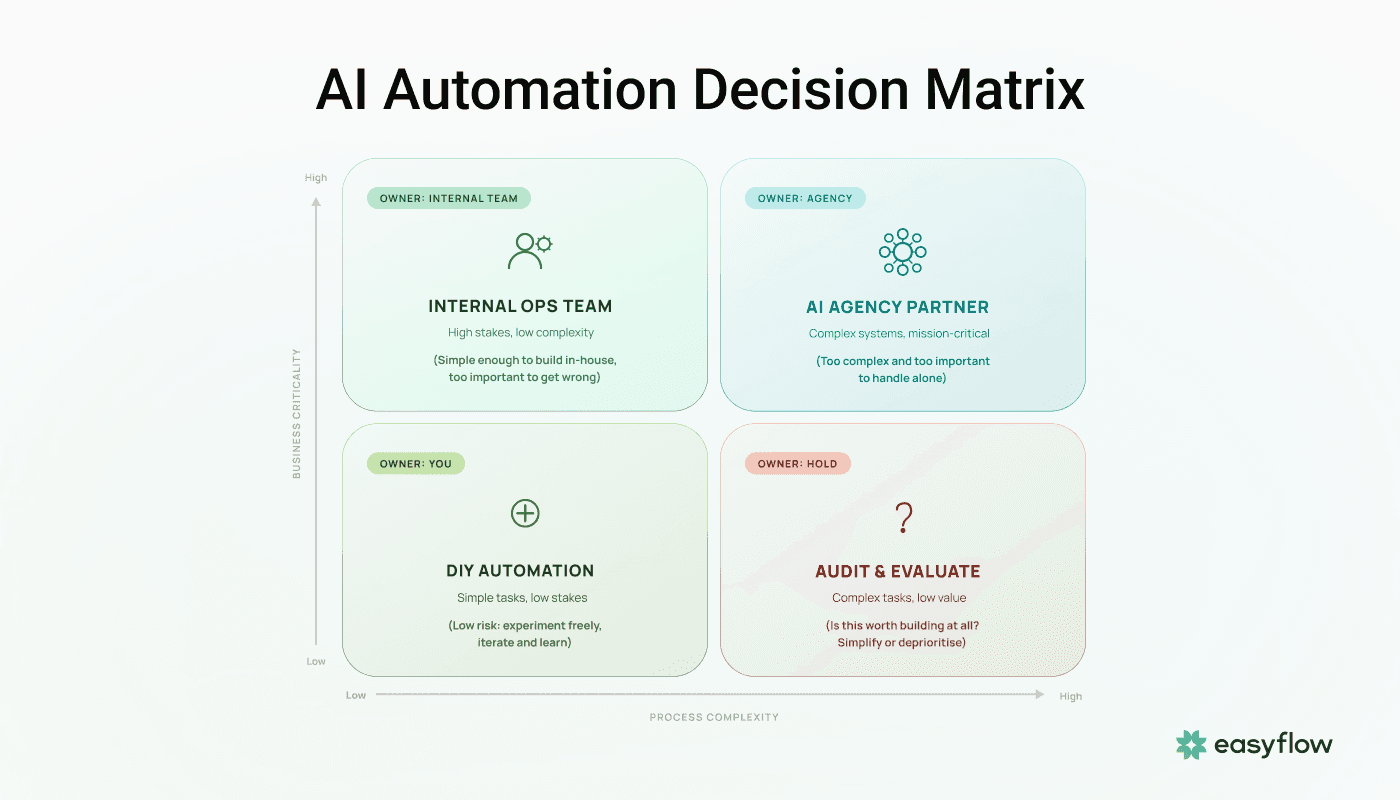
There's a third scenario that most companies are actually in: they've built several DIY automations and hit a ceiling. The existing workflows are fragile, there's no clear picture of what's working, and there's appetite to go further but no confidence in the current foundation. This is the right entry point for an AI audit, where existing automations are reviewed in context.
When DIY Stops Scaling
When complexity accumulates faster than value, maintenance increases, data quality becomes harder to trust, and every new workflow adds more surface area for failure, it becomes an architectural problem.
This is where working with an AI transformation partner starts to make practical sense. The focus shifts from adding more workflows to designing a system that can support growth, adapt to change, and operate reliably under pressure.
Easyflow supports this transition across:
AI transformation: a coordinated change across your operations, products, and people.
Embedded AI engineering: adding engineering capacity directly to your team.
AI product development: building MVPs to validate ideas.
Custom AI agents: deploying agents that operate across your tools and workflows.
The goal is not to replace what you’ve built, but to make it usable for the next growth stage.
A Practical Next Step
If your current setup feels harder to maintain than to extend, it’s time to take a closer look at the foundation. A focused audit will show:
where your current automations are creating hidden risk
which parts of the system can scale as-is
where structural changes will have the highest impact
Contact us to explore how our approach looks in practice, or start with a system-level review to understand what your next step should be.
Posted by

Viktoriia Pyvovar
Content Writer