Build vs Buy for AI Agents: A Practical Framework for Ops Leaders

Many ops leaders approach the build vs buy AI agent decision by focusing on which tool appears most capable, but that is the wrong starting point. A more useful question is what the process actually requires and what minimum solution can reliably deliver it at production scale and quality.
Getting this wrong in one direction means spending four months building a custom agent for a workflow that a no-code tool could have handled in a day. Getting it wrong in the other direction means wiring a rigid automation workflow to a process that requires contextual judgment, then spending the following six months maintaining it as edge cases accumulate.
According to Gartner's August 2025 forecast, 40% of enterprise applications will be integrated with task-specific AI agents by the end of 2026, up from less than 5% in early 2025. The question operations leaders need to answer is where their processes actually fall within that spectrum.
Why the Build vs Buy Decision Matters for AI Agents
Ops leaders today face a spectrum of automation choices that are more differentiated than they appear at first glance. At one end sit off-the-shelf tools like Zapier, Make, or n8n, which connect applications and execute rules without requiring any code. At the other end sit custom AI agents built on top of large language models, capable of reading unstructured content, reasoning through edge cases, and making intermediate decisions before passing a result to a human or a downstream system.
Between those two poles are configurable AI products, vendor-packaged agents, and low-code platforms that blend both approaches in varying proportions.
The wrong choice consistently produces one of two operational problems. A company overbuilds a simple process, committing engineering time and budget to an AI agent that does exactly what a basic workflow tool would have done at a fraction of the cost. Alternatively, a company tries to automate a complex, judgment-heavy process with a rule-based tool and ends up with a fragile workflow that breaks on every non-standard input, requiring more human intervention than the original manual process did. Both failures come from matching the solution to the vendor's pitch rather than to the actual shape of the process.
Automate the Predictable, Agentise the Complex
Traditional automation produces reliable results where the rules are stable and the inputs are clean. A rule-based workflow moves data from one system to another according to a fixed set of conditions: if a form is submitted, create a CRM record; if a ticket is marked urgent, send a Slack notification. These are deterministic operations where the inputs are known, the output is specified, and the same input always produces the same output.
AI agents occupy a meaningfully different category of tool, useful where the process requires reading something that does not follow a predictable structure, deciding between multiple possible next steps based on context, handling inputs that a fixed rule cannot cover, or producing an output that a human will then review and act on.
A rule-based workflow moves data from A to B. An AI agent understands what the data means, decides what should happen next, and handles the edge cases that a fixed rule cannot anticipate. The distinction sounds straightforward, and in the abstract it is, but in practice most teams underestimate how quickly a seemingly simple process becomes complex once real-world inputs arrive.
When Is No-Code Automation Enough?
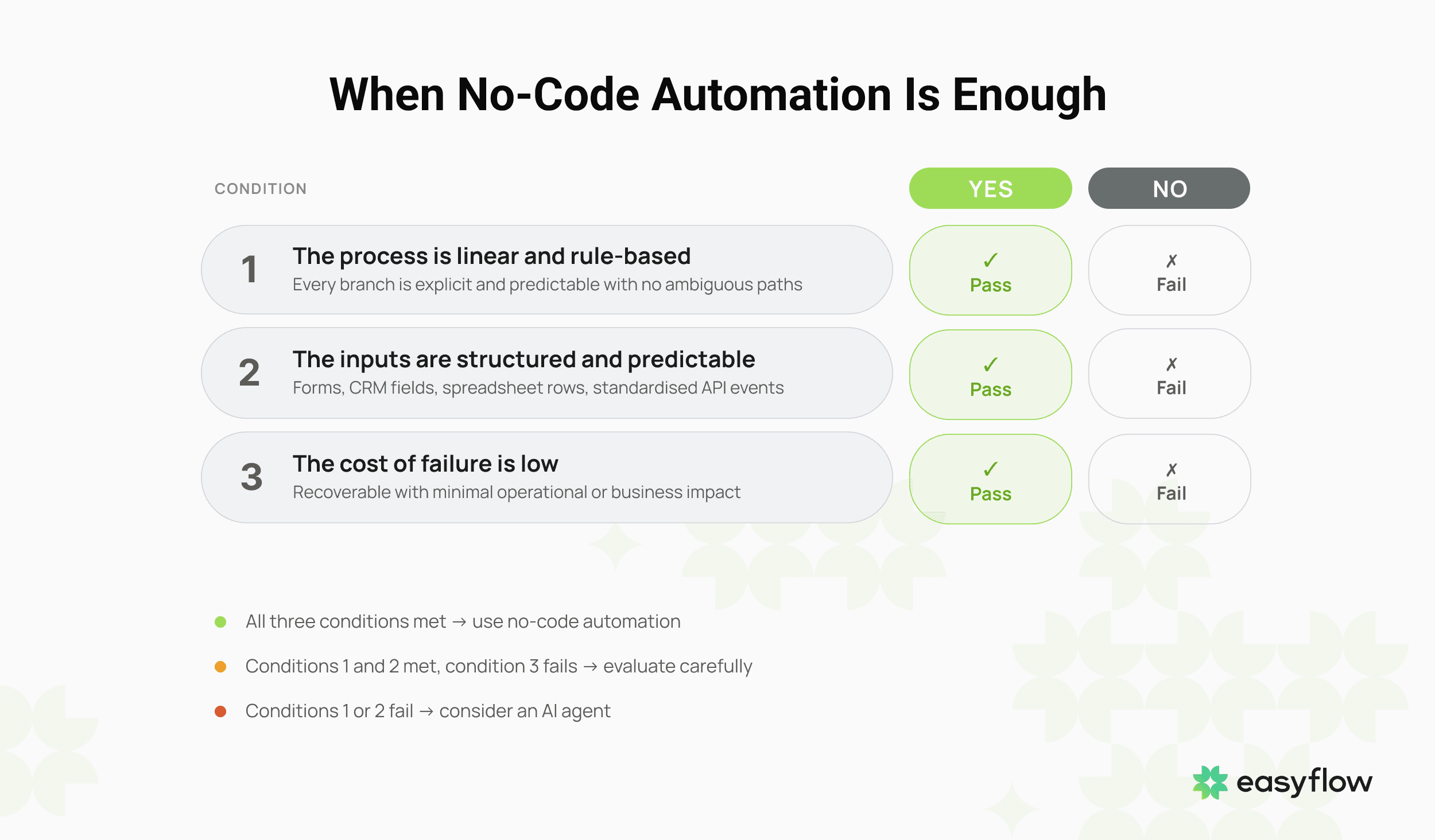
The AI agents build vs buy conversation should start here, before any agent is considered. If a process meets the following three conditions, no-code automation is almost certainly the appropriate solution.
The process is linear and rule-based
Zapier, Make, and n8n perform well when the process resembles a decision tree with clear, unambiguous branches: if X happens, do Y. Common examples include moving data between tools, sending notifications based on triggers, creating tasks in a project management system, updating CRM fields from a form submission, syncing records between platforms, and triggering emails based on status changes.
If the entire logic can be written in a flowchart with no ambiguous branches, the process does not require an AI agent. A Zapier survey of over 500 enterprise C-suite leaders from October 2025 found that 30% of leaders see automating routine workflows as the greatest potential use case for AI agents, a figure that also reflects how much scope exists for no-code tools to handle the work that currently sits just below that threshold.
The inputs are structured and predictable
No-code tools produce reliable results when working with structured data: form submissions, CRM field values, spreadsheet rows, standardised API events, and database records with defined schemas. When every input looks broadly the same and the system knows exactly which field to read, rule-based automation is fast, inexpensive, and stable.
The same Zapier survey found that 47% of enterprises use AI agents mainly for data management tasks like data entry and extraction, which suggests that a large part of that work could also be done with no-code automation if the data sources are already structured.
The cost of failure is low
No-code automation is appropriate where a failure is recoverable at low cost. In terms of operational significance, issues such as a Slack notification that failed to send or a CRM field that requires manual correction are more bothersome than important.
Where a process failure would mean a missed compliance deadline, a client receiving incorrect information, or a financial error, the requirements change materially, and a more capable solution becomes worth the additional investment.
When to Build or Implement an AI Agent
The enterprise AI agent strategy build vs buy decision tips toward an agent when the conditions above do not hold. Three specific signals are worth assessing systematically before committing to a build or procurement decision.
The process depends on unstructured data
AI agents deliver clear value when the primary input is something a rule-based system cannot parse: PDFs, emails, support tickets, invoices, contracts, call transcripts, free-text customer requests, or spreadsheets where the structure is inconsistent.
A no-code tool can extract a field value from a form submission, but it cannot read a three-page vendor contract and determine whether the payment terms fall within acceptable parameters, identify missing clauses, or flag deviations from a standard template. An AI agent can handle all three operations in a single pass.
The workflow has conditional branching that cannot be described in fixed rules
Some workflows appear straightforward but branch into dozens of scenarios depending on context that only becomes clear after reading the inbound request. A vendor onboarding process might have eight standard cases and fifty exceptions, with the correct routing path determined by information embedded in an email or an attached document. Writing fifty fixed rules for this kind of process is expensive to build and brittle to maintain as the business logic evolves, whereas an AI agent evaluates the input, applies judgement, and routes accordingly without requiring an explicit rule for every possible case.
Exception handling is consuming too much human time
When a team spends a meaningful portion of its week reviewing cases that did not fit the standard workflow, that is a strong signal that the process is a candidate for an AI agent.
The exceptions, in effect, are the processes. Document processing, lead qualification, customer support triage, claims review, vendor onboarding, compliance checks, and multi-step reporting all share this characteristic: the volume of non-standard inputs is high enough that human review of each one creates a genuine operational bottleneck that scales poorly with growth.
Where AI Agents Outperform Traditional Automation
The build vs buy AI agents comparison is clearest in the following three process categories. In each case, traditional automation reliably handles the straightforward path and fails on the rest, while an AI agent handles the full range of inputs at consistent quality.
Document processing
A no-code workflow can move a PDF from an email attachment to a shared folder and trigger a notification. A document processing AI agent reads the document, extracts the relevant fields, checks them against business rules, flags missing or inconsistent information, and passes a structured result to the appropriate system or reviewer.
For a company processing hundreds of invoices, contracts, or applications per week, the agent handles the routine cases end-to-end and surfaces only the genuinely ambiguous ones for human review, compressing a multi-step manual process into a single automated pass with a human approval gate at the end.
Intake screening
When inbound requests arrive through email, a web form, or a support queue, routing them correctly at volume is time-consuming and error-prone as a manual task. An AI agent reads each request, classifies it by type and priority, identifies the relevant team or process, and routes it with a structured summary attached. The same logic is behind our candidate evaluator, which cuts up to five hours of manual CV review per shortlist down to minutes.
This use case is particularly valuable for growing teams managing increasing inbound load without proportional headcount growth.
Multi-step reporting
Compiling operational reports typically involves pulling data from several systems, calculating comparisons, identifying anomalies, and drafting a summary for a manager or a client, with each step requiring a person to switch between tools and reconstruct context.
A reporting agent handles the full sequence: pulling data from connected sources, identifying meaningful changes, drafting the summary, flagging anomalies with suggested explanations, and producing a formatted output ready for review. The analyst reviews and approves the output rather than building the report from scratch, converting a three-hour task into a fifteen-minute review.
Build, Buy, or Use No-Code Automation?
Question | If yes | Best fit |
|---|---|---|
Is the process linear and rule-based? | Yes | Zapier / Make / n8n |
Does the process use structured data only? | Yes | No-code automation |
Does the process require interpreting emails, PDFs, or free-text inputs? | Yes | AI agent |
Are there many exceptions or edge cases? | Yes | AI agent |
Does the workflow require human review before final action? | Yes | AI agent with human-in-the-loop |
Is the business logic changing often? | Yes | AI agent or custom automation |
Is the process high-volume and repetitive? | Yes | AI automation candidate |
Is the cost of an error high? | Yes | Custom AI agent with safeguards |
The decision is rarely binary in practice. Many production workflows benefit from a hybrid model in which no-code automation handles the deterministic steps, such as sending notifications, updating records, and triggering downstream events, while an AI agent handles the judgment-heavy steps where a fixed rule genuinely cannot do the work.
Separating these two layers keeps the system modular, makes each layer easier to test and maintain independently, and means the AI agent's scope stays tightly bound to the work that actually warrants it. Human-in-the-loop remains the most common approach to AI agent management at 38% of enterprises, which reflects exactly this kind of hybrid architecture in practice.
How Ops Leaders Should Evaluate AI Agent ROI
The build vs buy agentic AI question cannot be answered on capability alone. ROI for AI agents tends to surface in three places, and assessing all three before making a build decision produces a more defensible business case than focusing on speed alone.
Start with time saved
The most immediately measurable ROI signal is the volume of human hours currently spent on a process and the proportion of that work the agent can handle without review. A support triage process that takes a team four hours per day at the current volume is worth quantifying before any build decision is made.
Where an agent handles 70% of cases end-to-end and the remaining 30% require a human review that takes two minutes instead of ten, the arithmetic is straightforward and can be projected against the expected cost of the build and ongoing maintenance.
Measure error reduction
Speed accounts for roughly half of the ROI picture in most AI agent deployments. Agents operating on consistent logic produce more consistent outputs than humans working under time pressure at high volume, and the operational value of that consistency matters considerably in regulated environments, client-facing processes, and any workflow where a downstream error is expensive to correct.
Fewer misclassified tickets, fewer missed fields in a document review, and faster escalation of genuine edge cases all contribute to a return that does not appear in hours-saved calculations but is nonetheless real and measurable over time.
Look at process scalability
An AI agent's cost per transaction does not increase with volume in the way a human team's does. For companies growing headcount without wanting to grow their operations team proportionally, this is the strongest long-term ROI signal. An agent built on a process that is currently manageable continues to be manageable at three times the volume without any additional hiring, which is the characteristic that makes AI agents a fundamentally different cost structure from both human teams and fixed-capacity software tools.
What Easyflow Looks for in a Discovery Call
Easyflow's role in an AI agent engagement is to determine, before any build decision is made, whether an agent is actually the right solution for the process under discussion. The questions that shape this judgement during a discovery call are:
Which part of the process is repetitive, and which part requires judgement?
What are the inputs, and how structured are they?
How often do exceptions occur, and who handles them today?
Who reviews the output before it reaches a system or a client?
What does a failure in this process cost the business?
Which tools and systems are already in the workflow?
What would a successful outcome look like, and in what timeframe?
The answers to these questions determine whether the process is a candidate for no-code automation, a configurable AI product, a custom agent, or a hybrid of the two. For businesses evaluating their AI agent infrastructure, this diagnostic step is where the practical value of a structured engagement sits.
Getting the architecture right before writing the first line of code prevents both failure modes described at the opening of this article, and is consistently where the largest share of the total project cost is determined.
Conclusion
It is important to focus on the process rather than the technology during build vs buy AI agents evaluation.
When the process is well-defined, sequential, and governed by rules, no-code automation can efficiently and affordably manage it. In cases when the process requires handling exception-heavy workflows, contextual branching, or unstructured inputs, an AI agent is the way to go.
The most practical option for deciding between building and buying AI agent infrastructure is often a hybrid strategy, where automation takes care of the predictable phases and an agent handles the judgement. This works for processes that comprise both basic and complicated layers.
Choosing the tool first and working backwards from it is where poor build vs buy AI agents decisions originate.
Posted by

Viktoriia Pyvovar
Content Writer
What is the main difference between no-code automation and an AI agent?
No-code automation tools like Zapier, Make, or n8n execute predefined rules: if X happens, do Y. They work with structured data and predictable inputs, and every output follows from a logic set in advance. An AI agent reads inputs that do not follow a fixed structure, such as emails, documents, or free-text requests; reasons through what should happen next; and handles edge cases that a fixed rule cannot cover. The practical difference is whether the process requires reading comprehension and contextual judgement or data movement and condition-checking.
How do you calculate ROI on an AI agent before building it?
Start with three numbers: the weekly hours spent on the process, the hourly cost of the people doing it, and a reasonable estimate of the proportion of instances the agent can handle end-to-end without human review. Weekly hours-saved may be extrapolated yearly by multiplying the third number by the first two. The argument is strengthened by adding the quantifiable cost of mistakes in the existing procedure. Comparing that number to the construction cost and ongoing maintenance generally yields a payback time under six months for most operations-heavy processes at high volume.
What does a hybrid automation approach look like in practice?
In a hybrid model, no-code automation handles the deterministic steps of a workflow where the logic is fixed and the inputs are structured, while an AI agent handles the steps that require interpretation or judgement. In a vendor onboarding workflow, a no-code tool receives the inbound form submission, creates a record in the CRM, and notifies the responsible team, while the AI agent reads the attached documents, checks them against onboarding requirements, flags missing information, and drafts a structured summary for the reviewer. The agent is involved only where a fixed rule cannot do the work, which keeps the system modular and each layer easier to test and maintain independently.
How long does it take to build and deploy an AI agent for an operations use case?
If process mapping and data preparation are done concurrently with the build, a single, well-scoped use case with clean data access and clear success criteria can be deployed in four to eight weeks. When data is unavailable or ungoverned, process scope extends during construction, or the production environment needs unplanned security or compliance tests, timelines stretch. Underestimating the data and integration work is the most common reason agent builds run beyond their original schedule, and it is consistently the area where thorough discovery-phase scoping adds the most value.