Why AI Projects Fail: 7 Reasons They Stall Before Production

Eighty percent of AI projects never deliver business value. That figure, from RAND Corporation's 2024 study, has barely shifted as enterprise AI spending has continued to grow. Why AI projects fail has become less a question about the underlying model and more one about how the work surrounding the model is structured, owned, and operated.
The Percentage of AI Projects That Fail Is Higher Than Most Boards Realise
The numbers are consistent across the major research bodies, even when the framing differs. Failure rates land between 70% and 95% depending on how the term is defined.
Source | Year | Finding |
|---|---|---|
RAND Corporation | 2024 | Over 80% of AI projects fail, twice the rate of non-AI IT projects |
MIT Project NANDA | July 2025 | 95% of GenAI pilots show zero measurable P&L impact |
S&P Global Market Intelligence | 2025 | 42% of companies abandoned most AI initiatives, up from 17% in 2024 |
BCG | October 2024 | 74% of companies reported no tangible value from AI investments |
Gartner | 2024–2026 | 30% of GenAI projects abandoned after PoC; only 28% of I&O AI use cases meet ROI expectations |
A consistent pattern sits beneath these numbers. The vast majority of failures originate in the operating layer surrounding the technology rather than in the model itself, which is now mature enough for most enterprise use cases. What tends to give way is everything around it: who owns the outcome; how the work connects to a specific business decision; whether the data infrastructure can carry the production load; and whether the people who will use the system are involved in building it.
This is what is behind why most AI projects fail. Better models do not fix governance gaps, which explains why the aggregate failure rate has remained largely flat even as model quality has improved year over year.
Why Do AI Projects Fail: 7 Patterns We See in Audits
Across the AI audits we've run for fintechs, logistics operators, and SaaS scale-ups, the same patterns appear when we look at why AI projects fail. Each one below comes from a real engagement with a company that asked us to figure out why its AI work had stalled.
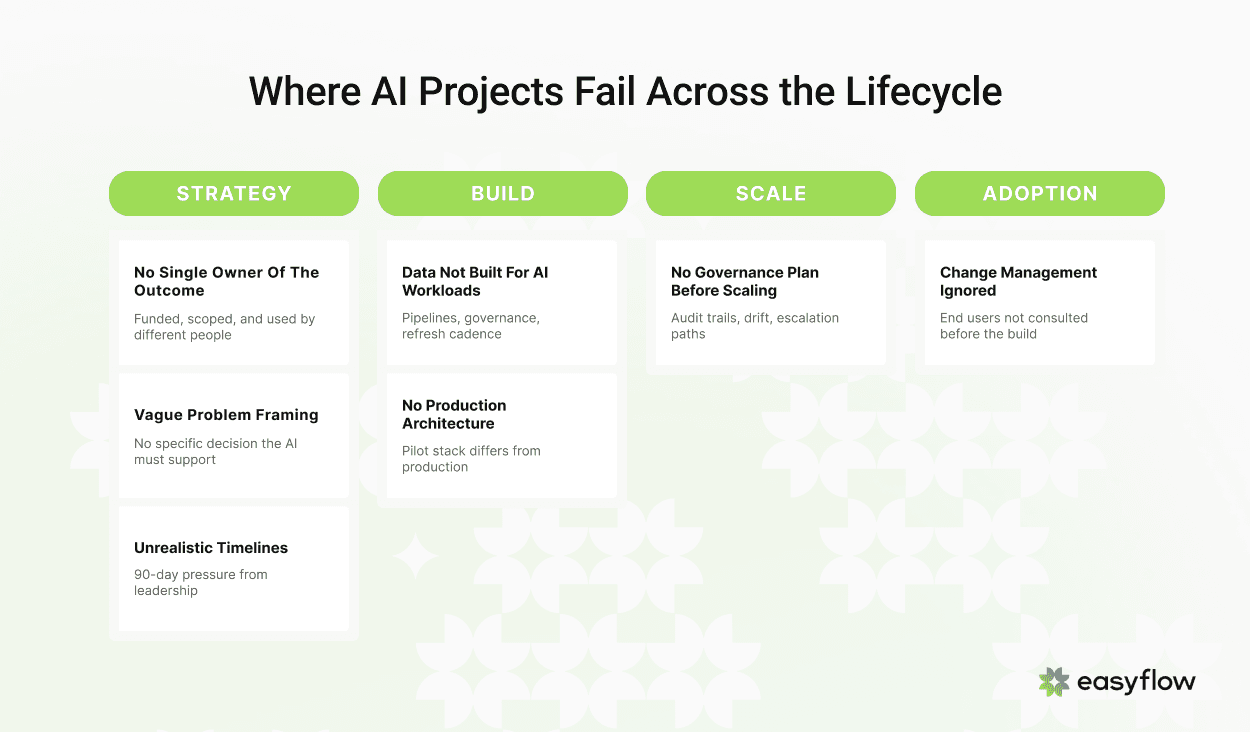
1. No single owner of the outcome
The most common cause has nothing to do with technology. A CFO funds the initiative, a CTO scopes it, and a department head is expected to use it. When the project stalls, no one's job description includes the responsibility for finishing it.
In practice, the accountability structure is usually what gives way first, well before any technical limitations surface.
2. Vague problem framing
"We need to do something with AI" is the most expensive sentence we hear in discovery calls. Without a specific decision the AI is supposed to support or a specific cost line it is supposed to reduce, success becomes structurally undefinable before the project even begins.
Without agreed metrics from the start, teams ship something and then discover, retrospectively, that there was never a shared standard for judging whether the result was worth the investment.
3. Data and infrastructure that weren't built for AI workloads
Data readiness is rarely about completeness. The more common gap is structural: nobody has mapped what the data needs to look like for the specific use case, who governs it, or how often it refreshes.
Gartner predicts that 60% of AI projects lacking AI-ready data will be abandoned through 2026. Cleaning a static dataset for a one-time demo is a contained piece of work, while building governed, regularly refreshing pipelines that hold up under production load is a multi-month engineering programme that tends to be the part of the budget that gets cut when timelines slip.
4. No governance plan before scaling
A team builds an agent that handles 200 customer queries a week. It works well. They then scale it to 20,000, and at that point the absence of an audit trail, an escalation path for high-risk cases, and active drift monitoring becomes operationally significant. By the time someone notices, the agent has been sending incorrect information to clients for three weeks.
Governance work built into the design from the start is comparatively inexpensive, whereas governance retrofitted after a public incident usually costs an order of magnitude more, both in remediation and in reputational damage.
5. Unrealistic timelines from leadership
Boards see competitor announcements and ask for results in 90 days, but production-grade AI in operations-heavy domains rarely fits that timeline. According to Gartner's April 2026 survey of 782 I&O leaders, 57% of those whose AI initiatives failed cited "expected too much, too fast" as the primary cause. Compressed timelines force teams to skip the parts of the build that matter most for durability: integration testing, governance, and change management.
6. No production architecture from day one
The pilot was built in a notebook by two engineers. Moving it to production typically requires rebuilding it from scratch on different infrastructure, with different latency requirements, different security controls, and different observability needs. The rebuild often takes longer than the pilot itself, a cost most organisations did not budget for at the start, and some projects never recover from the gap between the two stages.
7. Ignoring change management
The model performs to spec, the integrations are stable, and adoption nevertheless stalls.
Deloitte's 2026 State of AI in the Enterprise report found that 84% of companies have not redesigned jobs or the nature of work around AI capabilities, meaning the system lands inside workflows that were never rebuilt to accommodate it. When the people the system is built for were not consulted during the design phase, they tend to disengage from the result regardless of how technically sound it is.
Why AI Pilots Fail Even When the Demo Worked
A successful pilot is usually a controlled experiment, conducted with clean data, supportive users, no service-level agreement, and no formal compliance review. Production conditions are materially different in nearly every dimension that affects whether the system actually works at scale.
The pilot-to-production gap is the single most expensive part of an AI programme. CIO Magazine reports that 88% of AI pilots never reach production, and the pattern is consistent across the engagements we have audited:
The pilot proves the model can answer a question accurately, while production has to answer 50,000 questions a day in under three seconds each.
The pilot uses a clean snapshot of data, while production needs data that updates daily, with an audit trail.
The pilot has no governance, while production needs role-based access, escalation paths, and logging that satisfies the legal team.
An engineer scoped the pilot, while production must fit into a workflow used by people who weren't in the pilot meetings.
A demo proves the technology can produce a correct output under controlled conditions, while a production deployment proves that the operating model around the technology can carry those outputs into reliable real-world use. The first is genuinely difficult. The second is harder still, and according to MIT Project NANDA's 2025 research, it is what 95% of GenAI pilots fail to clear.
What Separates Companies That Don't Fail
The companies that get AI to production share a small number of habits, different from the rest of the market in only a few specific ways.
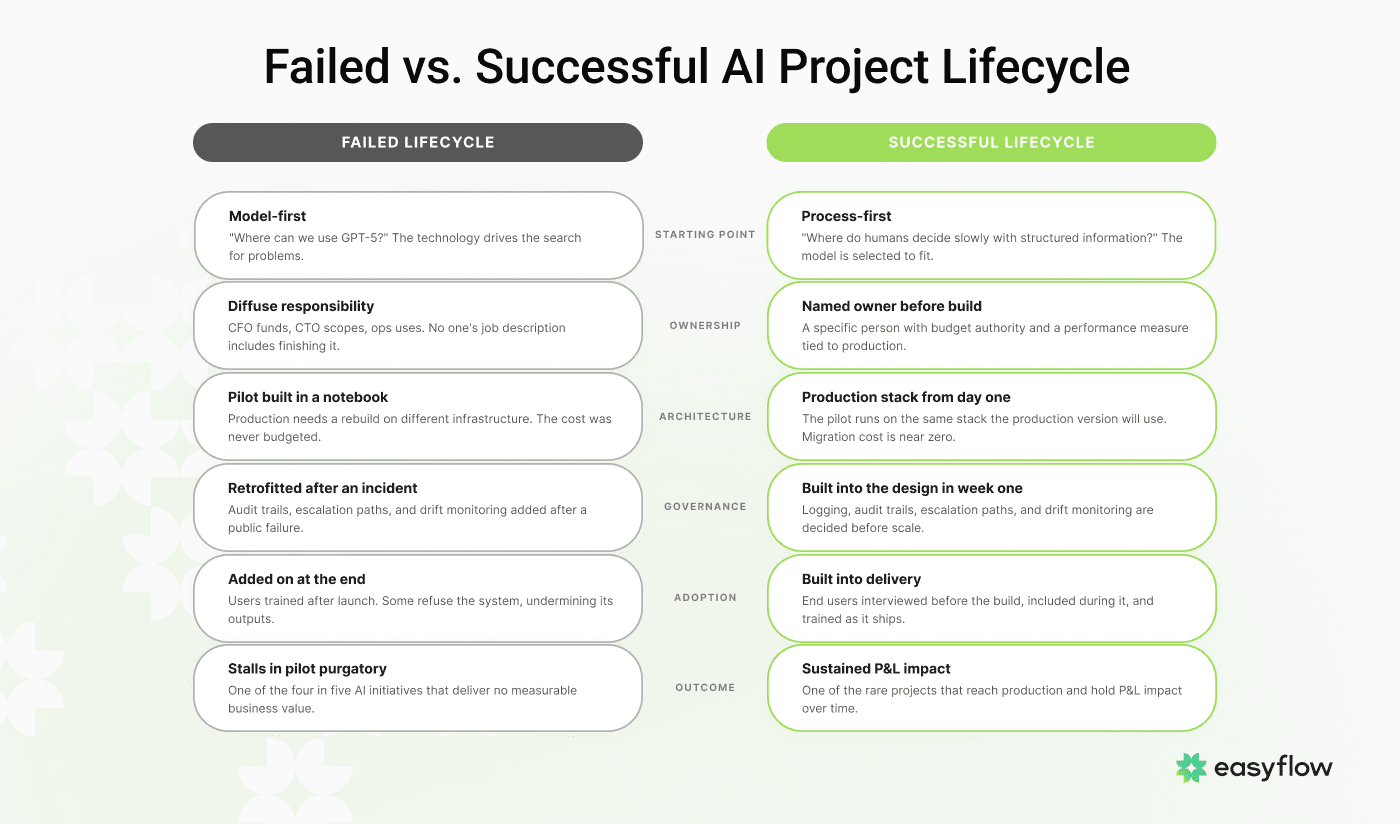
Process redesign comes before model selection. The starting question is not which model to deploy, but where in the company's operations people are making decisions slowly, repeatedly, and with structured information that an AI system could plausibly handle. The model is selected to fit the process once it has been mapped.
The outcome has a named owner before the build starts. A specific person is identified, with budget authority and a performance measure tied to whether the system reaches production, before any code is written. Projects without a designated owner tend to become diffuse, which is another way of saying everyone's problem and no one's job.
Governance is built before scale, not after. Logging, audit trails, escalation paths, and drift monitoring are decided and implemented in the first weeks of the project, well before the system is handling enough volume to make these the kind of questions an auditor or regulator might ask.
Production architecture is planned from day one. The pilot is built on the same infrastructure stack the production version will run on, and the data pipeline used in the demo is the same pipeline that handles live workloads, which keeps migration costs close to zero.
Adoption is built into the project rather than bolted on at the end. The people who will use the system are interviewed before the build, included during it, and trained as it ships, on the principle that adoption is part of delivery rather than a separate phase that follows it.
These habits explain why the 5% MIT identified achieve sustained P&L impact, while the rest produce demos that look impressive but stop functioning the moment they meet real operational load.
AI Project Failure Prevention Checklist
Before approving the next AI initiative, work through these questions. If three or more answers are "no" or "we don't know", the project is at risk before it starts.
Is there one named person whose performance will be measured by this initiative reaching production?
Is there a specific cost line, decision, or process that this AI is replacing or improving, with a measurable baseline?
Does the data the AI needs already exist, governed, and refreshed at the right frequency?
Is there a logged escalation path for cases where the AI is wrong or uncertain?
Will the production version run on the same architecture as the pilot?
Have the end users been interviewed before the build starts?
Is the timeline realistic for the scope, including integration and change management?
The following are signals that an in-flight project is heading toward failure:
The original sponsor has changed roles or left the company.
The success metric has been redefined more than once.
The pilot is being demoed but no one has signed off on the production go-ahead.
The team is talking about scaling before governance is in place.
The end users haven't been part of the build conversation.
Conclusion
Why most AI projects fail comes down to operating discipline more than to model choice. The 80%-plus failure rate is largely explained by organisations treating AI as software they buy and turn on, while the companies in the minority treat it as an operations transformation that happens to use AI as the tooling.
Failure rates will continue to fall for organisations willing to do the surrounding work. Why AI projects fail at scale is, in most cases, an operating problem rather than a technology problem, which means the corresponding fix tends to involve clearer ownership, governance built into the design from the start, and a production architecture chosen on day one rather than rebuilt after a successful demo.
If you are already running AI initiatives and aren't sure whether they are tracking toward production, an audit is the fastest way to find out. Easyflow's AI Transformation engagement starts with a fixed-scope audit that maps where your current AI work stands, what is likely to reach production, and what is draining your budget. The output is a prioritised roadmap with cost and timeline against each opportunity.
Posted by

Viktoriia Pyvovar
Content Writer
What percentage of AI projects fail?
Estimates from RAND Corporation, MIT Project NANDA, BCG, and S&P Global converge between 70% and 95% depending on how failure is defined. The variation reflects whether failure is being measured as outright abandonment, completion without value, or completion without ROI justification.
What are the top 5 reasons why AI projects fail?
Across the AI audits we've run, the most common are: (1) no single owner of the outcome, (2) unclear or shifting success metrics, (3) data infrastructure not built for AI workloads, (4) no governance plan before scaling, and (5) ignored change management. Each of these is independent of the model itself, and addressing them is largely a matter of operating discipline rather than technology selection.
How long should an AI project take to reach production?
For a single, well-scoped use case in an operations-heavy domain, 8 to 16 weeks from kickoff to production is realistic if data and governance work is done in parallel. Multi-process AI transformation programmes run longer, typically 6 to 12 months for the first wave. Projects pitched as live in 30 days are usually pilots that will need a rebuild before production, which is one of the more common reasons the pilot-to-production gap becomes so expensive.
What's the difference between a successful AI pilot and a successful AI project?
A pilot proves the technology can answer a question correctly under controlled conditions, while a successful project proves the answer holds under production load, with governance, in a workflow that the end users actually adopt. The gap between a working pilot and a working project sits in the operating model that surrounds the technology, where governance, ownership, and adoption either align or quietly come apart.