AI Change Management: How Executives Should Talk to Teams

On 6 July 2026, Microsoft eliminated 4,800 roles, roughly 2.1% of its global workforce. Chief People Officer Amy Coleman told employees none of those roles were being replaced by AI, then said in the same memo that AI is changing how work gets done. Three weeks earlier, Robinhood cut about 290 people, close to 10% of full-time staff. Neither the CEO note nor the regulatory filing mentioned AI at all.
Two companies made different choices in their messaging. Employees, investors, and regulators are observing both.
Most organizations deploying AI have a detailed technology plan and nothing written down about what to tell their own people.
Instant Insight: What’s the Best Way for Executives to Convey AI-Driven Transformation?
Executives should communicate AI-driven change by explaining which business problem AI is solving, which tasks will change, which decisions stay human-owned, what support employees will receive, and how role changes or displacement will be decided.
From our experience, the worst message is vague reassurance. Employees need clarity about work, skills, timing, consequences: in that order. Good AI change management treats communication as a delivery workstream with an owner and a date, not as an announcement drafted the week before go-live.
Key Takeaways
AI is now the stated reason. It led US job cuts for five straight months through July 2026, cited in roughly 112,700 announcements, about 24% of all cuts, according to Challenger, Gray & Christmas.
Fear runs ahead of reality. McKinsey's 2026 State of AI survey found 14% of organizations saw an AI-related headcount decline last year, against the 32% that expected one.
AI change management starts from a weak base. Only 27% of leaders say their organization manages change well, per Deloitte's 2026 Global Human Capital Trends.
Managers absorb the strain. Mid-level managers and individual contributors report AI-related negative effects at 47%, against 31% for executives.
The message has to hold across audiences. New York has required employers to disclose technology-driven layoffs on WARN notices since March 2025.
Winners redesign work instead of tools. Nearly three-quarters of McKinsey's AI high performers report fundamentally redesigning workflows. One-quarter of everyone else does.

Why AI Transformation Creates a Communication Gap
In many organizations, executive communication, AI implementation, and role design are typically managed through three distinct strategic plans, each overseen by separate departments. AI change management serves as the critical linkage between these initiatives, yet it remains largely understaffed. Without aligning the people plan to the technical rollout, these initiatives often turn into AI experiments that never become strategy.
Technology Plans Move Faster Than People Plans
A workflow automation pilot can be scoped in two weeks and live in six. Role redesign, a skills assessment and a reskilling path take a quarter or more, and they need HR, legal and line managers in the room.
Deloitte found only 6% of leaders are making progress on designing human-AI interactions, while 85% call workforce adaptability critical and 7% say they lead in it. That distance between intent and delivery is where the message breaks.
Employees Hear "AI" and Think "Job Risk"
Nobody reads an internal AI announcement in isolation. They read it against a stream of external headlines about AI job displacement, and the external signal is loud. Challenger recorded AI as the top stated reason for US job cuts every month from March through July 2026.
Whatever leadership says internally is competing with that.
Managers Are Asked to Explain Changes They Do Not Fully Own
Line managers deliver the message and take the questions, usually without having seen the business case. McKinsey found mid-level managers and individual contributors report AI-related strains at 47%, against 31% of executives and senior managers.
The people closest to the work carry the most friction and hold the least context.
Vague Reassurance Creates More Anxiety Than Clarity
"Nothing changes for now" is heard as "something changes soon and we're not telling you."
Deloitte put one-third of workers through 15 major organizational changes in a single year, with 68% reporting reduced wellbeing and 58% feeling less relevant. Against that background, internal communication without specifics reads as evasion rather than calm.
Two AI Implementation Communication Examples: Microsoft vs. Robinhood
Comparing Microsoft and Robinhood highlights two distinct communication strategies often seen around other companies in 2026.
What Microsoft's Message Signaled
Microsoft named AI, then drew a boundary around it. The memo separated two claims: these specific roles are not being replaced by AI, and AI is changing the shape of work across the company.
That gives employees something testable. It also creates an obligation, because every future restructuring will be measured against it.
What Robinhood's Message Avoided
Robinhood framed its reduction as restructuring: high-performance culture, product velocity, a leaner organization. The company booked about $20 million in cash restructuring charges. TechCrunch noted the CEO conspicuously made no mention of AI in a year when most of his peers were citing it.
Company | What happened | How AI was communicated | Signal to employees |
|---|---|---|---|
Microsoft, 6 July 2026 | 4,800 roles, about 2.1% of global headcount | Named AI as changing how work gets done, while stating these roles were not replaced by AI | AI is part of the work redesign story, and leadership will say so |
Robinhood, 16 June 2026 | About 290 roles, roughly 10% of full-time staff | Framed as restructuring, speed and a leaner organization; no AI reference anywhere | AI may still be inferred, because nothing rules it out |
What Employees, Investors, and Regulators Read Between the Lines
Three audiences want different things and all three see the same material. Investors want evidence that AI spending converts into margin. Employees want to know whether their work survives. Regulators increasingly want a filed answer.
New York added an AI and automation disclosure to its WARN notices in March 2025. In the first year, not one of more than 160 filings attributed layoffs to AI, even as public AI attribution climbed. Gartner analyst Catherine Donnelly, speaking to Axios, put the risk plainly: employees can handle complexity, but not "a narrative that doesn't add up".
The Lesson: Silence Is Also a Communication Strategy
Saying nothing is a choice with consequences, not a neutral default. It protects you from an inconsistency claim and leaves every employee free to assume the worst available version.
Microsoft and Robinhood both decided in advance what their position would be. That is the part worth copying.

What Employees Actually Want to Know About AI at Work
Six employee questions come up in every workforce session Easyflow runs. Executives tend to answer a different question than the one being asked.
Employee question | Weak executive answer | Better answer |
|---|---|---|
Will my job disappear? | "AI is here to help, not replace." | "These tasks are being automated. These responsibilities stay human-owned. These roles are under review, and here's when we'll know." |
Which tasks will AI take over? | "It'll handle the repetitive stuff." | "Intake triage and first-draft reporting, starting with the Q3 pilot. Client calls and exception handling stay with you." |
What skills will matter more? | "Everyone should upskill." | "Three skills matter for your function over the next six months, and here's who's paying for the training." |
How will performance be measured? | "Productivity will improve." | "Cycle time, quality, adoption rate and the outcome of human review steps." |
When will this affect me? | "Nothing changes immediately." | "Pilot starts in Q2. Workflow changes begin after validation. Role decisions follow in Q4." |
Who decides if a role is redesigned or removed? | "That's an HR matter." | "The process owner recommends, the function head approves, HR reviews. You'll be told before it's final." |
As you may see, every answer in the middle column is technically true and operationally useless. Generic answers usually frustrate teams, while providing concrete details (though it is harder to align on internally) gives employees the clarity they actually need. Sometimes a bitter truth is better than a sweet lie.
What Not to Say When AI Changes Roles
"AI Will Only Augment, Not Replace"
Nobody can guarantee this three years out, and employees know it. Cut one role and the promise is retired, with every future message inheriting the discount.
"Nothing Changes Yet"
True for about a week. Employees then watch a pilot start, a job posting change or a team get restructured, and conclude the original message was managed rather than honest.
"Everyone Just Needs to Upskill"
This moves the burden onto the individual without naming a skill, a budget or a date. Deloitte found only 8% of organizations rate themselves highly effective at meeting continuous learning needs, so the instruction usually arrives without the system behind it.
"We Are Becoming More Efficient"
Efficiency is the CFO's word for headcount. Used without saying what happens to people, it turns a neutral statement into a threat.
Why Technically True Messages Can Still Destroy Trust
Each of those four survives a board review. Each fails the person deciding whether to start a job search.
Trust breaks down when announcements dodge the core questions. Once employees feel leadership is being evasive, future messaging will be met with skepticism.
How to Communicate AI Role Changes Clearly
Separate Augmentation From Automation
State which tasks a system performs end to end and which it drafts for a human to approve. That line is where human-AI collaboration actually gets defined. It is concrete and checkable, unlike a promise about jobs.
Explain Which Tasks Change Before Which Jobs Change
Task-level change is observable within weeks. Role-level change follows once you have data on quality and volume. Sequencing the message this way matches how the work actually moves, so employees can verify it as they go.
Name the Decisions That Are Still Human-Owned
Pricing exceptions. Clinical judgment. Hiring calls. Anything carrying legal exposure. Publishing that list defines the boundary and gives people something stable to hold while the rest moves.
Be Specific About Reskilling Paths
Name the skill, the format, the hours, who pays, and what it qualifies someone for. Reskilling without those five details is a slogan, and your team has heard it before.
Say What Is Unknown Instead of Pretending Everything Is Settled
"We don't yet know whether this changes team size, and we'll have an answer by 15 November" beats a confident answer that turns out wrong. It also gives you a date to be judged against, which is the point. Easyflow uses these five rules as the drafting frame for client announcement copy.
When to Communicate During AI Implementation
Communication is not a launch event. Each stage of a deployment produces a different fact, and the fact should be shared when it exists rather than held until everything is settled.
Easyflow builds AI change management into the AI project delivery process as a named workstream with an owner and a date, not as a task assigned to whoever writes the all-hands deck.
AI implementation stage | What to communicate | Typical timing |
|---|---|---|
Strategy | Why AI is being introduced and which business problem it solves | Before any vendor is selected |
Discovery | Which workflows are being assessed and who will be interviewed | Week 1 of the audit |
Workflow mapping | What the team told us and what we found | During mapping, to the people mapped |
Pilot | What is being tested, and what is explicitly not being decided yet | Two weeks before pilot start |
Deployment | What changes in daily work, tool by tool and step by step | At rollout, per team |
Post-launch | What the results show, what changed, what comes next | 30 days after go-live |
Restructuring | Whether AI affected roles, skills, team structure or cost decisions | Before any external announcement |
One rule sits underneath that table: involve the people doing the work during mapping, not after. They know where the process actually breaks, and involving them turns the exercise from something done to them into something they contributed to.
AI Workforce Communication Checklist for Executives
Six messages, in this order, cover most of what an AI workforce transformation communication plan needs.
Why we are using AI: the business problem in one sentence, with a number attached.
What AI will and will not do: named systems, workflows, clear limits.
How roles may change after implementation: where role-level change is possible, say so and give the decision date.
What support employees will receive, if their role changes: training budget, hours, format, and what happens to someone whose role is removed.
How decisions about roles will be made and by whom: who recommends, who approves, what evidence is used, when people are told.
What managers should repeat consistently: a short written set of answers managers can use verbatim, so the story holds across multiple separate team conversations.
An AI people strategy that lives only in the CEO's head produces more than 40 versions by the time it reaches the front line. Easyflow drafts the set as a single document, so executive and manager messaging can be checked against each other before either is delivered.

How Managers Should Talk About AI With Their Teams
Manager enablement is the part of AI change management most programs skip, and it decides whether the executive message survives a team meeting. For most employees the most trusted source of information about a change is their own manager, not the CEO. Train managers before anyone else hears the announcement.
Translate Strategy Into Daily Work
"We're deploying agentic workflows in operations" means nothing to someone who processes invoices. Managers need the version that names which three tasks change in their team's week, and when.
Create Space for Job-Security Questions
Employee questions about job security get asked whether or not you invite them. Inviting them means you hear the real ones, rather than the version that circulates afterwards.
Avoid Overpromising Safety or Opportunity
A manager who guarantees safety to reduce discomfort in the room buys a month and spends years of credibility. "I don't know, I'll find out by Friday" is the stronger answer.
Document Concerns and Feed Them Back to Leadership
A standing channel where concerns reach the program owners, and visibly change something, is what separates consultation from theatre.
Reinforce the Difference Between Tools, Tasks, and Roles
A new tool is not a changed task. A changed task is not a changed role. Managers who hold that distinction defuse most of the anxiety in the room without promising anything they can't deliver.
AI Change Management: What Organizations That Get This Right Do Differently
Data shows that meaningful change is driven by foundational decisions rather than mere PR language.
They Redesign Work, Not Just Deploy Tools
McKinsey found nearly three-quarters of AI high performers report fundamentally redesigning workflows, up from 55% a year earlier, against roughly a quarter of everyone else. High performers are about 6% of respondents. Work redesign forces the role conversation to happen deliberately rather than as a downstream surprise.
They Invest in Capability Building
Deloitte's State of AI in the Enterprise found insufficient worker skills is the single biggest barrier to integrating AI into existing workflows. Yet 53% of organizations focus on general AI fluency while only 33% redesign career paths, which is the part employees are actually asking about.
They Treat Communication as Part of Implementation
Deloitte found 65% of organizations believe their culture must change significantly because of AI, and 34% say culture is already blocking their AI goals. That describes a delivery risk, not a soft one.
They Train Managers Before Employees Hear the Announcement
High performers are twice as likely to report that senior leaders demonstrate visible commitment to AI initiatives. Change leadership here is a measurable behavior, and briefing the manager layer first is the cheapest version of it.
They Measure Trust, Adoption, and Workflow Change Together
Tool usage tells you people logged in. Pair it with a quarterly read on whether employees believe what leadership says about AI, and you see problems a license utilization dashboard hides. In Easyflow engagements that is a two-question pulse survey, run at the same cadence as adoption reporting.
The Role of People Enablement in AI Transformation
Managing AI transformation internally usually fails on capacity rather than intent. The people running the rollout are the same people running the business, and communication is what gets cut when the pilot slips.
People enablement is the third phase of Easyflow's AI transformation model, running alongside product and process rather than after them. Six pieces of work sit inside it:
Role mapping. Which roles a given workflow change touches, named before the pilot starts.
Skills gap assessment. What that change requires that the team doesn't have yet.
Manager enablement. Briefing and scripts for the manager layer, ahead of the announcement.
Communication scripts and FAQ. So the answer is the same in every room and on every channel.
Adoption feedback loops. A route from the front line back to the program owners.
Post-deployment support. Easyflow certifies internal champions here, so the capability stays after the engagement closes.
None of it works retroactively. A communication plan written after a restructuring is a press release. Written before, it is AI change management.
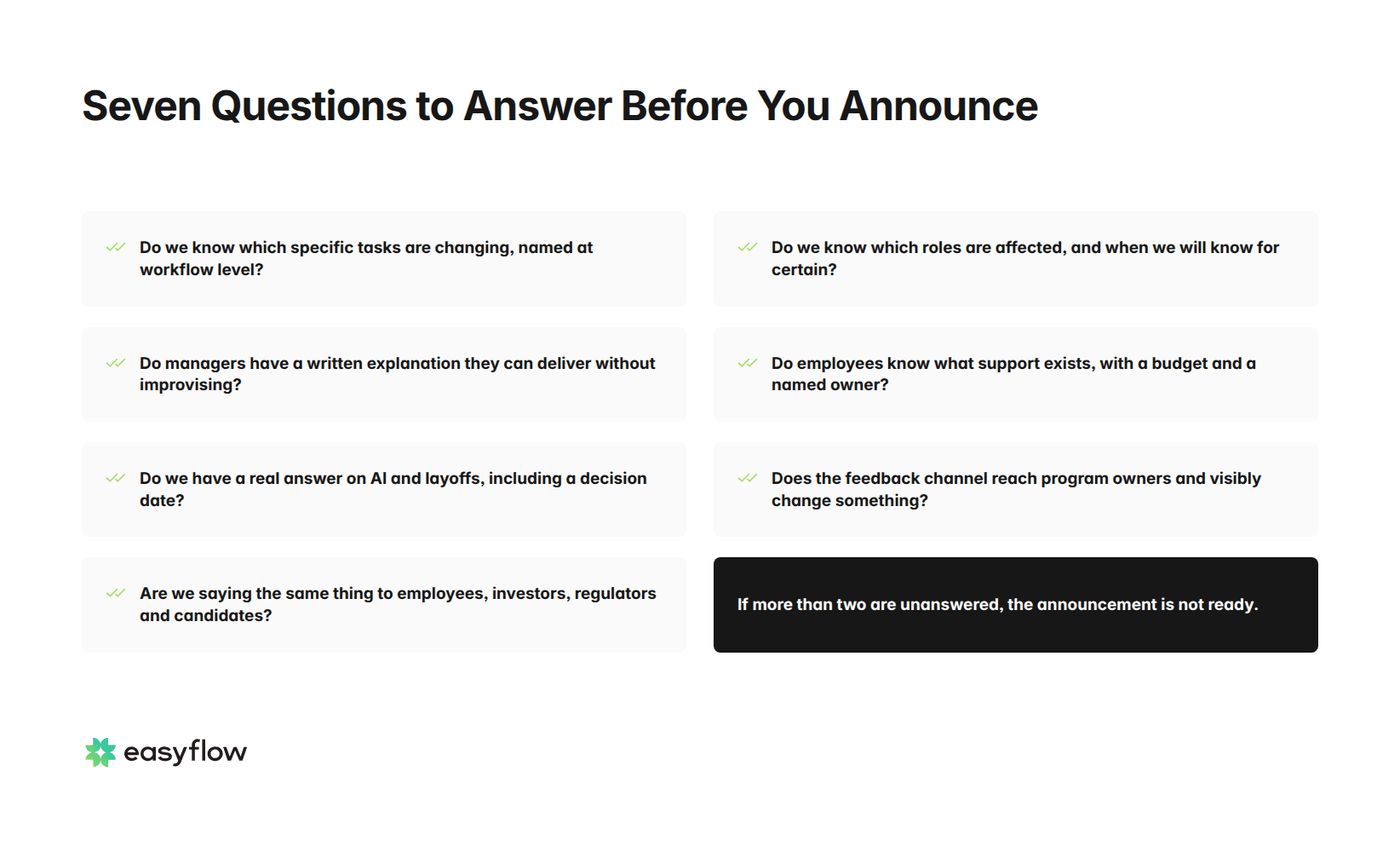
Questionnaire: Before You Announce an AI-Driven Change
Do we know which specific tasks are changing, named at workflow level?
Do we know which roles are affected, and can we say when we'll know for certain?
Do managers have a written explanation they can deliver without improvising?
Do employees know what support exists, with a budget and a named owner?
Do we have a real answer on AI and layoffs, including "not yet decided, decision by [date]"?
Do we have a feedback channel that reaches program owners and visibly changes something?
Are we saying the same thing to employees, investors, regulators and candidates?
Easyflow runs this list before any client-side announcement. If more than two are unanswered, the announcement isn't ready. Delaying a week costs less than spending a year rebuilding trust.
Conclusion: AI Communication Is Part of AI Implementation
While Microsoft and Robinhood took different approaches, both made clear choices. The biggest mistake leaders make is avoiding the conversation entirely. They build the system, hit go-live, then improvise the internal message under time pressure with legal in the room.
The organizations that come through AI-driven workforce transformation with their teams intact aren't the ones with the best phrasing. They decided early what was true, wrote it down, told managers first, and said the same thing to every audience member. That is the executive communication AI transformation demands, and it belongs in the project plan next to the integration work.
Posted by

Shykula Kateryna
Content Producer
How should executives communicate AI changes to employees?
Start with the business problem AI is solving, then move to task-level change before role-level change. Name which decisions stay human-owned, what support exists, and how role decisions will be made and by whom. Give dates for what is not yet decided rather than filling the gap with reassurance. Brief managers before employees hear anything, because they will field the first round of questions.
What should companies avoid saying about AI-driven change?
Avoid guarantees you can't keep, such as "AI will only augment, not replace." Avoid non-answers that expire quickly, such as "nothing changes yet." Avoid instructions with no system behind them, such as "everyone just needs to upskill." Also avoid efficiency language with no people answer attached. Each is technically defensible, and each costs credibility the first time reality contradicts it.
What do employees want to know during AI transformation?
Six things, in a predictable order: whether their role survives, which tasks AI takes over, which skills matter more, how performance will be measured, when the change reaches them, and who decides if a role is redesigned or removed. Employees are asking about their own work, not about the technology. Answers that describe the strategy without naming tasks, dates and decision owners will not land.
When should leaders communicate about AI implementation?
At every stage, not at launch. Explain the business reason before vendor selection, name the workflows during discovery, involve the people doing the work during mapping, define what the pilot tests and what it does not decide, explain the daily changes at deployment, and share results 30 days after go-live. If restructuring follows, communicate internally before any external announcement.
What is AI workforce communication?
AI workforce communication is the practice of explaining an AI deployment to the people whose work it changes: what the system does, which tasks move, which decisions stay human, what support is available and how role decisions get made. It differs from external AI messaging in one important way. The audience can verify every claim against their own daily work, which means an inaccurate statement is found out within weeks.
How is AI change management different from traditional change management?
Three differences. Employees arrive with strong external priors about AI job displacement, so leadership is correcting a narrative rather than introducing one. The technology changes faster than an annual planning cycle, so the message needs regular updating. And the same information now reaches employees, investors and, in some jurisdictions, regulators, which makes inconsistency across audiences discoverable in a way it previously was not.
How can companies build trust during AI transformation?
By being specific, and by being early. Publish which tasks change and which decisions stay human-owned, give dates for what is still unknown, and brief managers before the announcement so employees hear it from the most trusted source available to them. Then measure it. A short quarterly read on whether employees believe what leadership says about AI will surface problems long before adoption metrics do.