From AI Prototype to Production: A 5-Phase Cleanup Playbook

An AI prototype that works in a demo and an AI system that holds up in production are two different engineering problems.
A 2025 survey of 1,006 enterprises found that 42% of companies abandoned most of their AI initiatives that year, with the average organisation scrapping 46% of its proofs of concept before they reached production. No matter the timing, it’s likely the demo worked, stakeholders approved, and then scalability, security, dependability, and governance changed the picture.
A typical spot where AI initiatives get stuck is the move from AI prototype to production.
With hands-on experience from Markiian Paprotskyi, an AI Engineer at Easyflow, we put together a five-phase guide for engineering and product teams navigating that transition. It covers how to move from AI prototype to production across five phases, with the goal of avoiding the most common and costly failure modes along the way.
What AI Prototype to Production Means
The distance between a proof of concept, an MVP, and a production-ready AI system is not just semantic; it determines the full scope of work ahead and where to invest engineering effort first.
A proof of concept answers one question: can this AI perform the task at all? An MVP answers whether users find enough value in it to justify continued development. A production-ready AI system answers something more demanding: can it run reliably, at scale, under adversarial conditions, for real users, without losing data or producing harmful output? Each stage represents a fundamentally different set of requirements. Skipping the transition work between them is where most projects run into trouble.
The shift from AI prototype to production changes three things at once:
The inputs: real users send edge-case prompts, malformed data, and adversarial queries, not the clean test inputs the prototype was built against.
The stakes: failures affect real transactions, users, or regulated processes rather than a sandbox environment where nothing is at risk.
The expectations: uptime, latency, auditability, and compliance become stringent requirements that architecture must be designed around.
Why Vibe-Coded Prototypes Break in Production
Understanding why a working demo falls short of a production-ready AI system is the first step toward avoiding the most expensive mistakes.
Brittle Prompts and Undocumented Logic
Prompt logic in a prototype typically lives in one engineer's head. When that person moves on, the reasoning behind specific phrasing disappears with them, and the system becomes fragile in ways that are difficult to diagnose and impossible to safely change.
AI-Specific Failure Modes
Production AI engineering introduces failure modes that standard software does not: hallucinations, prompt injection, model version drift, inconsistent outputs under similar inputs, and unpredictable cost spikes that can make a seemingly stable system expensive to run at scale.
Teams that treat an AI system like a deterministic application tend to rely on unit tests and error rates as their primary quality signal. Production-ready AI requires evaluation frameworks, monitoring pipelines, and human-in-the-loop checkpoints built specifically for probabilistic output where correctness is not binary.
Security Holes
API keys committed to Git, customer data leaking into prompt logs, absent rate limiting, and no input validation are standard features of a fast-built AI prototype. GitGuardian's State of Secrets Sprawl 2026 report, published by the Cloud Security Alliance, documented 28.65 million new hardcoded secrets in public GitHub commits during 2025, a 34% year-over-year increase and the largest single-year jump ever recorded, with AI-assisted commits exposing secrets at more than twice the rate of human-only commits (3.2% versus 1.5%). None of this matters in a demo, but all of it matters the day someone scrapes your endpoint or files a GDPR request.
Companies that move from AI prototype to production cleanly treat the prototype as a research artefact, not a foundation, and rebuild the parts that need to be load-bearing.
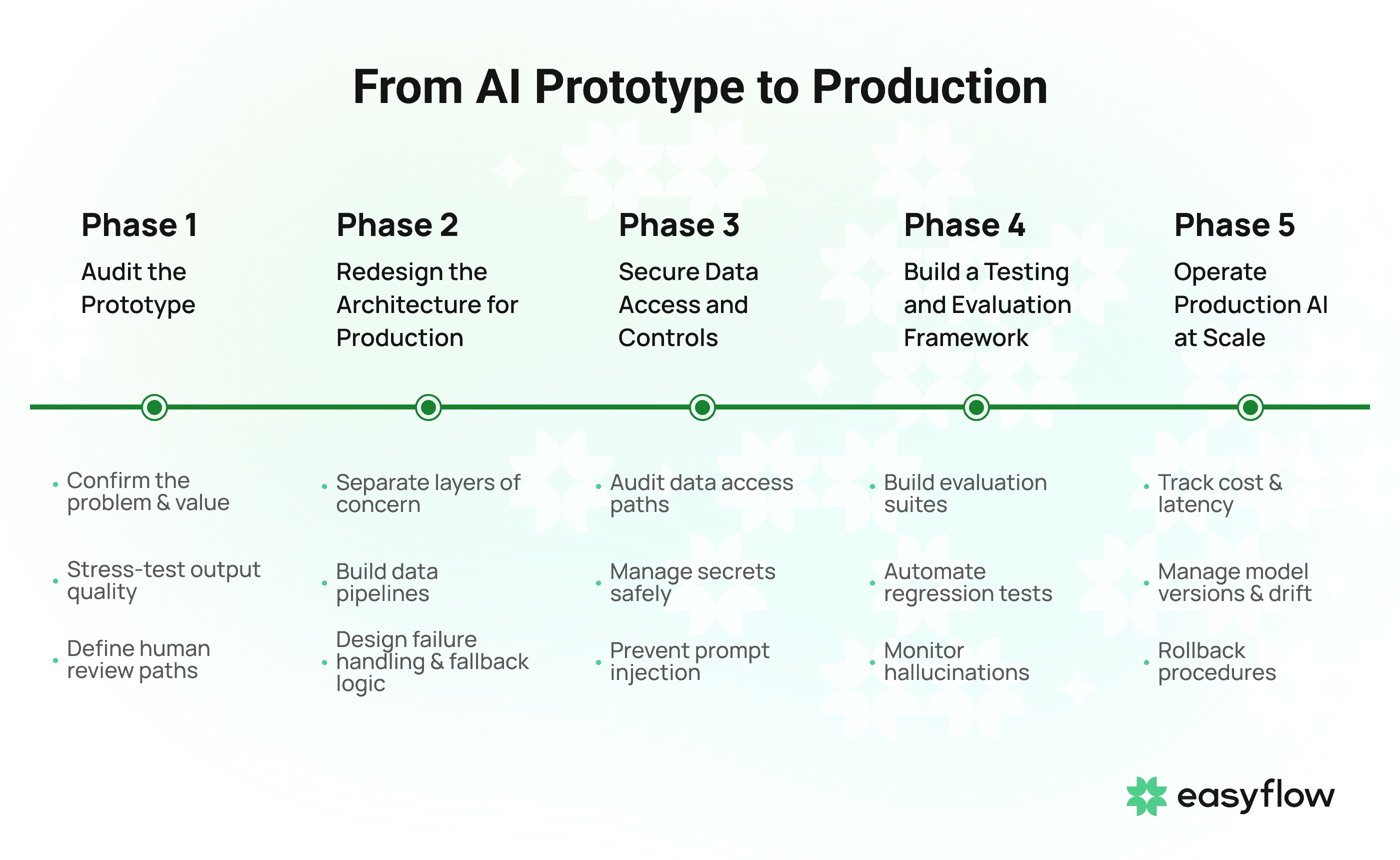
Phase 1: Audit the Prototype
Before any engineering work begins, the prototype needs an honest review, a process that typically takes one to two weeks and genuinely warrants the investment required to take it to production.
Confirm The Problem and The Value
Start by confirming that the prototype solves a real business problem with measurable value and that you can define what good output looks like along with who has the authority to decide.
These questions have direct consequences for architecture decisions downstream. For example, a document extraction system that requires 95% accuracy needs a fundamentally different production approach than one where 80% accuracy combined with a human review layer is acceptable. Mixing those requirements up at this stage may lead to expensive changes later.
Stress-Test Model Output Quality
Run the prototype against adversarial inputs, edge cases, and a data sample representative of real production traffic. Measure the hallucination rate, output consistency, latency under load, and failure behaviour. Where the model produces unreliable output, document those boundaries, as they define the guardrails, confidence thresholds, and human review requirements the production system will be built around.
Markiian explains, "Define the output schema before writing the prompt. Decide what fields the model must return and what counts as a valid response. Free-form text outputs are nearly impossible to test, validate, or pass downstream reliably. While a structured output contract gives every later stage something concrete to check against."
Decide Where Humans Stay in the Loop
For every output type, determine whether it should be auto-approved, human-reviewed, or escalated. High-stakes outputs (financial decisions, customer-facing communications, anything regulated) typically need human review for the first three months in production.
Phase 2: Redesign the Architecture for Production
This stage is the most technically intensive phase, with the goal of decoupling the prototype's business logic from a scalable system architecture and rebuilding the infrastructure layer to production standards.
Separate Prototype Logic From Production Systems
Vibe-coded prototypes typically tangle model calls, business logic, data access, and side effects inside the same functions. Testing is unreliable, scaling difficult, and debugging slow.
Markiian puts it directly: "The most common mistake is collapsing everything into a single layer — model calls, business logic, data access, and side effects all in the same functions, often the same file. It works for a demo because the entire system fits in one engineer's head. The moment you need to scale one part independently or test a single component in isolation; the whole structure has to come apart."
The first architectural move is enforcing separation of concerns: defining clear boundaries between the AI inference layer, the application logic layer, and the data and integration layer so that each can be tested, scaled, and replaced independently without cascading changes across the system.
Build Reliable Data Pipelines And Integration Layers
Production AI consumes real data, often from multiple sources with inconsistent formats, varying update frequencies, and unpredictable reliability. When an AI agent calls other systems (CRM, ERP, ticketing), each integration needs an interface contract, error handling, and observability instrumented from the start. This is exactly where most teams asking how to build production ready AI agents underestimate the scope: the agent logic itself represents approximately 20% of what needs to be built, with the integration and data pipeline work making up the remaining 80%.
Design Failure Handling And Fallback Logic
Every model call requires a clear answer to three questions: what happens on a timeout, what happens if the output is unusable, and what happens during a provider outage. Practical patterns include cached responses for repeated queries, a simpler model as a backup for high-frequency requests, and a graceful degradation message that keeps the user informed rather than presenting an unhandled error.
Markiian advises putting a feature flag around the entire AI surface from day one. When something goes wrong in production, the team can disable the AI behaviour and fall back to a deterministic path in seconds, without a deployment.
Phase 3: Secure Data Access and Controls
Security in AI systems covers a broader attack surface than conventional software. It includes all standard application security concerns plus AI-specific vectors that conventional static analysis tools often fail to catch.
Audit Data Access, Credentials, And Authentication
Audit every data access path in the prototype, enforce least-privilege access at the service and user level, and confirm that PII and sensitive business data are not being transmitted to external model APIs without data processing agreements in place.
Any endpoint left open or informally protected during prototyping needs authentication before launch. Shortcuts in this area are among the most common sources of production security incidents.
Markiian adds that logging pipelines deserve the same scrutiny: "Instrument cost, latency, and full request and response payloads from the first model call. Teams that add observability late may spend their first weeks in production catching up rather than moving forward."
Address AI-Specific Attack Vectors
The OWASP Top 10 for Large Language Model Applications 2025 ranks prompt injection as the single greatest security risk to LLM applications. It occurs when human input modifies the model's behaviour in ways that were not intended by the system. Addressing it requires input sanitisation, output validation, and system prompt hardening rather than relying on the model to police its own inputs.
It is equally important to audit the prototype for exposed API keys, credentials stored in code or environment files, and logging pipelines that may inadvertently capture sensitive data.
Phase 4: Build a Testing and Evaluation Framework
Testing AI is fundamentally different from testing deterministic software, and this phase is where many teams underinvest, with the consequence that a production-ready AI system behaves unexpectedly in production because the quality signals used during development did not reflect what real-world usage would reveal.
Build Evaluation Suites for Non-Deterministic Output
Traditional unit tests assume the same input produces the same output every time, which is not how language models work. Evaluation suites score outputs across multiple dimensions (correctness, format, tone, and refusal rate) and run automatically on every prompt or model change.
Stanford's Holistic Evaluation of Language Models (HELM) framework is a widely used reference for structuring multi-dimensional LLM evaluation in production; it demonstrates why a model that scores well on accuracy can fail badly on bias, calibration, or adversarial robustness and why those dimensions all need to be tracked together. Without a systematic evaluation suite, every change to a production AI system is effectively uncontrolled.
Automate Regression Tests Across AI Workflows
Build a test suite that covers the full workflow from input to output, including downstream effects, and run it against every model update, prompt change, or configuration change. AI systems drift when their components change. Automated regression testing catches that drift before it reaches production.
Monitor Hallucinations, Accuracy, and Response Consistency
Production monitoring for AI goes beyond latency and error rate. Track output quality continuously: hallucination detection, factual consistency where verifiable, and output distribution drift over time. Set alert thresholds and build dashboards that surface quality degradation before users do.
Phase 5: Operate Production AI at Scale
The final phase is operational readiness, meaning the system needs to run sustainably as load, data, and model behaviour change over time.
Track Latency, Cost, And Infrastructure Load
AI inference is more expensive than conventional API calls, and model API costs at scale are often an order of magnitude higher than what prototype-stage estimates suggested, which makes cost tracking, per-request logging, and budget alerting from day one non-negotiable.
Latency monitoring also requires tracking p95 and p99 response times separately from the median, because response time distributions for AI systems can diverge significantly under load in ways that median metrics obscure until users are already impacted.
Manage model versions, prompt changes, and output drift
Model behaviour in production does not stay static, meaning prompts, model versions, and evaluation benchmarks all need version control in addition to code.
Every change to any of these components is effectively a deployment event that requires regression testing and rollout management. This discipline is at the core of how to build production ready AI agents that remain reliable.
It’s important to keep model and prompt rollbacks separate from the application rollback process. When a model update degrades output quality, being able to revert quickly is what keeps an incident manageable.
Prototype vs Production-Ready AI
Dimension | Vibe-Coded Prototype | Production-Ready AI |
|---|---|---|
Architecture | Single script | Layered: API, orchestration, data, logging |
Prompts | Hardcoded strings | Versioned, tested, reviewable artifacts |
Failure handling | Errors crash the flow | Documented fallbacks, graceful degradation |
Evaluation | Manual checks on 5 examples | Automated suite of 200+ cases per change |
Security | Hardcoded keys, no RBAC | Secrets manager, audit logs, RBAC |
Observability | Print statements | Dashboards for accuracy, latency, cost, drift |
Governance | Whoever edits the code | Change review, approvals, rollback paths |
Common Mistakes When Moving an AI Prototype to Production
These failure patterns are consistent in AI prototype to production transitions.
Scaling prototype code directly without refactoring. Architecture debt compounds under load and makes debugging progressively slower and more expensive
Treating AI failure modes like standard software bugs. Model behaviour and user input distribution both drift over time, so evaluation needs to be continuous rather than a single gate during QA.
Relying on ad-hoc testing. Launch dates consistently arrive faster than expected, and the security review is reliably the first item to slip when the timeline compresses.
Launching without rollback paths. A prompt change that breaks something in production needs to be reversible in under five minutes. Waiting for the next scheduled deploy window is rarely an acceptable recovery plan.
No named owner for ongoing operations. AI systems in production require someone whose role explicitly includes keeping them working.
Refactor or Rebuild?
Most teams answer this question wrong in both directions, either refactoring when they should rebuild or restarting entirely when a focused refactor would have worked.
Markiian defines three things that tell us a refactor is realistic:
"First, the data model maps to the actual business domain. The code can be messy and the abstractions wrong, but if the underlying entities and relationships reflect what the business does, the refactor has something to build on.
Second, the original engineers are still on the team and can explain their decisions. Prompt logic, model selection, the reasoning behind specific thresholds, and the edge cases that drove particular guardrails — most of this knowledge lives in someone's head.
Third, the security debt is patchable rather than structural. Exposed API keys, missing rate limits, and absent input validation are surface issues that cost days to fix. But wrong authentication architecture, an integration model that assumes a trust boundary that doesn't exist, or a logging pipeline that captures PII by design are structural issues, and refactoring around them often costs more than starting clean.
When any one of those is missing, we typically recommend a parallel rebuild and a defined deprecation schedule."
Rebuilding is the safer choice when the prototype was written by someone who has since left the company, the model choice was wrong for the use case validated by real users, the security debt is too severe to remediate incrementally, or the system was built before the feedback that actually defined what it needs to do.
Signal | Refactor | Rebuild |
|---|---|---|
Core logic | Sound, needs cleanup | Flawed or unscalable by design |
Code quality | Messy but navigable | Incoherent; no engineer owns it |
Data model | Minor adjustments needed | Wrong abstractions throughout |
Test coverage | Under 30% but recoverable | Near zero; adding tests costs more than rewriting |
Security posture | Surface issues, patchable | Exposed keys, wide attack surface, structural gaps |
Timeline | Refactorable within a sprint | Rebuild in parallel; deprecate the old system |
On cost: for most AI products, moving from a vibe-coded prototype to production AI costs between 1.5x and 3x what the original prototype cost to build. Proposals pricing this work at less than 1x the original build are almost always either omitting evaluation and governance from scope or planning to add those costs later as scope changes.
A Production-Readiness Checklist
Before launch, every item below should have a documented yes or an explicit, written exception.
Use this before declaring any AI prototype to production transition complete.
Product Readiness | |
|---|---|
☐ | Business problem and success metrics are clearly defined |
☐ | AI output quality has been tested against production-representative data |
☐ | Edge cases, adversarial inputs, and failure scenarios are documented |
☐ | Human review requirements are defined and staffed |
☐ | The rollout plan includes staged deployment: internal, beta, full |
Technical Architecture | |
|---|---|
☐ | Prototype logic is decoupled from infrastructure |
☐ | Data pipelines have validation, error handling, and retry logic |
☐ | Fallback logic is defined for all AI failure modes |
☐ | The inference layer is independently scalable |
☐ | Prompt versioning and model version tracking are in place |
Security and Compliance | |
|---|---|
☐ | All API keys and credentials are stored in a secrets manager |
☐ | Input sanitization and prompt injection protection are implemented |
☐ | PII handling and data residency requirements are met |
☐ | Access controls are enforced at the service and user level |
☐ | Audit logging covers all sensitive operations |
QA and Monitoring | |
|---|---|
☐ | AI output evaluation framework with defined quality metrics is in place |
☐ | The regression test suite covers complete AI workflows |
☐ | Latency, cost, and quality monitoring with alerting is configured |
☐ | Rollback procedure for model and prompt changes is documented and tested |
☐ | Hallucination and output drift detection is operational |
Taking an AI Prototype to Production With Easyflow
If the audit in Phase 1 reveals significant technical debt, security gaps, or architecture that cannot be salvaged cleanly, that is often where teams stall. The refactor-or-rebuild decision has been made, but the path forward requires engineering capacity and AI-specific expertise that most product teams are not staffed to run in parallel with their existing roadmap.
Easyflow's AI Engineering practice works with teams at exactly this stage. The work includes vibe code cleanup and refactoring, production architecture design, security hardening, evaluation framework setup, and observability instrumentation. For prototypes that need to be rebuilt rather than refactored, we scope and run that rebuild with the production requirements defined during the audit as the starting point.
If you are working through this checklist, get in touch and we can scope what the path forward looks like for your system specifically.
Posted by

Viktoriia Pyvovar
Content Writer
How long does it take to move from AI prototype to production?
For most products, the work takes between six and sixteen weeks once the audit is complete. Simple use cases with a limited integration surface can finish in six weeks, while complex agents handling regulated data or strict latency requirements take longer. The average time from prototype to production across enterprise deployments is eight months, which suggests that teams working from a clean audit and a realistic scope can move significantly faster than the industry average.
Can we refactor the vibe-coded prototype to production AI, or do we need to rebuild?
Both paths are viable, and the right answer depends on what the audit surfaces. Refactoring works when the core logic is sound and the engineers who built the prototype are still available to explain the decisions behind it. Rebuilding is the more defensible choice when the original developer has left, the model selection was wrong for the validated use case, or the security debt is too deep to remediate without incurring greater risk than starting fresh. The Phase 1 audit produces this decision with a cost estimate for both paths.
How do we know if our AI prototype is ready for production planning?
Three conditions indicate readiness: the use case is validated by real user behaviour and not merely assumed, the model performs well against a representative evaluation set of at least 200 inputs, and there is a named owner for the system once it goes live. If any of those conditions is missing, the prototype warrants further iteration before the production conversation starts.
How do we build production ready AI agents that don't break on real customer data?
The same four phases apply: audit the prototype, rearchitect for clear layer separation, lock down security and all integrations, and establish continuous evaluation. The specific challenge with agents is the integration surface, because most agent systems fail at the boundary where they call external services rather than inside the agent logic itself. Each integration deserves to be treated as a first-class system with its own interface contract, error handling, and dedicated observability.