AI ROI Framework: How to Pitch AI to Your Board

Most internal AI proposals die in the gap between the people who understand the technology and the people who control the budget. The technical leader is convinced the initiative is right. The board, looking at the same proposal, sees cost and uncertainty. That gap has almost nothing to do with the technology itself.
MIT's NANDA initiative studied 300 public AI deployments and found that 95% of enterprise generative AI pilots delivered no measurable impact on profit and loss. The cause was the lost connection between a working pilot and a result the business could see and fund. Technical leaders lose the internal AI investment conversation because they pitch capability, while the board buys outcomes.
So this is a guide to enable this connection:
how to translate an AI initiative into the risk and ROI language a board responds to,
the AI ROI metrics that actually move investors,
how to rank and present AI risk,
mistakes that sink an internal pitch before anyone gets to the budget.
It's the same framework Easyflow uses to turn a technical leader's AI idea into a case the board signs off on.
Quick Answer: How Do You Build an AI ROI Framework Boards Approve?
A board approves AI investment when the proposal answers five questions in plain business terms: what problem this solves, why now, the expected ROI, the risks and how they're controlled, and the cost of doing nothing. A working AI ROI framework translates model capabilities into revenue, margin, cost, and risk reduction, puts a number and a timeline on each, and asks for one specific, bounded decision instead of an open-ended budget.
That, in one paragraph, is the ready framework for the board conversation. The rest of the article shows how to build each part of it, starting with the translation step that everything else depends on.
Why Boards Reject Internally Strong AI Proposals
The proposals that fail are rarely the weak ones. More often they're excellent initiatives presented in the wrong language. Three patterns explain most of the rejections.
The first is leading with the technology instead of the outcome. A board does not fund retrieval-augmented generation, fine-tuning, or an agent orchestration layer. It funds a shorter sales cycle, a lower cost-to-serve, or a compliance exposure that shrinks. The moment a pitch opens with architecture, the people holding the budget have no way in. They can't judge whether your vector database choice is sound, they know it, and an unevaluable proposal becomes a no.
The second is a vague return. “This will make us more efficient” is not a number. Boards have already watched AI spend climb without matching profit. McKinsey's 2025 global survey found that 88% of organizations now use AI in at least one function, yet only 39% can point to any measurable impact on earnings, and most of those put the figure below 5%. That gap is the exact fear in the room. A proposal with no defensible ROI hypothesis reads as one more entry in the 88%.
The third is silence on risk, which reads as naivety rather than confidence. A board weighing an AI investment is already thinking about data exposure, regulatory questions, and what happens when a system gets something wrong in public. Raise none of it and someone else will, and now the pitch looks like it missed the obvious. Gartner expects more than 40% of agentic AI projects to be canceled by the end of 2027, citing escalating costs, unclear business value, and weak risk controls. That means your AI initiative pitch should be able to break this barrier.
How to Translate AI Initiatives Into Risk and ROI Language
This is the core skill, and most of the work happens before the meeting. The board does not care that you're deploying an LLM, agents, or copilots. It cares about revenue, cost, margin, cycle time, risk, and what happens to all of those if the company sits still. Translating an AI initiative into risk and ROI language means rewriting every technical claim as a business one.
From Model Performance to Business Outcomes
Accuracy, latency, and token cost are inputs. The board needs the output. A support agent that resolves tickets isn't interesting because of its resolution rate. It's interesting because of what that rate does to cost-to-serve and the next hiring plan.
The table below is the whole translation move in one view. The left column loses the room. The right column gets a decision.
AI initiative | Weak pitch | Board-ready pitch |
|---|---|---|
AI support agent | “It automates customer support." | “It handles routine tier-one tickets, cuts average resolution time, and delays new support hires as volume grows." |
AI sales copilot | “It helps reps write better emails." | “It cuts research time per rep, frees up selling hours, and shortens the path from lead to first meeting." |
AI reporting agent | “It generates reports faster." | “It removes weekly manual reporting hours across finance and shortens the lag between month-end and a decision." |
Notice the changes: the board-ready version names metrics the board already tracks. None of them mentions a model or capability.
The AI ROI Metrics That Move Boards and Investors
Boards and investors react to a specific set of numbers. Sort your metrics into four groups and lead with whichever one your board weights most.
Revenue and margin metrics carry the most weight because they connect straight to enterprise value: revenue influenced by AI-assisted workflows, margin from a lower cost-to-serve, conversion or retention lift. BCG's 2025 study of 1,250 companies found that the small group capturing AI value at scale reported 1.7 times the revenue growth and 1.6 times the EBIT margin of their peers. Investors know that gap is real, which is why a credible revenue story lands harder than any efficiency claim.
Productivity and cost metrics come next, and they're the easiest to defend because you measure them before and after: hours returned to revenue-generating work, cost per transaction, headcount leverage as volume scales. McKinsey reports that function-level returns already show up where AI is deployed well, with software engineering, IT, and manufacturing seeing 10 to 20% cost reductions in organizations past the pilot stage. This is also where AI productivity ROI is most concrete.
Risk and compliance metrics turn a cost center into something the board can value: errors caught before they reach a customer, audit trail completeness, time to detect an incident. In a regulated business, a risk that gets smaller is a return.
Adoption and execution metrics are the ones most pitches skip and shouldn't be: active users, the share of target workflows actually running on the system, override rates. A model nobody uses returns nothing. McKinsey's data points to workflow redesign as the single practice most correlated with measurable earnings impact, yet only about a fifth of organizations have redesigned workflows instead of bolting AI onto the old ones. Adoption metrics are how you prove you're in that fifth.
The way to make any of these land is to pair each metric with the question it answers in the board's head. A number on its own invites “so what.” A number tied to a board question answers it before it's asked.
Metric | Board question it answers | Example |
|---|---|---|
Cost-to-serve | Will this reduce operating cost? | Support cost per ticket |
Sales cycle length | Will this increase revenue velocity? | Days from lead to first meeting |
Margin impact | Will this improve profitability? | EBIT or gross margin lift |
Risk reduction | Will this reduce exposure? | Fewer compliance exceptions |
Adoption rate | Will people actually use it? | Share of the target workflow running through AI |
The AI ROI Formula: How to Calculate the Number
When the board asks for the return, give them an arithmetic they can check, not a black box. The AI ROI calculation doesn't need a complex financial model. One formula carries most of the weight:
AI ROI = (Revenue gain + Cost savings + Risk reduction value − Total AI cost) / Total AI cost
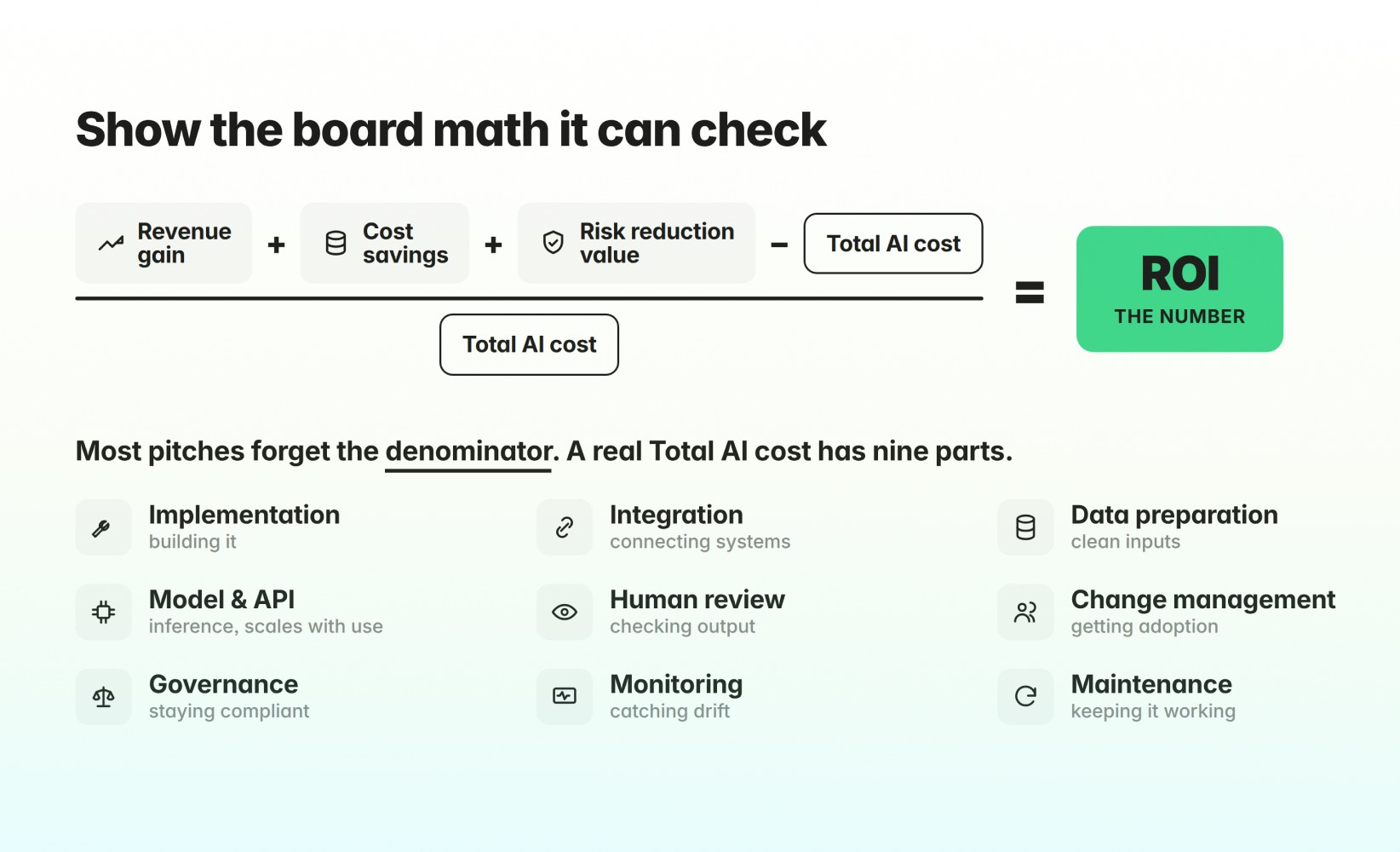
The numerator is where most pitches stop, and the denominator is where most of them get caught out.
A credible AI ROI model accounts for the full Total AI cost which includes:
Implementation cost to build the thing in the first place
Integration cost to connect it to the systems it has to read from and write to
Data preparation to get inputs clean enough for the model to be reliable
Model and API cost for the inference itself, which scales with usage
Human review wherever a person checks or corrects output
Change management to get people actually using it
Governance to keep it compliant and accountable
Monitoring to catch drift and failures in production
Maintenance to keep it working as models, data, and workflows change
Put the cost breakdown on the slide. A board of directors trusts a return on investment that can withstand their scrutiny, and the fastest way to lose that trust is to present a number that ignores half the cost of achieving it. A credible AI ROI model accounts for the Total AI cost.
The AI Board Pitch Framework: Five Questions Every Pitch Must Answer
Here is the framework itself, and it's deliberately simple. Strip away the slides, and a board-ready AI investment pitch answers five questions, in this order. Miss one and the proposal wobbles on exactly that point.
What business problem does this solve? Open with the operational pain the board already feels, in their words, before AI enters the sentence. If they recognize the problem, they'll hear the solution.
Why now? Explain why this can't wait a year and why a traditional software fix or more headcount won't get there. “Why now” is also where you earn trust by saying where AI isn't the answer.
What is the expected ROI? State the return with a number, a timeline, and the assumptions under it. A defensible estimate with its assumptions on the table beats a confident number with none.
What risks are involved? Name the data, compliance, quality, and dependency risks, and show the control for each. This is the question that, left unanswered, hands the room to whoever asks it first.
What happens if we do nothing? This is the one most technical leaders forget, and it's often the most persuasive. Standing still isn't neutral. BCG describes a widening gap where 5% of companies capture AI value at scale while 60% see minimal returns despite spending, and the leaders compound their lead by reinvesting it. The cost of inaction isn't zero. It's falling further behind a group that's pulling away. Present that plainly, without manufactured urgency, and let the board weigh it.
Build the pitch as the answers to those five questions, and you've moved the meeting from “convince us AI matters” to “approve this specific decision.” That shift is the whole game. Turning a raw AI idea into those five answers, with numbers behind each, is precisely the work that gets a project funded, and it's the work Easyflow does with technical leaders before they ever walk into the boardroom.
A Board-Ready AI Pitch Template
The five questions expand into a one-page template you can fill in before the meeting. If every line has a real answer, the pitch is ready. If a line is blank, that's the part the board will catch.
Business problem: the operational pain, in the board's language
Current cost of the problem: what it costs today in money, time, or risk
AI-enabled solution: what the system does, stated as an outcome
Expected business impact: the revenue, cost, or risk metric it moves
ROI assumption: the formula inputs and the assumptions behind them
Pilot scope: what gets tested, with whom, and for how long
Main risks: the top three, ranked
Controls: the specific mitigation for each risk
Budget request: the number, tied to the pilot, not the full rollout
Decision needed: the one approval you're asking for today
Fill that in honestly, and you've done the hard part of the board conversation before the meeting starts.
How to Present AI Risk to a Board Without Killing the Deal
Raising risk doesn't weaken a pitch. Ranking it strengthens one. The goal is to show the board you've already thought through what they're about to worry about and that you know which worries are serious and which are housekeeping. AI risk management at board level isn't a disclaimer slide. It's evidence that you understand the thing you're asking them to fund.
Modern AI strategy treats risk as a built-in layer, not an afterthought. That means a data strategy, clear security and legal requirements, KPI tracking from day one, a human in the loop where errors are costly, and ongoing employee education so adoption holds. A pitch that shows those pieces signals maturity. A pitch that talks only about model selection signals the opposite. When Easyflow builds a business case, this risk layer is part of it from the start, not a slide added at the end.
Rank the Risks Before You Walk In
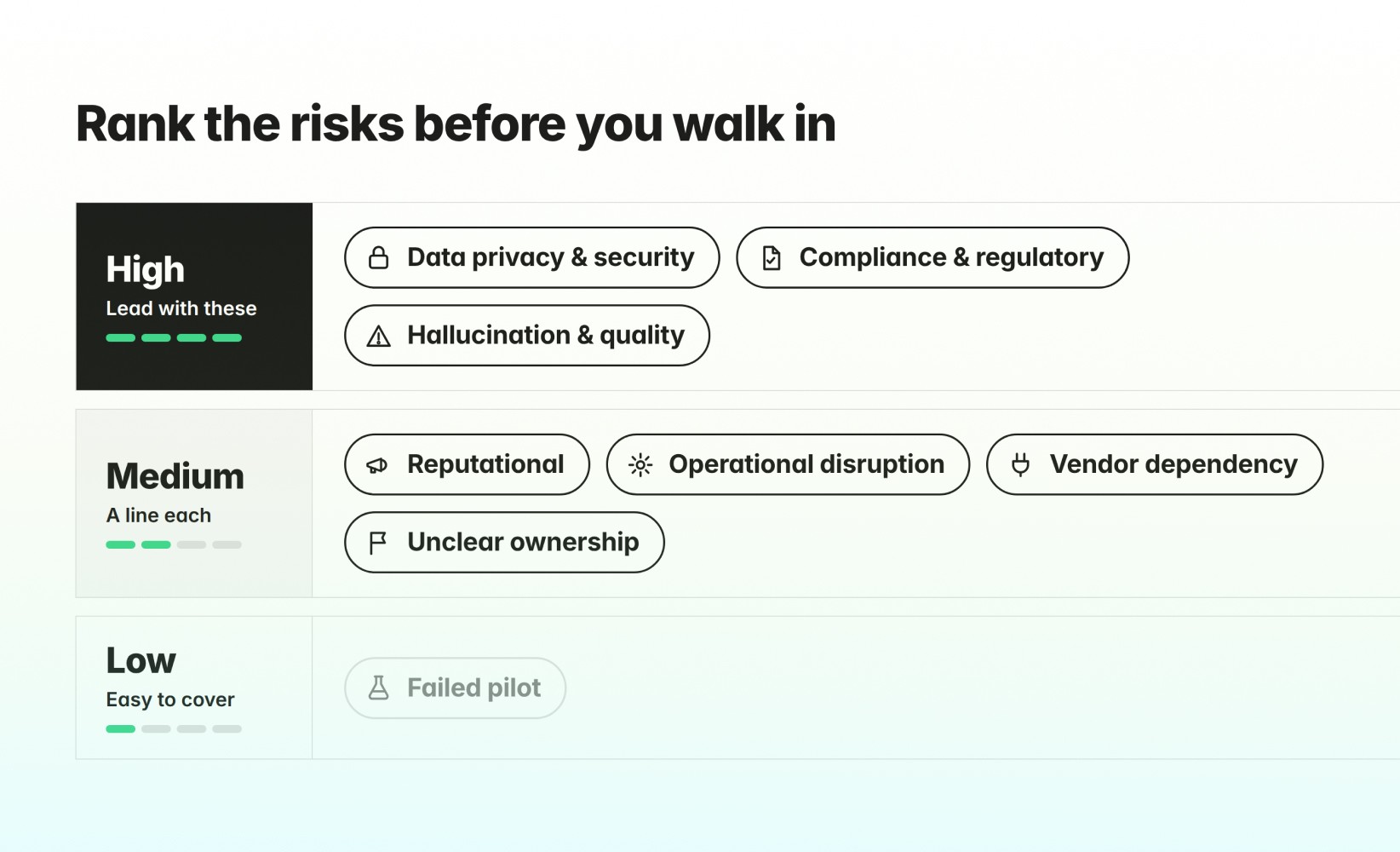
Not every risk deserves equal airtime. Do the ranking before pitching and prepare the assets that would help you present the initiative without breaking the deal. Below is a sample table of typical risks that might appear in every project. Note that the number of risks and their priority may vary.
Risk | Priority | How to present it |
|---|---|---|
Data privacy and security | High | “Customer data stays inside our environment. Sensitive fields are scoped out of prompts and logs, and only named roles can see model outputs.” Address this first; for most boards it's the top concern. |
Compliance and regulatory | High | “We mapped this against our obligations before building. Here's the audit trail and the human sign-off point for regulated decisions.” Critical in finance, health, and insurance. |
Hallucination and quality | High | “We ground every answer in verified data, track override rates, and keep a human in the loop wherever a wrong answer is expensive.” Frame the control, not the fear. |
Reputational | Medium–high | “A wrong answer in public is a brand cost, so customer-facing outputs carry a confidence threshold and an escalation path.” Pairs with quality risk. |
Operational disruption | Medium | “We phase the rollout so a failure is contained to a pilot group, not the whole workflow.” A phased plan is the answer here. |
Vendor and model dependency | Medium | “The architecture lets us swap models without rebuilding around them, so we're not exposed to one provider's pricing or roadmap.” |
Unclear ownership | Medium | “One named owner is accountable for this outcome, with a defined review cadence.” Boards fund initiatives that have an owner. |
Failed pilot | Low–medium | “The pilot is bounded and cheap to stop. The downside is capped at this number, and we learn either way.” A bounded pilot makes this minor. |
Lead the meeting with the top three. Cover the rest in a line each. The board doesn't need you to pretend the minor risks don't exist; it needs to see that you can tell them apart from the serious ones.
The Risk That Sinks Most Projects Is Adoption
The most common failure is a working system without real usage. MIT traced the 95% pilot failure rate, with the primary causes being a learning gap and the inability to fold AI into workflows, structures, and internal culture. Klarna learned this in public: AI assistant handled two-thirds of customer chats in month one, did the work of 700 agents, and cut resolution time from 11 minutes to under 2 minutes.
Then something went wrong. By 2025 Klarna started hiring human agents again because the AI was having trouble with the hard questions. CEO said that they had tried to save money by using automation. It did not work very well. This is a problem for a Fintech company. If you give someone the answer about their money, that is a serious issue.
So if you want to make sure your project works, you need to think about the adoption process. You need to have a plan for how to deal with the problems that come up when you are trying to get people to use something. If you do that, then the board will listen to you because you will sound like someone who knows what they are talking about, and why a lot of money spent on AI does not do good.
Common Mistakes When Pitching AI Internally
A few errors sink otherwise sound proposals, and they're easy to spot once you know them.
Leading with the technology.
If the first slide names a model or framework, the board has already drifted. Start with the business pain.Overpromising automation.
Claim a function will be fully automated, and you invite scrutiny you can't survive plus a failure the board will remember. Klarna's “work of 700 agents” headline became the line the company later had to walk back. Promise the version that holds up.Ignoring adoption and workflow change.
Treating AI as a tool to install rather than a workflow to redesign is the documented reason most pilots return nothing. Budget for the change, not just the build.Asking for an open-ended budget.
A request with no phases and no checkpoints reads as uncontrolled risk. Phase the ask.Measuring the wrong things.
Track model accuracy or token cost instead of business outcomes, and even a working deployment can't prove its worth when the budget review comes around.
When to Bring in an AI Transformation Partner
Turning an AI project into a business plan that impresses the board is not the same as building the AI system. Many technical leaders are good at building the system. Need help with creating a solid business plan. This plan includes things like a return on investment (ROI) model, risks, a step-by-step roadmap, and a list of important uses of AI that makes sense to the budget team.
That's the work an AI transformation partner is for. At Easyflow we check if a company is ready for AI, create a roadmap, and help with product, process, and people changes. We take responsibility for the outcome when a lot of vendors just hand over the presentation and leave.
Our audit gives the board what they need to see: a list of AI uses in order of importance, each with an ROI model and a clear picture of the risks. If a process can be improved with software or a new workflow instead of AI, we say so before you spend any money on it.
The goal of working with Easyflow is to create a business plan that gets approved.
Final Thoughts: Boards Fund Outcomes, Not AI
Your technical case is probably already strong. The reason it stalls is translation. A board approves AI investment when it can see the business problem, weigh the return against the risk, control its downside through a phased plan, and understand the cost of standing still. Answer the five questions in their language, rank the risks honestly, and lead with the metrics that move them, and the conversation changes shape entirely.
If you're heading into that conversation and want the business case built to hold up, that's exactly what Easyflow does.
Posted by

Shykula Kateryna
Content Producer
How do you pitch AI to a board?
Answer five questions in order: what business problem this solves, why now, the expected ROI, what risks are involved, and what happens if you do nothing. Lead with the problem the board already recognizes, attach a number and timeline to the return, rank the risks so the serious ones get airtime, and ask for one specific decision. Boards fund bounded, measurable proposals, not open-ended AI strategies.
What AI metrics actually move investors?
Investors react first to revenue growth and margin, because those connect to enterprise value. BCG found that companies capturing AI value at scale report roughly 1.7 times the revenue growth and 1.6 times the EBIT margin of peers. Productivity, cost-per-transaction, and credible adoption metrics support the case, but they rarely lead it.
How do you present AI risk to a board?
Rank the risks before the meeting. Lead with data privacy, compliance, and hallucination risk, because those are the ones a board probes hardest, and show a specific control for each. Cover routine risks like a failed pilot in a sentence each. Showing you can tell a serious risk from a minor one is more reassuring than pretending there are none.
How do you explain AI ROI to non-technical executives?
Drop every model and architecture term and restate each claim as a business outcome: revenue, margin, cost, cycle time, or risk reduction, each with a number and a timeline. A non-technical executive can't evaluate your tech stack but can evaluate a shorter sales cycle or a lower cost-to-serve.