Best Companies for Legacy System Modernization in 2026

The systems running your invoicing, claims, or order flow were likely written before your current engineering team joined. Choosing between the best companies for legacy system modernization is now less about who can rewrite code and more about who can preserve business logic while making the system AI-ready. This guide compares seven vendors and gives you the criteria to run the selection yourself.
Quick Answer: Best Legacy Modernization Companies in 2026
The top legacy modernization companies in 2026 are Easyflow, Accenture, IBM Consulting, Capgemini, Cognizant, Hexaware, and Keyhole Software. Here is the shortest useful version of what the best companies for legacy system modernization 2026 has to offer:
Easyflow: best for AI-ready modernization and mid-market application modernization with fixed scope and audit-first delivery
Accenture: best for large enterprise transformation programs spanning hundreds of applications
IBM Consulting: best for mainframe and COBOL modernization backed by watsonx tooling
Capgemini: best for cloud migration and replatforming at enterprise scale
Cognizant: best for regulated industries with heavy compliance requirements
Hexaware: best for AI-assisted code conversion and automated migration tooling
Keyhole Software: best for US mid-market monolith-to-microservices projects
The right choice depends on stack, industry, and what "modern" needs to mean: cheaper, faster to change, or AI-ready.
Key Takeaways
US federal agencies typically spend about 80 percent of a 100-billion-dollar-plus annual IT budget maintaining existing systems, according to the GAO.
The vendor market splits into three tiers: global integrators, AI-tooling specialists, and engineering-led firms built for mid-market speed.
Seven strategies cover most modernization paths, with cost and risk rising from encapsulate through replace.
Gartner predicts that by 2027, generative AI will cut legacy modernization costs by 70%.
The most common failure mode is not technical: choosing a rebuild before anyone has documented what the current system does.
What Is Legacy Modernization?
Legacy modernization updates outdated software, so it stops blocking the business: lower run cost, safer to change, connected to modern infrastructure and AI tooling. Business logic must survive the change, since pricing rules often exist nowhere but in the code.
Legacy Modernization vs Application Modernization
Application modernization targets one application. Legacy modernization covers the whole estate: infrastructure, integrations, data, process.
Legacy Modernization vs Mainframe Modernization
A subset with its own rules: COBOL, PL/I, RPG, batch windows, hardware-coupled architecture. Industry surveys attribute more than 800 billion lines of COBOL to daily production use, and the engineers who understand it are retiring fast.
Legacy Modernization vs Cloud Migration
Cloud migration moves workloads; it does not necessarily modernize them. A lift-and-shift produces the same monolith with a different hosting bill.
Legacy Modernization vs Digital Transformation
Digital transformation is a business program: new products, channels, operating models. Legacy modernization is an engineering prerequisite.
Why Legacy Modernization Matters in 2026
Rising Maintenance Costs
The clearest public benchmark is the US federal government's roughly 80 percent operations-and-maintenance ratio, cited above. The older the estate, the less budget for anything new.
Security and Compliance Risk
Legacy systems run on unsupported frameworks and log too little for fast incident response. IBM's 2025 report puts the global average breach at 4.44 million dollars.
Talent Shortages Around Legacy Technologies
Most universities dropped COBOL and RPG decades ago. The engineers who built these systems are retiring, and the undocumented rules retire with them.
Slow Release Cycles and Innovation Bottlenecks
When a system becomes expensive to change, the business stops asking for changes, and workarounds pile up for modernization to untangle.
AI and Cloud Readiness Gaps
AI initiatives need accessible data, callable APIs, and event-driven flows. Legacy systems typically offer none of the three.
How We Selected the Top Legacy Modernization Companies
Most vendor lists in this category rank by brand size. We ranked by delivery evidence: public case studies, verified Clutch reviews, published tooling benchmarks. The best software modernization companies score well across most of the eight criteria below; no vendor scores well on all.
Proven Modernization Delivery
Named clients, verifiable metrics, production outcomes.Legacy Technology Expertise
COBOL, PL/I, RPG, VB6, PowerBuilder, early Java or .NET.Cloud, Microservices, and API Capabilities
Production microservices and cloud-native deployment, not certification badges.AI-Assisted Modernization Tooling
AI tooling paired with deterministic engineering, not AI as the whole method.Data Migration and Business Logic Preservation
Explicit parity-testing and documented logic-recovery methods.Security, Compliance, and Risk Management
SOC 2, ISO 27001, rollback and continuity planning as standard practice.Industry Experience
Domain depth reduces discovery time and expensive surprises.Post-Launch Support and Knowledge Transfer
Knowledge transfer built into delivery, not dependency.

Top Legacy Modernization Companies in 2026: Comparison Table
The table below compares the top legacy software modernization companies across the dimensions buyers ask about first.
Company | Best for | Typical client | Core strength | What to watch for |
|---|---|---|---|---|
Easyflow | AI-ready modernization, mid-market | 50-300 employees | Audit-first, fixed-scope delivery in weeks | Not a fit for mainframe COBOL conversion |
Accenture | Enterprise transformation programs | Global enterprise | Scale, industry benches, program governance | Cost and pace sized for enterprise budgets |
IBM Consulting | Mainframe and COBOL modernization | Large regulated enterprise | watsonx Code Assistant for Z | Strong pull toward IBM platforms |
Capgemini | Cloud migration and replatforming | Upper mid-market, enterprise | Structured migration factories | Factory model can feel templated |
Cognizant | Regulated industries | Healthcare, banking, insurance | Compliance depth, delivery capacity | Team seniority varies by engagement |
Hexaware | AI-assisted code conversion | Upper mid-market, enterprise | Automated migration tooling | Output still needs engineering review |
Keyhole Software | Monolith-to-microservices, US mid-market | US mid-market, enterprise | Senior teams, transparent methodology | US-centric delivery footprint |
Top Legacy Modernization Companies in 2026
The profiles below add what the table cannot: why each vendor works the way it does once you are inside the engagement.
1. Easyflow
Easyflow is an AI engineering and automation agency that approaches modernization from the direction most vendors ignore: making legacy systems ready for AI, not just cheaper to host. The engagement model is audit-first: a fixed-scope AI Transformation Audit maps systems and constraints, then a delivery sprint modernizes the highest-value slice at a fixed price and deadline, delivered by embedded squads of 2 to 7 engineers with knowledge transfer built in, not bolted on at the end.
The clearest evidence is production, not a pitch deck: a night operations agent built for IOPS.TEAM cut manual triage by 60 percent with full audit-trail coverage in under eight weeks, human-in-the-loop at every sensitive decision point. Primary services span application-layer modernization, API enablement, and AI engineering squads.
2. Accenture
Accenture's advantage shows up at portfolio scale: hundreds of applications, deep cloud partnerships, and program governance over years, though smaller engagements can still draw junior staffing.
3. IBM Consulting
IBM's differentiator is watsonx Code Assistant for Z, generative AI applied to COBOL analysis on the platform where most of that code runs, with a natural pull toward IBM's own infrastructure.
4. Capgemini
Capgemini runs structured migration factories, standardized assessment and wave planning that industrialize cloud replatforming, built more for throughput than for unusually shaped applications.
5. Cognizant
Cognizant's practice centers on regulated verticals, healthcare, banking, insurance, where compliance evidence is as much a deliverable as the code, and team seniority is worth confirming per engagement.
6. Hexaware
Hexaware leans hardest into AI-assisted tooling, proprietary platforms that shorten conversion timelines through automation, though output still needs senior engineering review before it ships.
7. Keyhole Software
Keyhole Software is a US consultancy where legacy modernization is the entire business, not a service line, with senior engineers doing the work directly and a US-centric footprint.
Legacy Modernization Strategies: Which Approach Fits Your System?
Seven strategies cover nearly every decision, with cost and risk rising in this order.
Encapsulation
Wrap the system in an API layer, core untouched. Right when nothing can talk to the system.
Rehosting
Move to new infrastructure, usually cloud, without changing code. Wrong when the code is the problem.
Replatforming
New infrastructure with limited changes: managed database, containers, updated middleware. Captures cloud economics without a rewrite.
Refactoring
Restructure code without changing external behavior. Right when the architecture is sound but the code decayed.
Rearchitecting
Change the architecture itself, typically decomposing a monolith into services. High effort, high payoff.
Rebuilding
Rewrite from scratch while preserving business rules, justified only when the system cannot express what the business now needs.
Replacing
Retire the system for a commercial product. Migration effort routinely exceeds the license cost.

Legacy Modernization Services These Companies Provide
Application assessment and portfolio analysis: mapping systems and risk before code changes
Code refactoring and code conversion: manual and AI-assisted translation between languages
Mainframe modernization: COBOL and PL/I analysis, offloading, staged exits
Database migration: schema conversion, data quality remediation, cutover planning
API modernization: exposing legacy functions as documented, secured APIs
Cloud migration and replatforming: infrastructure moves with rollback paths
Monolith to microservices migration: domain decomposition, strangler-pattern delivery
DevOps and CI/CD modernization: automated build, test, and deployment
Security and compliance modernization: encryption, access control, audit evidence
AI-assisted documentation and code analysis: generating documentation from code
AI-Ready Legacy Modernization: What Changes in 2026?
Modernization budgets survived 2025 planning cycles because of AI: boards approved roadmaps that dead-end at systems with no accessible data. Five changes define AI-ready modernization.
Making Legacy Data Accessible for AI
Models and agents need clean, queryable data, extracted from flat files and proprietary databases into governed pipelines.
Preparing APIs for AI Agents and Automation
AI agents act through APIs. A system with no API is invisible to automation.
Turning Batch Systems Into Real-Time Workflows
Overnight batch windows made sense decades ago. Agents deciding things in real time need event streams, not overnight jobs.
Adding Governance and Auditability for AI Use Cases
Gartner predicts that over 40 percent of agentic AI projects will be canceled by the end of 2027, citing rising costs and weak risk controls.
Avoiding AI on Top of Broken Architecture
Pointing an LLM at the legacy system and calling it transformation fails predictably: the model inherits every data quality problem underneath it.
How Much Does Legacy Modernization Cost?
Any vendor quoting before an assessment is guessing, but the cost structure is describable.
What impacts cost: codebase and data quality, integration points, compliance requirements, and how much business logic is documented.
Cost by approach: encapsulation and rehosting typically run five figures for a mid-market application. Replatforming and refactoring reach low-to-mid six figures. Rearchitecting, rebuilding, and mainframe exits run into eight figures for large estates.
Why mainframe modernization costs more: scarce skills, decades of accumulated logic, batch dependencies, zero tolerance for downtime.
Why regulated systems increase scope: compliance evidence is a deliverable in its own right, adding validation cycles.
How to reduce cost with phased delivery: modernize the highest-value slice first, prove parity, then repeat.
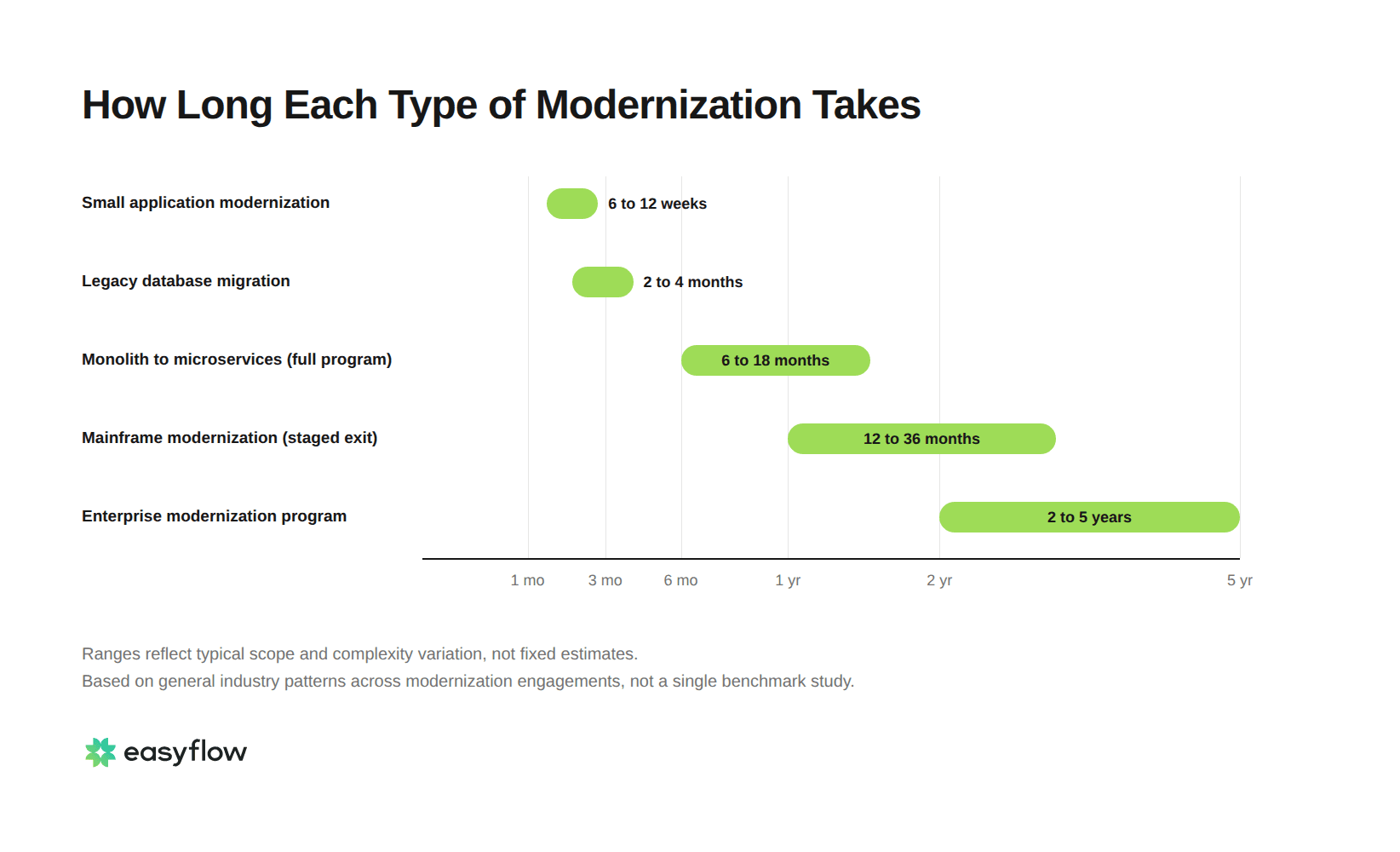
How Long Does Legacy Modernization Take?
Small Application Modernization Timeline
6 to 12 weeks for encapsulation or replatforming, including parity testing.
Legacy Database Migration Timeline
2 to 4 months for a single production database, longer when data quality is poor.
Mainframe Modernization Timeline
Staged exits run 12 to 36 months. A promised full exit in one quarter hasn't happened.
Monolith to Microservices Timeline
First extracted service typically ships in 2 to 3 months; the full program runs 6 to 18.
Enterprise Modernization Program Timeline
Portfolio-wide programs at integrator scale run 2 to 5 years, delivered in waves.
Legacy Modernization ROI: What Should You Measure?
Baseline these eight metrics before the project starts:
Maintenance cost reduction: run-rate spend before and after
Release velocity: deployment frequency and lead time for changes
Incident reduction: production incidents and mean time to recovery
Infrastructure cost savings: hosting and licensing deltas
Developer productivity: time to onboard a new engineer
Security risk reduction: closed vulnerabilities and audit findings
Customer experience improvement: latency, uptime, feature delivery
AI and data readiness: share of data accessible through governed APIs
How to Choose the Right Legacy Modernization Partner
Start With the System Constraint, Not the Vendor List
Define what the legacy system blocks: a launch, an AI initiative, a compliance deadline. That constraint shortlists the vendors.
Check Experience With Your Legacy Stack
A vendor with deep Java experience learns nothing useful from your PowerBuilder estate.
Ask for Production Modernization Evidence
Architecture diagrams from real engagements and before-and-after metrics, not case studies without numbers.
Review the Delivery Model and Team Seniority
Ask for the staffing plan by name. Integrators often sell senior and staff junior.
Validate Their Data Migration Approach
Ask how they profile data quality, run dual-run validation, and plan cutover.
Evaluate Security and Compliance Practices
Certifications are the floor. Ask how compliance evidence is produced during delivery, not retrofitted before an audit.
Confirm Knowledge Transfer and Post-Launch Ownership
The engagement should end with your team operating the system. Most lists of top IT services companies for legacy system modernization 2026/2027 skip this step, which is where selections go wrong.
Questions to Ask a Legacy Modernization Company Before Hiring
What systems have you modernized that look like ours? Same stack, similar scale, comparable compliance context.
How do you preserve business logic? Listen for logic recovery and characterization testing, not "our analysts will interview your team."
How do you prevent downtime during migration? Look for parallel-run strategies and staged cutovers.
How do you test data and functional parity? Automated comparison at scale, not manual spot checks.
What happens if the first modernization path is wrong? Good vendors describe checkpoint decisions and pivots.
Who owns the system after handover? The answer should be your team, with a defined transfer plan.
Red Flags When Choosing a Legacy Modernization Company
They recommend rebuilding before assessment. A revenue plan, not an engineering judgment.
They treat lift-and-shift as full modernization. Rehosting is a valid step, not a destination.
They cannot explain business logic preservation. "We will be careful" is not a method.
They underestimate data migration. A single line item for data work signals nobody has done one.
They ignore user adoption and change management. A system nobody uses correctly delivers negative ROI.
They do not define rollback and continuity plans. Every cutover needs a documented way back.
They focus only on cost reduction. The durable business case includes speed and capability too.
Legacy Modernization Assessment Checklist
Assemble this before talking to any vendor; it shortens every conversation that follows:
System inventory: applications, versions, hosting, owners
Business-critical workflows: what must never break, verified by the right people
Data dependencies: databases, file exchanges, upstream and downstream consumers
Security and compliance requirements: applicable regulations and current audit findings
Integration points: every system that reads from or writes to the legacy system
Performance constraints: batch windows, peak loads, latency requirements
Internal ownership: who decides, who verifies, who operates after handover
Modernization success metrics: the baseline numbers from the ROI section above
Final Thoughts: Choosing the Best Legacy Modernization Company
Shortlists of top legacy system modernization companies providers 2026/2027 all contain competent firms. The selection error is almost never picking a bad vendor; it is picking a mismatched one. The best companies for legacy system modernization for your situation are the ones whose delivery model and engagement size match your constraint.
Our position is deliberate: fixed-scope, audit-first modernization for mid-market companies whose legacy systems block AI adoption. The audit takes 30 days and produces a roadmap you can execute with us or without us.
Posted by

Shykula Kateryna
Content Producer
What are the top legacy modernization companies in 2026?
The most-shortlisted vendors are Easyflow, Accenture, IBM Consulting, Capgemini, Cognizant, Hexaware, and Keyhole Software. Integrators fit portfolio programs, IBM leads mainframe work, and engineering-led firms fit mid-market scope with faster timelines. The right pick depends on stack and engagement size, not brand.
How do you choose a legacy modernization company?
Start from the constraint the legacy system creates, then pick the strategy that removes it. Shortlist vendors with production evidence on your stack. Verify team seniority and confirm knowledge transfer is built in.
How much does legacy modernization cost?
Encapsulation and rehosting typically land in five figures for a mid-market application. Replatforming and refactoring run low-to-mid six figures. Rearchitecting, rebuilds, and mainframe exits reach eight figures for large estates.
How does AI help with legacy modernization?
AI tooling accelerates reading undocumented code and drafting converted code, the phases that used to take the most manual effort. Gartner projects generative AI will cut modernization costs substantially by 2027. AI capability now dominates search results for top companies for legacy system modernization B2B 2026 2027, but treat it as an accelerant, since AI-drafted conversions still need parity testing.