Multi-Agent Orchestration: A Practical AI Agents Guide for Mid-Market Teams

Over 40% of agentic AI projects will be canceled by the end of 2027 due to escalating costs, unclear value, or weak risk controls, according to Gartner. Most writing on multi-agent orchestration targets the companies least likely to land in that statistic: banks and Big Four firms with platform teams and budgets built to absorb mistakes. This AI agents guide is for everyone else. If you run engineering or operations at a Series B to mid-market company with one or two agents in production, whether coordinated AI agents are the next step comes down to engineering signals, not analyst momentum.
This guide draws on a working interview with Dmytro Savitskyi, AI Engineer at Easyflow, who ships agent systems for exactly this segment. His position: mid-market companies capture most of the operational value of multi-agent orchestration with two or three specialized agents and one constrained coordination layer, without an enterprise broker, a dedicated platform team, or betting the roadmap on it.
Quick answer: Move from one AI agent to several only on a measurable signal: the agent systematically picks the wrong tool as its tool count nears 25 to 30, two workflows carry a different cost of failure, or different teams maintain them. For mid-market, the working architecture is two or three specialized agents behind one hub-and-spoke orchestration layer, with routing in code and a month budgeted for coordination.

What Multi-Agent Orchestration Actually Is (and Is Not)
An AI agent is an LLM-based system with a prompt, its own state, and the ability to act through tools. A multi-agent system is a set of such agents coordinated through orchestration.
Multi-agent orchestration is the coordination layer that lets several specialized AI agents work on one business process: routing requests, passing state between agents, handling partial failures, and enforcing who can do what. One agent triages a ticket, another drafts the response, a third updates the record. The orchestration layer decides the sequence and carries the context.
What it is not: a way to make your AI smarter by adding headcount in silicon.
"The second agent doesn't make the system smarter. It makes it separately deployable. Those are different kinds of value, and people confuse them constantly."
Dmytro Savitskyi, AI Engineer, Easyflow
That confusion is common enough that Gartner named it: "agent washing," vendors rebranding chatbots, RPA, and assistants as agentic products. Gartner estimates only about 130 of the thousands of vendors claiming agentic capabilities are building the real thing. The same inflation happens internally: three chained prompts get called a multi-agent system, and the architecture conversation starts from a false premise.
A useful working definition: you have a multi-agent system when at least two independently deployable agents share state on the same business process, and something arbitrates between them. If nothing arbitrates, you have parallel single agents. If nothing shares state, you have separate projects. Neither needs an orchestration layer yet.

When a Single Agent Hits Its Ceiling
Most companies considering multi-agent AI have no engineering reason to. Dmytro puts the ratio bluntly: in roughly eight cases out of ten, the push comes from impression, not evidence. The one signal he trusts is measurable.
"The one signal I actually trust: the agent has started systematically picking the wrong tool. You have 25 to 30 tools, and the logs show it consistently misses on a certain type of request. That's an engineering reason to split."
Dmytro Savitskyi
Two more legitimate reasons exist, neither about AI. Blast radius: parts of the system with a different cost of failure need isolation, a nightly enrichment job should not take down a live customer chat. Team structure: workflows maintained by different people on different schedules should be separate deployments, Conway's law applied to agents.
Signal | Add another agent? | Why |
|---|---|---|
Agent picks wrong tools near 25 to 30 tools | Yes | Tool routing has become unreliable |
Workflows carry different blast radius | Yes | Failures need isolation |
Different teams maintain the workflows | Often yes | Deployment ownership differs |
Leadership wants twelve agents | No | Usually an automation backlog, not architecture |
The process has no named owner | No | You cannot automate an undefined process |
Agent works but needs better data | Not yet | Fix retrieval and data quality first |
What is not a signal: "five departments" is an org chart drawn as architecture, and "we want it to look serious" is heard more often than anyone admits.
There is also a cost that rarely makes the business case: every handoff carries its own error rate, and five sequential steps at 95% accuracy compound to 77% at the end of the chain. A UC Berkeley study of seven multi-agent frameworks found failure rates as high as 86.7% on standard benchmarks, with agents miscommunicating or overriding each other among the dominant failure modes.
"We want twelve agents": what the request actually means
When leadership arrives with a number, the number is rarely the requirement.
Q: What's really behind "we want twelve agents"?
"Almost never a request for twelve agents. The real request is: we have twelve places where people do tedious manual work, do something about it. My first question is always: which of these twelve exists today as a documented process with a specific owner? Twelve usually compresses to two: nine are things nobody does the same way twice, and you can't automate a process that doesn't exist. One more almost always turns out to be a report that's a single database query."
Dmytro Savitskyi
His second question matters more than the requirements list: what happens when the agent gets it wrong, an hour lost or a wrong invoice sent? The third, nearly everyone forgets: who maintains twelve prompts that drift and twelve integrations that break when a vendor changes an API. The advice is always the same: take the one with an owner and a number, prove it in production, and let the rest simplify or disappear.
Add an agent when the logs show a specific failure, not when the org chart suggests one.

The Mid-Market Entry Point: Two or Three Agents, One Orchestration Layer
The destination is two or three agents; the entry point is still one. The pattern that works at 50 to 300 employees is deliberately constrained: two or three specialized agents behind a single orchestration layer, sequenced rather than launched together. This is not a stripped-down version of enterprise AI agent orchestration, at mid-market scale it is the correct architecture, because the alternative assumes operational capacity that does not exist.
The market data supports starting narrow. In McKinsey's 2025 State of AI survey, 62% of organizations report experimenting with AI agents but only 23% are scaling one in even a single business function. That gap is where most agent programs sit: past the demo, short of proof.
What "one orchestration layer" means in practice is a set of guarantees that only become necessary once a second agent touches shared state, and Dmytro has watched their absence turn expensive.
"The most expensive failure I've seen: one agent talked to customers, another updated the CRM. Both could write to the same record, and nobody had decided whose write wins. It worked for a month. Then traffic grew, retries fired more often, and customers started getting duplicate emails while one agent's CRM updates silently overwrote the other's. Nobody noticed until the numbers in a report stopped matching."
Dmytro Savitskyi
The failure underneath is simple: nobody defined who owns the truth. The fix is equally unglamorous: a typed contract that validates and fails loudly, not free-text handoffs that silently drop information. One owner per entity. An idempotency key on every external action so a retry cannot send a second email. One trace ID through every log. With one agent you can skip this for years. With two, you cannot.
This is also where AI workflow automation quietly differs from agentic AI architecture: automation chains deterministic steps, agents decide inside them. The orchestration layer is what keeps the second category auditable, and it is where most engineering effort in a coordinated system goes.
Hub-and-Spoke vs Mesh: The 2 a.m. Test
Two multi-agent system architecture patterns dominate the conversation. Hub-and-spoke means a dispatcher: one agent receives the request, decides which specialist to call, and assembles the result. Specialists never talk to each other; to the dispatcher they are tools. Mesh means agents communicate directly, peer-to-peer, with no center.
For mid-market, Dmytro chooses hub-and-spoke almost every time, and his criterion has nothing to do with architecture diagrams.
Q: By what criterion do you choose between hub-and-spoke and mesh for mid-market?
"The criterion is: can one person at 2 a.m. open one trace and see the whole chain? With a hub, state lives in one place, the log is written in one place, permissions are checked in one place. With mesh you have ten logs and behavior you can't reproduce."
Dmytro Savitskyi
The advantages of mesh are real: no bottleneck, no single point of failure. They pay off at a scale mid-market never reaches; at two hundred requests a day, a bottleneck is not among your problems. Mesh is justified only when agents belong to different companies and cannot share a runtime, a boundary someone else drew rather than a choice.
One bias worth adopting alongside the hub: keep routing in code. The model classifies intent; code decides where the request goes. An orchestrator that freely chooses its own sequence of steps is, in Dmytro's words, the most expensive thing you can drag into production without a platform team: impressive in a demo, then a month spent failing to reproduce one bug.
Criterion | Hub-and-spoke | Mesh |
|---|---|---|
Where state lives | One place, at the hub | Distributed across agents |
Debugging at 2 a.m. | One trace shows the whole chain | Ten logs, behaviour you cannot reproduce |
Permission checks | Enforced once, at the hub | Repeated in every agent |
Main failure mode | The hub becomes a bottleneck | Silent divergence between agents |
Scale where it pays off | From the first coordinated agent | High throughput mid-market rarely reaches |
When it is justified | Nearly every mid-market case | Agents owned by different companies that cannot share a runtime |
What Multi-Agent AI Costs and What It Buys
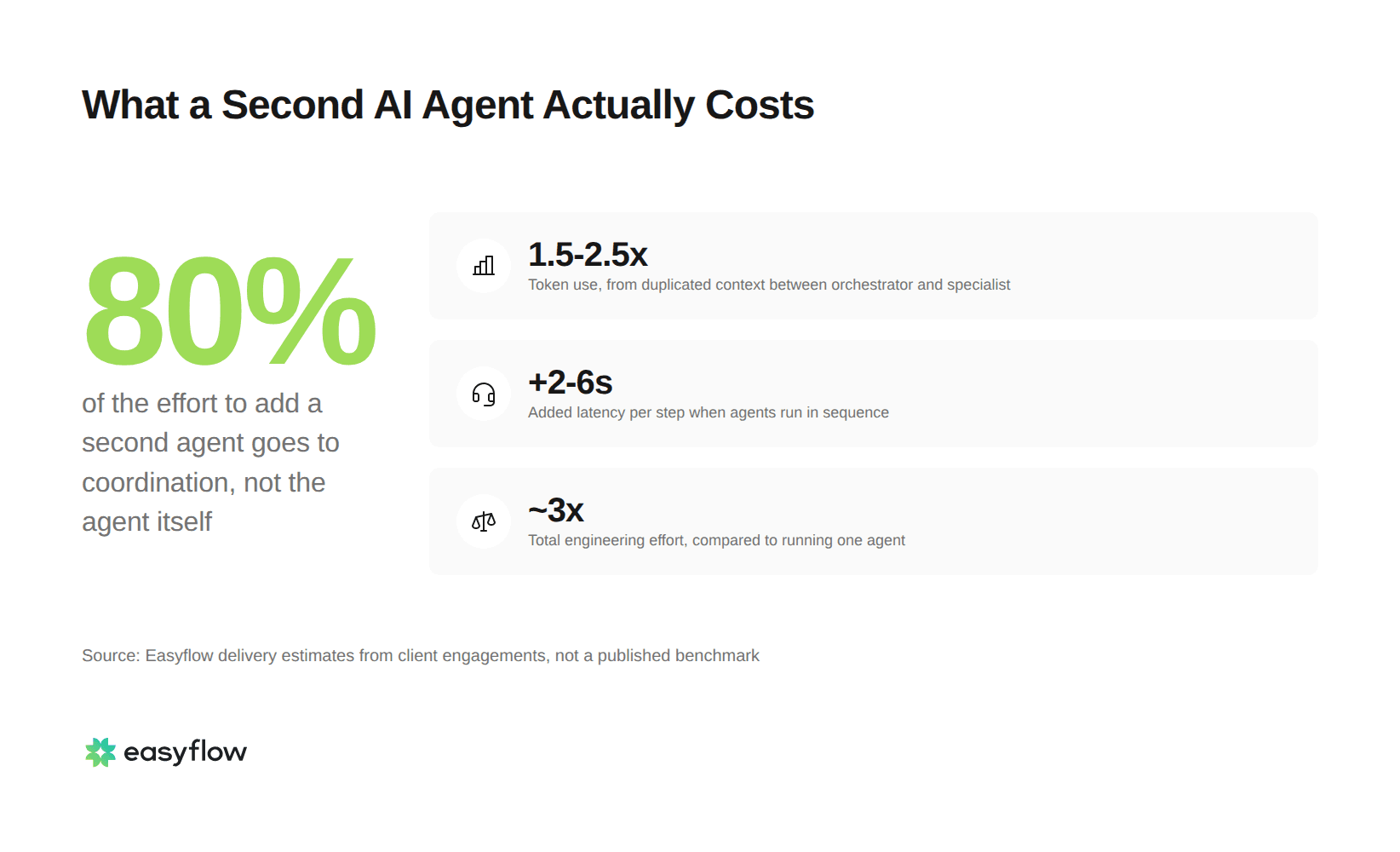
The honest numbers for going from one agent to two, as Dmytro estimates them from delivery work: token consumption rises roughly 1.5 to 2.5 times, because context duplicates when the orchestrator re-reads what the specialist already read. Passing IDs instead of full text, and a cheaper router model, pulls that back down. Latency gains one or two model calls, roughly two to six seconds on sequential steps: noticeable in a live chat, irrelevant in back-office AI workflow automation.
Engineering effort is the number that surprises people. It does not double. It roughly triples, and the distribution surprises teams.
Q: What actually determines the difficulty of moving from one agent to two?
"The second agent itself is about twenty percent of the effort. The easiest part. The other eighty percent is coordination: state, contracts, tracing, handling partial failures, and evals for the whole system together. The test matrix grows fast: now you're testing A, B, A to B, A to B when B is down, A to B with stale state."
Dmytro Savitskyi
His planning rule: budget a month for the coordination layer even if the second agent is written in a week. If that month is not in the budget, do not add the agent, give the first one more tools and revisit later.
A note on these figures: they are delivery estimates from Easyflow's project work and Dmytro's interview, not universal benchmarks. They are useful for planning, but actual cost depends on system count, tool complexity, evaluation coverage, and how much autonomy the agents hold.
What the investment buys, when the earlier signals are present, is the ability to redesign a workflow end to end rather than speed up isolated tasks inside it. McKinsey finds that AI high performers are nearly three times more likely to have fundamentally redesigned workflows as part of their AI deployment. Coordinated agents make that redesign operable: a ticket triaged, resolved, and logged without a human relaying context between tools is a redesigned workflow, not a faster old one.
One variable determines difficulty more than headcount: a company of 80 people with seven integrated systems is harder than one of 400 with two. Complexity lives in the seams, each system being a separate contract, error format, and partial-failure mode. Two systems create one seam; seven create up to twenty-one.
The second agent costs roughly three times the engineering effort of the first, and 80% of that goes to coordination rather than to the agent.
What to Have in Production Before Considering Orchestration at All
Sequencing is where mid-market teams have a genuine advantage: the stack stays small enough that one team understands all of it. This checklist is what should exist before a second agent enters the roadmap, and it doubles as the foundation of agent-native operations, where processes are designed for agents to execute and humans to supervise.
A regression eval set built from production
Forty to sixty real cases pulled from logs, each with a recorded correct answer, run on every prompt, model, or tool change. Not invented workshop scenarios, those are always easier than reality. Every bug found becomes a permanent test case.
Tracing and observability from the start
Bought, not built, installed before the first incident. When agents multiply, per-agent and end-to-end metrics diverge: two agents can each score 95% while the system delivers 70% at the exit, invisible without a through-line metric.
A business baseline
One metric agreed before launch, with the "before" number recorded. One red flag worth keeping verbatim: if the only answer to "is it working?" is "the team likes it," you have a demo, not a system.
An access model that survives a second agent
The common mistake is one wide service account shared by everything; each agent needs its own identity scoped at the tool level, "read deals in its own region," not "access to the CRM." Permissions must not accumulate across a chain of calls, and retrieval must filter by the requesting user's rights inside the query, never in the prompt. Full detail lives in our AI agent security guide.
Accountability wiring
A named owner per agent, an unabridged audit log, and prompts and configs versioned in git, otherwise a decision from a month ago cannot be explained once the prompt has changed. Reversible actions run autonomously; expensive-but-reversible ones run with logging and rollback; irreversible ones, payments, customer messages, deletions, need human confirmation for the first year. One bad case costs more than the labor saved.
Boring infrastructure choices
The buy-versus-build criterion without a platform team is not "what is cheaper" but "what will someone maintain at 2 a.m." Buy anything needing on-call: model access via API, tracing, authentication, prebuilt connectors, ideally through MCP so every agent reuses one interface. Build anything that encodes your process: routing, contracts, business rules, limits, evals. Vendors are weakest there since they do not know your process. Skip the enterprise broker: a Postgres queue, an outbox in the same transaction as the data change, webhooks with idempotency keys, and hourly reconciliation cover mid-market volumes. Kafka at 200 people is copied from companies a hundred times larger.
Requirement | Why it matters before adding a second agent |
|---|---|
Regression eval set | Prevents one agent change from breaking the system |
End-to-end tracing | Shows where a multi-agent workflow failed |
Business baseline | Proves whether orchestration created value |
Scoped access model | Prevents permission accumulation across agents |
Named owner | Makes maintenance accountable |
Versioned prompts and configs | Lets teams explain past decisions |
Idempotency keys | Prevents duplicate external actions |
If the eval set, the trace, and the named owner are missing, that work comes before the second agent, and it takes weeks rather than quarters.
Missing several items is not a verdict against agents, it is the work plan, and it is smaller than it looks when scoped to one process. This mirrors Easyflow's audit-first model: rank layers by ROI, build the highest-value one, prove the numbers, then extend. Where engineering capacity is the gap, an embedded AI engineering squad builds this layer inside your stack.
Conclusion: Build the Seams Before You Add the Next Agent
The pattern underneath every question above is the same one: value in multi-agent orchestration tracks how well the seams between agents are engineered, not how many agents are deployed. Optimizing for agent count buys a coordination bill nobody sized in advance; optimizing for one owned process, a hub that keeps state and logs in a single place, and contracts that fail loudly instead of drifting quietly, buys a system that survives real traffic. Mid-market carries a structural advantage here that enterprise case studies tend to obscure: fewer integrated systems, fewer seams, and a team small enough to hold the whole architecture in its head. The limiting factor was never capital or headcount. It was always sequencing, doing the boring work in the right order before adding the next agent.
Posted by

Kateryna Shykula
Content Producer
What is multi-agent orchestration?
Multi-agent orchestration is the coordination layer that lets several specialized AI agents execute one business process together: routing requests to the right agent, passing validated state between them, handling partial failures, and enforcing permissions. Without that layer, multiple agents are just parallel deployments that happen to touch the same data.
What is the difference between a single AI agent and a multi-agent system?
You have a multi-agent system when at least two independently deployable agents share state on the same business process and something arbitrates between them. If nothing arbitrates, you have parallel single agents. If nothing shares state, you have separate projects. Neither of those needs an orchestration layer.
What is hub-and-spoke orchestration for AI agents?
Hub-and-spoke is a multi-agent system architecture where one dispatcher agent receives every request, decides which specialist to call, and assembles the result. Specialists never talk to each other. State, logs, and permission checks all live in one place, which is why one engineer can trace an entire chain from a single record.
Is mesh architecture useful for mid-market AI agents?
Rarely. Mesh removes the central bottleneck and the single point of failure, but those advantages pay off at throughput mid-market operations do not reach, and the cost is ten separate logs and behaviour that cannot be reproduced. Mesh is genuinely justified when agents belong to different companies or vendors and cannot share a runtime.
How many tools can one AI agent handle?
There is no fixed ceiling, but tool selection tends to degrade somewhere around 25 to 30 tools, and the degradation is visible in logs before it is visible in outcomes. The trigger to split is not the count itself: it is the agent consistently missing on a specific type of request.
How much does multi-agent orchestration cost?
Going from one agent to two raises token consumption roughly 1.5 to 2.5 times, adds two to six seconds of latency on sequential steps, and roughly triples engineering effort. Only about twenty percent of that effort is the second agent; the rest is coordination. These are delivery estimates rather than published benchmarks, and they move with system count and autonomy level.
What should be in production before adding a second AI agent?
A regression eval set built from real production cases, end-to-end tracing, a recorded business baseline, an access model scoped per agent, a named owner, versioned prompts and configs, and idempotency keys on external actions. Missing several of these is not a verdict against agents, it is the work plan.
Why do multi-agent AI systems fail?
Mostly at the seams rather than inside the agents. Two agents writing to one record with no defined owner of the truth, free-text handoffs that silently drop information, retries without idempotency keys, and permissions that accumulate along a chain of calls. Errors also compound: five sequential steps at 95% accuracy deliver 77% at the end.
How should companies test coordinated AI agents?
Measure each agent separately and the whole chain end to end, because those numbers diverge. Run forty to sixty real cases from logs on every prompt, model, or tool change, read twenty live conversations a week by eye, and check the business metric monthly against the baseline recorded before launch.