The People Problem: AI Adoption Challenges and How to Fix Them

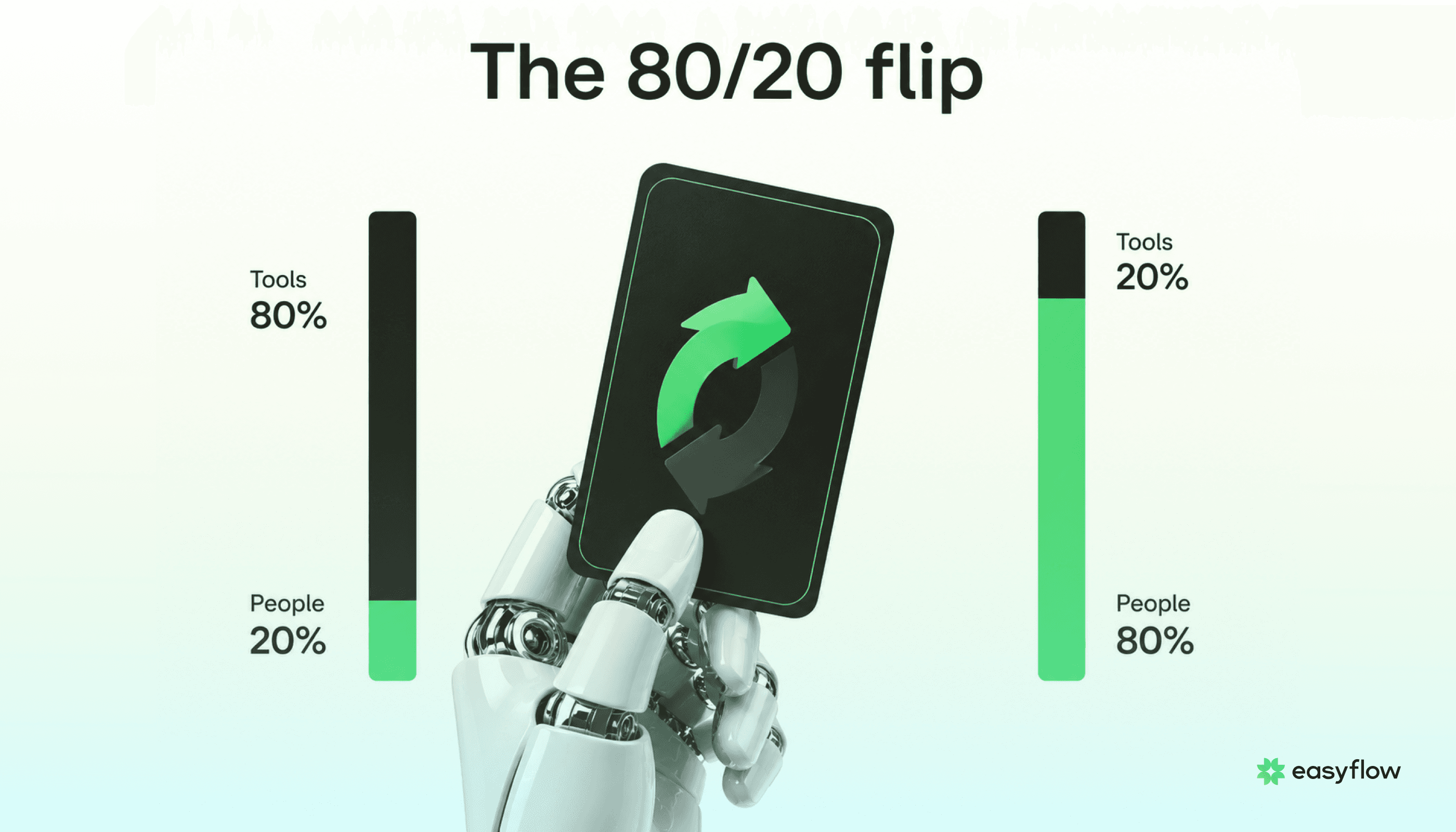
Most companies spend about 80% of their AI budget on tools and only 20% on the people who use them. Those that get results reverse this ratio. More than any specific model or platform, the decision divides firms that are realising ROI from those still awaiting effective adoption.
The numbers back this up plainly. In 2025, MIT's Project NANDA studied over 300 enterprise AI deployments and found that 95% of generative AI pilots delivered no measurable return, despite an estimated $30–40 billion in spending. The report concludes that the failure was not in the models but in how organisations approached their adoption.
Companies still treat AI adoption as a software rollout when it is really a change in how people work. Buying a tool is easy. Getting a team to trust it, build it into their daily tasks, and stick with it is the hard part, and it is the part most companies underfund.
Three pillars of successful AI adoption:
People understand how AI changes their role.
The use cases map to the work they actually do.
Leaders are the ones who model the behaviour of the team.
Fix the people side first, and the tools you already own start to pay off.
What Is AI Adoption in Business?
AI adoption is the process of embedding AI into real business workflows, so teams consistently use it to improve speed, quality, decisions, or cost. It is not the same as buying AI tools or giving people access to ChatGPT or Copilot. Access is the starting line. The adoption of AI is a behaviour change: it happens when the work itself changes, and people trust the output enough to rely on it. Successful enterprise AI adoption shows up as redesigned workflows, not licence counts.
Why AI Adoption Is Not Just a Tooling Problem
Buying an AI tool does not change behaviour. It only creates the possibility of changed behaviour. A licence is permission to change, not the change itself.
Real adoption asks a person to trust a new tool, rebuild a familiar task around it, and keep doing so when the old way still works. That is a human shift, and it does not happen because IT flipped a switch. It is why companies can buy the best model on the market and watch it sit idle.
The numbers highlight just how wide this gap is. WalkMe’s 2025 research revealed that although 79% of executives were confident in meeting their AI goals, only 28% of their employees believed they had sufficient training.
This is why "usage" and "adoption" are not the same word. Usage is one person opening ChatGPT to draft an email. Adoption is a team redesigning a process so AI is built into it and everyone trusts the result enough to rely on it. The distance between the two is the whole problem, and it is a people distance, not a technological one.
The impact of AI depends on people, on workflows, and on trust. The technology is seldom the bottleneck. The best AI models will sit unused if employees are afraid of the tool, don’t trust the results or don’t know how to use it in their day-to-day work.
The AI Adoption Gap: Usage Is Growing, But Impact Is Not
Usage has gone mainstream, but the impact is still questionable in many cases. This is the central puzzle of enterprise AI right now, and Boston Consulting Group named it directly in its December 2025 analysis.
Boston Consulting Group surveyed more than 10,600 workers and found 72% use AI regularly, yet the business value lands with only a small group of firms, the ones that redesigned how work gets done rather than just handing out tools. KPMG's data makes the same point sharper: 93% of leaders reported using or piloting AI, but only 2% saw measurable returns. Widespread activity, almost no impact.
The simple reason is that when you look at behavior and not spending, people try a tool, they get a decent result, and they return to the process they know. There's no manager, there's no shared way, there's no metric around them that makes that experiment a habit. Microsoft’s own research into Copilot was spot on with the instinct: most people said training would help, then skipped it and fumbled their way through trial and error. Experimentation alone rarely leads to adoption.
This is often missed by leaders because they measure the wrong thing. A 60% “active users” dashboard can hide a department at 95% and one at 15%. Logins tell you who can access, not whose work has changed. Only the second number predicts impact.
AI Adoption Metrics: What to Track Instead of Tool Logins
Most enterprise AI adoption dashboards count the wrong things. They track what is easy to pull from the admin panel, licenses, logins, and active users, instead of what predicts impact: changed work. The fix is to swap each weak metric for its behavioral counterpart.
Weak metric | Better adoption metric |
|---|---|
Licenses purchased | % of workflows redesigned around AI |
Tool logins | Active use by role and department |
Active users | Frequency and depth of use in named workflows |
The pilot launched | The pilot moved into daily operations |
Employee sentiment | Hours saved, cycle time reduced, errors reduced |
Strong AI enterprise adoption metrics share one trait: they measure changed work, not granted access. Segment every one of them by team, so a company-wide average cannot hide the departments that are stuck.
The 80/20 Flip: An AI Adoption Strategy That Funds People Before Tools
If the constraint is people, fund the people. That is the entire idea behind the flip.
Most companies do the opposite. Deloitte found that 93% of AI budgets go to technology and just 7% to the behavior and capability change needed to create value. The money goes where it is easy to spend, on licenses, not where the value is actually unlocked, in how people work.
The same research shows what happens when you correct the balance. In a controlled pilot with CIBC, a people-first approach reached 90% adoption and a 10–14% productivity lift by embedding AI into real workflows and getting leaders to drive the change. Same tools other companies already own; the difference was investing in the people using them.
The flip is not about literally spending 80% on training. It is about reordering priorities so the human work comes first:
Start with the workflow, not the tool. Pick three or four processes where AI removes real hours, and teach them to those. A prompt workshop built for engineers is useless to an HR lead.
Make it hands-on. Reading about AI is not using it. People need to write prompts and judge outputs inside their own work, with feedback.
Put leaders first. BCG found that genuine leadership support lifts positive employee sentiment from 15% to 55%, yet only a quarter of frontline workers get it.
Measure depth, not logins. Track which teams have actually changed how they work, and intervene where adoption stalls.
Do this, and experiments stop being one-offs. People build methods and share them, and a colleague saying "this cut my reporting time in half" converts skeptics faster than any mandate.
How to Fix AI Adoption With a People Enablement Program
Enablement is a sequence, not an event. Brief the leaders, train the teams on real work, then turn the best experiments into assets the company keeps: three moves, in exact order.
Run practical AI workshops for real team workflows
Teach to improve the workflow using new tools. Bring one team into a room for a day, take the two or three tasks that eat the most hours, and rebuild them live with AI in the loop. People leave with a method they used that day and a playbook the rest of the team can copy, not a deck they will never reopen.
Use AI hackathons to turn experiments into reusable use cases.
A hackathon converts scattered tinkering into something the organization owns. In a single day, cross-functional teams build real prototypes for real problems, and the loose experiments become catalogued use cases with named owners. This is also where the highest-value opportunities tend to surface: MIT found the biggest verified returns in back-office automation, with savings of $2–10M a year in some cases.
Give leaders a briefing before asking teams to change
Change starts at the top, so leaders go first. A half-day session with the C-suite settles the questions their teams will ask anyway: where AI fits the strategy, what good adoption looks like, how it gets measured, and what each leader will visibly do. Skip it, and leaders announce AI instead of modeling it, which is exactly when the support gap opens.
Mini Case Study: How One Company Reached 60%+ AI Adoption
A mid-sized professional services firm of about 250 people had bought enterprise AI licences and watched adoption flatline near 15%. The story of how it got unstuck is the whole argument in miniature.
Before: the tools were everywhere, and the use was nowhere. People had seen a demo but had no idea how AI would change their own jobs. Managers talked about it without touching it. The only metric was a login count, and it stayed low. All three classic blockers were present at once: fear about what AI meant for roles, a bad first impression from an early tool, and no shared definition of success.
The change: the firm fixed the order. Leadership was briefed first, so the partners agreed on what they were asking for. Then, department workshops rebuilt real tasks, proposal drafting, research, and client reporting, with AI in the loop, and a one-day hackathon turned the best results into a shared toolkit with owners. Adoption was tracked by the team, not as one company average, so stalls got caught early.
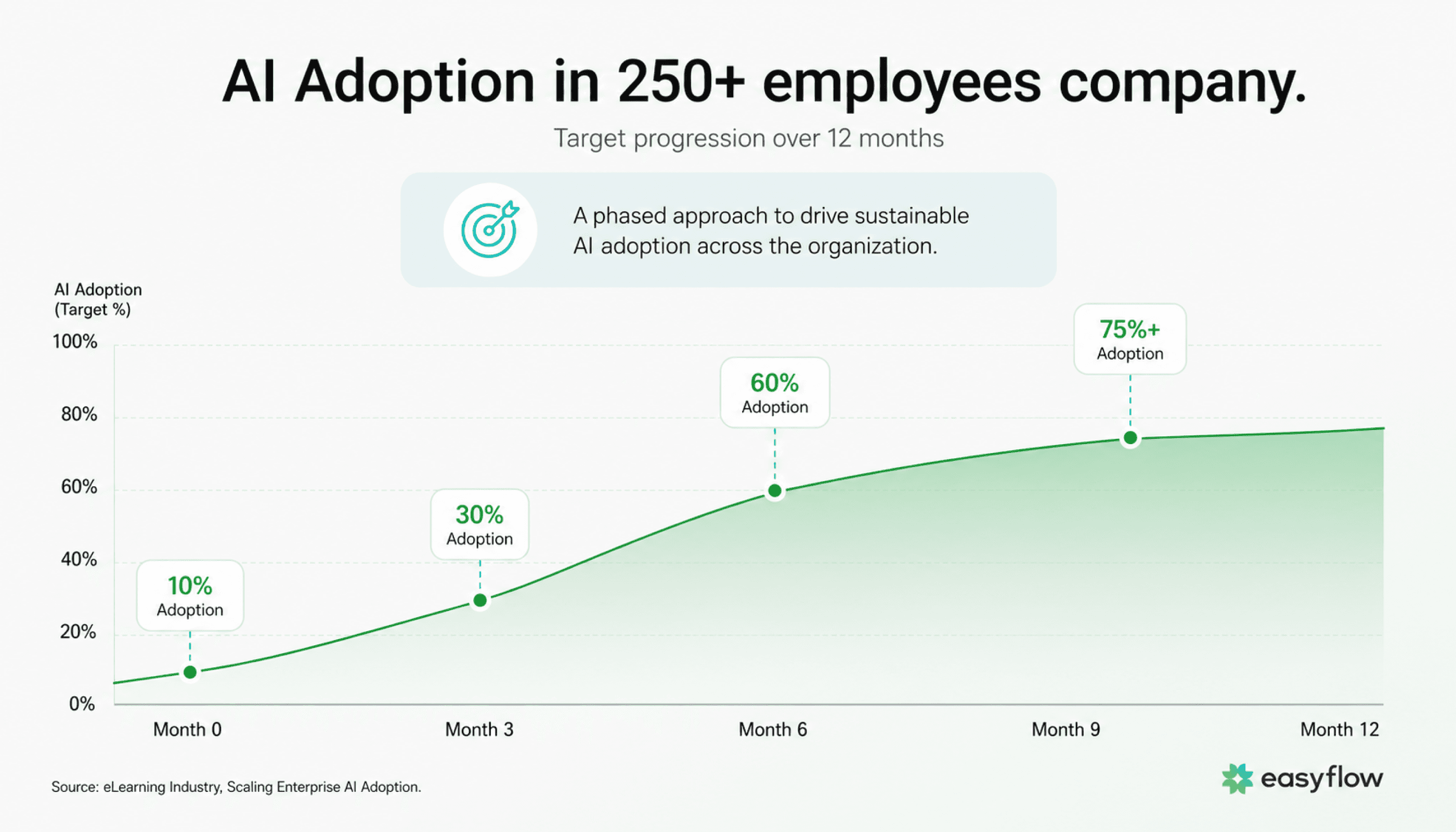
After: adoption passed 60% within two quarters, following the staged climb practitioners describe, from early adopters to roughly 30%, then 60%, then 75%, as proven workflows spread. The use was deep, not cosmetic: named processes ran faster, and the firm could finally point to hours saved rather than a login chart. The decisive move was sequence, enablement before more tools.
Mapping that sequence for your own organization is exactly what a People Readiness briefing covers before you spend on rollout.
What a People Readiness Briefing Should Include
A readiness briefing answers the hard questions before anyone spends money on rollout. It is short, senior, and built to produce a decision.
Which stakeholders should be in the room?
Keep the room small and senior: the executive sponsor who owns the mandate, the budget holder, the person who will run enablement day to day, and one or two internal practitioners who already use AI and know what is realistic. Big committees and managers without sponsors slow the decision-making without improving it.
What questions does leadership need to answer first
Four questions, before any tool is chosen: Which workflows are we targeting? Who owns the outcome? How will we measure adoption beyond logins? What does success look like in 90 days? If there is no clear owner of the outcome, that is the first thing to fix.
How to define outcomes for the first 90 days
This focused approach not only enhances accountability but also sets the stage for long-term success:
Keep results limited and tangible.
Choose two or three workflows.
Set a measurable goal for each hour saved, cycle time, and error rate.
Assign an owner for each.
Determine how progress will be measured.
90 days is enough time to demonstrate real change on a small set of processes and learn what scales.
The 90-Day AI Adoption Roadmap
The same plan, laid out as phases. This is the arc AI enterprise adoption programs follow, and it scales down cleanly to a single department.
Phase | Goal | Output |
|---|---|---|
Days 1–15 | Leadership alignment | Use cases, owners, and metrics agreed |
Days 16–45 | Team enablement | Workflow workshops run |
Days 46–75 | Use case development | Playbooks and prototypes built |
Days 76–90 | Measurement | Adoption report and scale plan |
AI Adoption Checklist for Leaders
A fast diagnostic. Each "no" marks a place where adoption is likely to stall.
Do employees know how AI affects their role? If people cannot describe how it changes their own tasks, they will not change their behavior.
Are use cases tied to real business workflows? A use case that cannot be linked to a process with a number attached is a demo, not adoption.
Are managers prepared to support behavior change? Managers have to use the tools themselves; one who only talks about AI signals that it is optional.
Are adoption metrics connected to business outcomes? Tie adoption to hours saved or errors reduced on named processes, and segment by team so averages do not hide who is stuck.
AI Adoption Challenges: The 3 People Problems Behind Stalled Adoption
Strip away the dashboards, and resistance almost always comes down to three human causes. Preparing for AI adoption means designing for all three from the start.
Fear of irrelevance. People do not adopt a tool they suspect is there to replace them. Tellingly, the countries with the highest AI usage also report the highest anxiety: BCG found 41% of workers worried their role could disappear within a decade. Enablement has to show AI changing the job, not erasing it.
A bad first experience. Many teams remember a tool that hallucinated, broke a workflow, or simply did not fit. That memory outlasts the tool. Good enablement rebuilds trust by starting with a task where AI visibly works.
No definition of success. When no one has said what good looks like and leaders are not aligned, people get mixed signals and default to old habits. It is the most common blocker and the most fixable, which is why the leadership briefing comes first.
These are the real AI adoption challenges, and not one of them is solved by buying a better model. They show up across every sector, though the mix shifts with AI adoption by industry: regulated fields carry more trust and metric concerns, and creative teams more role anxiety.
AI adoption challenge | Why it happens | How to fix it |
|---|---|---|
Low trust in AI outputs | Employees do not understand or verify outputs | Start with low-risk workflows where AI visibly works |
Experiments do not scale | No owner or shared method | Build reusable playbooks with named owners |
Leaders do not model behavior. | AI is announced, not practiced. | Run the executive briefing first |
How Easyflow Helps Companies Improve AI Adoption
Easyflow is an AI transformation agency that works across two tracks, systems and people, and treats the people track as half the job. Tools do not fail. Adoption does. People Enablement is the lowest-friction place to start, and it sets up everything that follows.
AI people readiness briefings
A half-day session that aligns the C-suite on where AI fits the strategy, who owns the outcome, and how adoption gets measured before any rollout. It is the entry point that prevents the leadership gap.
Workflow-based AI workshops
Hands-on, department-specific sessions that rebuild real tasks with AI in the loop, so each team leaves with a method it used that day rather than a generic overview.
AI hackathons and enablement programs
One-day, cross-functional builds that turn scattered experiments into a cataloged set of reusable use cases with owners, where individual tinkering becomes organizational capability.
Throughout, the work is built around knowledge transfer: teams are trained on the systems built with them so they can run and improve them without us. The goal is an organization that is AI-native and self-sufficient.
Final Thoughts: AI Adoption Is a People System
The firms stuck in the 95% did not buy the wrong model. They treated a behavior change like a software install. Every major study of enterprise AI adoption - MIT, BCG, McKinsey, Deloitte, and KPMG - lands on the same conclusion: usage is everywhere, value belongs to the few who invested in their people and redesigned how work gets done.
The 80/20 flip is how you join them. Move the attention from buying more tools to enabling the people who use them. Brief the leaders, train the teams on real work, turn experiments into owned assets, and measure depth by team. Companies that do this in the right order are the ones reporting 60%, 75%, and even 90% adoption while everyone else watches a flat login chart.
So the choice is straightforward: start with the people, and finally give the tools you already own a reason to pay off.
Posted by

Kateryna Shykula
Content Producer
What is the difference between AI usage and AI adoption?
Usage refers to one person using an AI tool to do a task, such as drafting an email. Adoption occurs when a team redesigns a process around AI and trusts the results enough to rely on them. KPMG's 2025 research demonstrates the disparity: 93% of CEOs used or piloted AI, yet only 2% experienced demonstrable results. The usage is simple. Adoption is what produces influence.
How much of an AI budget should go to people versus tools?
Most companies spend roughly 80% on tools and 20% on people; Deloitte put the tech-versus-behavior split at 93% to 7%. The firms seeing returns invert that emphasis. The exact ratio matters less than the principle: fund the enablement, leadership alignment, and workflow redesign that turn tools into changed behavior.
What does a realistic AI adoption rate look like?
Adoption usually climbs in stages rather than jumping to full use, commonly from early adopters to about 30%, then 60%, then 75%+ over roughly a year as proven workflows spread. A healthy target is deep adoption in a few high-value workflows first, measured by hours saved, not a company-wide login average that hides large gaps between teams.
How long does it take to see results from AI enablement?
A readiness briefing takes about 90 minutes, and a first round of workshops and a hackathon can run within a few weeks. Meaningful change on a small set of workflows is realistic inside 90 days if outcomes are defined up front, each workflow has an owner, and adoption is tracked by the team. The first quarter is about proving the model before scaling it.