Top AI Development Companies to Partner With in 2026

The AI development partner you choose for your project determines whether the work ships with governance, knowledge transfer, and a clear path to production or stalls before it goes beyond a promising demo.
This guide lists the top AI development companies operating in 2026, selected on the basis of work that survives production.
According to the Stanford HAI 2026 AI Index Report, organisational adoption of AI has now reached 88% globally, and global corporate AI investment more than doubled in 2025 to reach USD 581.7 billion. Organisations now expect to allocate roughly 5% of their annual business budget to AI, up from 3% in 2025, with 38% already operationalising generative AI use cases at scale.
The capital is moving from experimentation toward execution and measurable results, which raises the stakes of the partner decision considerably.
How We Evaluated the Best AI Development Companies for 2026
The companies on this list pass a filter that reflects the operational realities buyers face once a contract is signed. The market currently includes a meaningful number of agencies that added an AI service line in late 2024 with little more than surface-level familiarity with the technology, which makes a structured evaluation more important than at any prior point in the category.
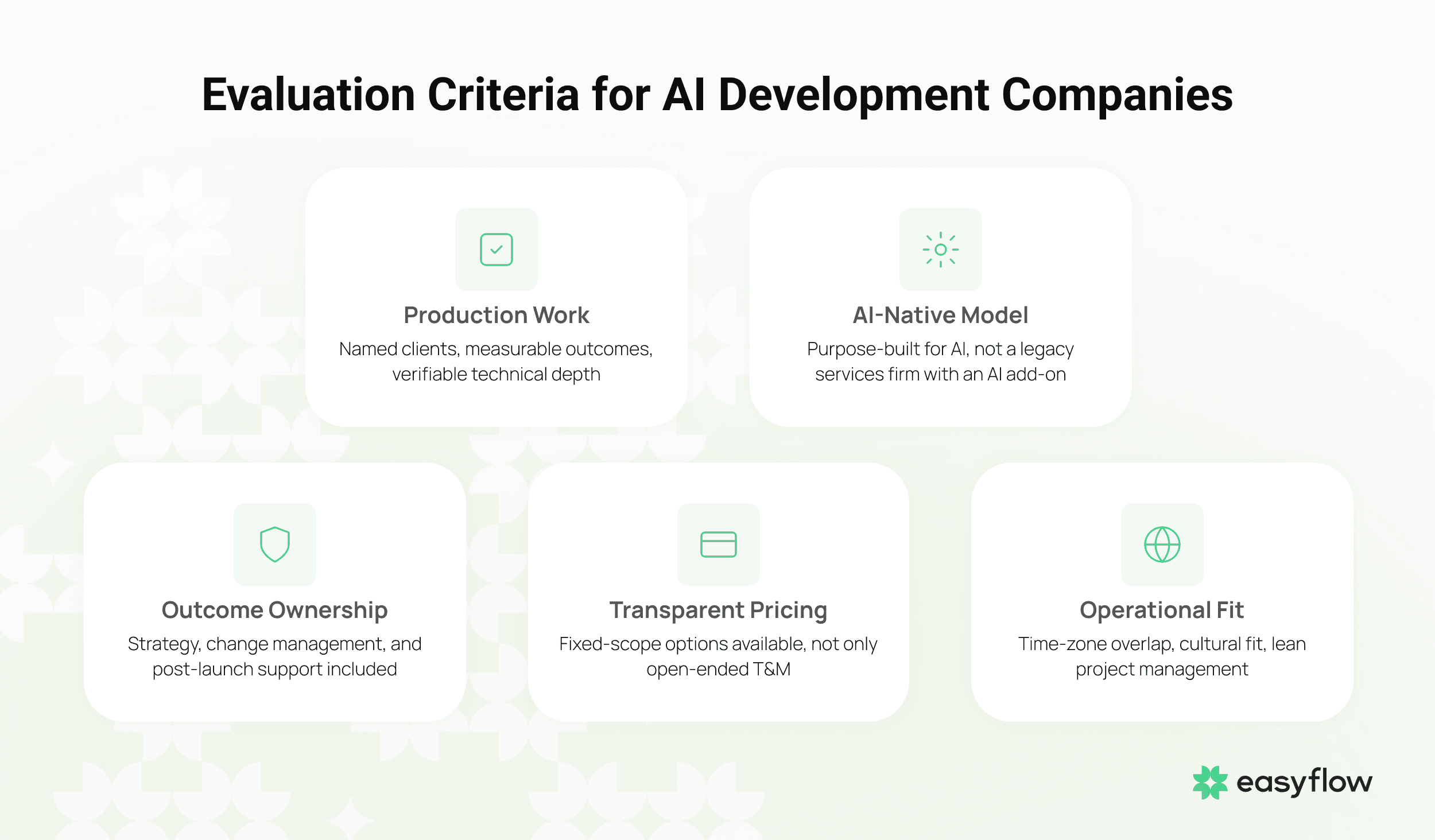
Demonstrated production work. Public case studies with named clients, business outcomes, and enough technical detail for a senior engineer to evaluate the claims independently.
AI-native or AI-first delivery model. Specialist firms purpose-built for AI delivery, rather than generic development shops that have retrofitted an AI practice on top of a legacy services model.
Ownership of outcomes through the production handover. Engagements that include strategy, change management, and post-launch support alongside the code itself, with explicit responsibility for the operating model.
Transparent commercials. Fixed-scope, fixed-price options for work that can be scoped that way, alongside clear retainer structures for ongoing engineering. Vendors who offer only time-and-materials billing typically place the scope risk entirely on the buyer.
Geographic and operational fit for the buyer. Time-zone overlap, cultural fit, and the ability to run a project without 14 layers of project management between the buyer and the actual delivery team.
We excluded the Big Four consultancies running pure strategy engagements; the foundation-model laboratories such as OpenAI, Anthropic, and Google DeepMind; and the platform vendors including AWS Bedrock, Azure AI Foundry, and Databricks. Those categories operate under a different commercial model in which buyers license platforms or buy advice, rather than hire a partner to design and build production systems alongside an internal team.
This guide focuses on the services tier, which is the set of firms a buyer engages to design and ship production AI software, agents, and AI-native operations.
Top 10 AI Development Companies to Consider in 2026
1. Easyflow

Easyflow is an AI transformation agency that embeds full teams of strategists, AI engineers, and trainers into client organisations, operating under a model that is structurally different from a conventional AI development shop. Easyflow runs each engagement as an operating partner that audits readiness, builds the roadmap, executes across product and process layers, and transfers knowledge to the internal team so that the work remains sustainable after the delivery team rotates off.
Four service lines cover the full offering. AI Transformation covers strategy through execution. AI Engineering provides dedicated squads that deliver production-ready AI each sprint. AI Agents ships fixed-price agents from a catalogue or as custom-built engagements. AI Product Development builds MVPs designed for validation before a full production build.
Engagements typically open with an AI audit, then move into an implementation sprint depending on scope and complexity, with the option of ongoing optimisation. Public clients include Spendbase, Remofirst, Jome, and Neusinger.
Best for: Mid-market and growth-stage companies with operational complexity, leadership buy-in for AI, and a 90-day-plus commitment horizon. Strong fit for fintech, logistics, professional services, SaaS, and operations-heavy industries.
Headquarters: Lviv, Ukraine
Engagement model: Fixed-scope, fixed-price AI audit, implementation sprint, and optional governance retainer; engagements are priced as defined scopes.
Core strengths: Operating partner model that embeds strategists, AI engineers, and trainers directly into the client organisation; knowledge transfer built into every deliverable so the internal team can operate the system after handover; full coverage across strategy, engineering, agents, and product development.
2. N-iX

N-iX is a global software engineering company with the AI practice covering more than 50 delivered projects spanning strategy development, MLOps, and generative AI. Service capabilities run from AI readiness assessment and use-case definition through LLM engineering, custom AI agent development, multi-agent orchestration, RAG pipelines, domain-specific fine-tuning, and MLOps pipeline design and implementation.
In March 2026, N-iX earned AWS AI Services Competency status, adding to existing partnerships with AWS, GCP, and Microsoft. N-iX emphasises the continuity of engineering teams across the delivery lifecycle, with the same engineers involved from application development through to post-launch support.
Best for: Enterprises and mid-market organisations that need a senior engineering team with proven AI/ML depth and multi-year delivery experience, particularly for complex engagements that span data engineering, legacy modernisation, and production AI in parallel.
Headquarters: Lviv, Ukraine, with offices and delivery presence across the USA and 25 countries.
Engagement model: Project- and squad-based, with managed services and long-term optimisation retainers.
Core strengths: 50+ delivered AI projects across strategy, MLOps, and generative AI; same-team delivery model from scoping through production handover; deep domain expertise across fintech, healthcare, automotive, retail, and logistics; full AI agent lifecycle coverage.
3. Globant

Globant runs digital and AI services for enterprise clients across Latin America, Europe, and India, with a model that packages capability into pre-built squads under named AI Studios for Conversational AI, Data and AI, and Generative AI.
The firm has a strong reference base in entertainment, finance, and travel, and its global delivery footprint suits enterprise buyers who need a single vendor to operate across multiple regions.
Best for: Enterprises that want a global delivery footprint with named pods of AI talent.
Headquarters: Luxembourg and Buenos Aires, with delivery across more than 30 countries.
Engagement model: Project- and time-based, sized for enterprise programmes.
Core strengths: Pre-built AI Studios spanning Conversational AI, Data and AI, and Generative AI; multi-region delivery capability under a single vendor relationship; long reference base across entertainment, finance, and travel.
4. Simform

Simform is a digital engineering company operating under a co-engineering delivery model in which agile, multi-disciplinary pods embed within client teams. The AI/ML engineering practice spans generative AI, MLOps, data engineering, and computer vision, supported by a proprietary GenAI framework that covers dataOps, governance, LLM integration, RAG, and model monitoring under one delivery structure.
In March 2026, Simform earned Azure Expert MSP status, one of fewer than 105 companies worldwide to hold Microsoft's highest-level managed services recognition, reinforcing the firm's depth in Azure Data and AI deployments alongside its existing AWS Premier Partnership.
Best for: Product-led ISVs and growing enterprises that need embedded engineering teams with strong Azure/AI and data engineering capability, particularly for engagements requiring ongoing product development alongside AI feature delivery.
Headquarters: Orlando, FL, USA, with delivery teams across North America, Europe, and Asia.
Engagement model: Co-engineering pods (squad-based), project-based, and managed services.
Core strengths: Co-engineering delivery model that places agile pods directly inside client teams; Azure Expert MSP status; full AI/ML engineering stack from data pipeline through to model monitoring; strong references across high-tech, fintech, healthcare and life sciences, and supply chain.
5. LeewayHertz

LeewayHertz is one of the most-cited names when buyers search for top custom AI development companies, having built a recognisable practice around generative AI, LLM applications, and AI agents across more than a dozen verticals.
The breadth of the portfolio covers healthcare, fintech, retail, and supply chain, giving the firm genuine cross-industry delivery experience that suits buyers across multiple verticals.
Best for: Companies that want a full-stack AI agency with deep generative AI experience.
Headquarters: San Francisco, CA, USA.
Engagement model: Project-based with a defined minimum engagement.
Core strengths: Recognisable practice in generative AI, LLM applications, and AI agents; full-stack delivery capability; horizontal breadth across more than a dozen verticals including healthcare, fintech, retail, and supply chain.
6. Master of Code Global

Master of Code is a conversational AI specialist with one of the strongest production reference bases in chatbot and voicebot work, including widely-cited deployments for Burger King, Coca-Cola, and Aveda.
The team has been building conversational interfaces since well before generative AI made them mainstream, and this experience shows in the production discipline applied to the work.
Best for: Conversational AI and bot programmes, particularly customer-facing.
Headquarters: Toronto, Canada.
Engagement model: Project-based, structured around conversational AI programme delivery.
Core strengths: Deep conversational AI specialism with widely-cited production deployments including Burger King, Coca-Cola, and Aveda; mature conversation design discipline that predates the generative AI wave; production-grade reliability that comes from years of operating customer-facing bots at scale.
7. Markovate

Markovate has positioned itself in generative AI and AI agent development for the US and Canadian markets, with a portfolio that covers enterprise SaaS, fintech, and healthcare AI products. Public case studies include LLM-powered platforms, RAG applications, and computer vision systems delivered as both standalone products and embedded features.
Best for: Generative AI product builds and LLM application development.
Headquarters: Toronto, Canada.
Engagement model: Project-based, structured around defined product deliverables.
Core strengths: Specialist focus on generative AI and AI agent development for North American buyers; production experience across LLM-powered platforms, RAG applications, and computer vision systems; portfolio depth in enterprise SaaS, fintech, and healthcare AI products.
8. MobiDev

MobiDev is a software engineering company with a strong applied AI practice, especially around computer vision, AI-powered mobile applications, and ML model integration into existing software. The firm has a long Clutch track record and consistent recognition among the top AI software development companies for mid-market work, particularly where the deliverable is a shipping product.
Best for: Mobile and product-led AI builds, including computer vision use cases.
Headquarters: Atlanta, GA, USA, with delivery teams in Eastern Europe.
Engagement model: Project- and squad-based, structured around shipping product deliverables.
Core strengths: Strong applied AI practice in computer vision and AI-powered mobile applications; mature ML model integration capability for existing software products; long Clutch track record in mid-market product engineering.
9. Chetu
Chetu is a custom software development company founded with more than two decades of delivery experience across 40+ industry verticals. The AI practice is structured around the proprietary Track2AI™ framework, which guides clients through eight sequential steps from initial assessment through deployment, giving mid-market and enterprise buyers a repeatable path to AI adoption without requiring deep internal AI expertise to manage the process.
The service catalogue covers generative AI development, computer vision, NLP, machine learning, agentic AI, fraud detection, and AI integration into existing enterprise platforms.
Best for: Startups, SMBs, and mid-market companies seeking to extend their existing engineering team with specialist AI capability, particularly where the buyer has clear requirements and wants execution capacity rather than an operating partner.
Headquarters: Sunrise, FL, USA, with delivery locations across the USA, Europe, and Asia.
Engagement model: Team augmentation and project-based, structured around client-defined tickets and sprint cycles.
Core strengths: Track2AI™ proprietary framework covering eight steps from assessment to deployment; full IP ownership guaranteed contractually; 40+ industry verticals with domain-specific AI solution experience; broad AI service catalogue spanning generative AI, computer vision, NLP, agentic AI, and ML.
10. Persistent Systems

Persistent is an Indian IT services firm with an established AI Lab and a mature MLOps practice, with a reference base that is particularly strong across enterprise software, healthcare, and BFSI.
The firm is useful when a project requires deep integration with existing enterprise systems and a multi-year delivery cadence aligned to a procurement-led purchasing process.
Best for: Enterprise AI integration programmes at scale.
Headquarters: Pune, India.
Engagement model: Enterprise rate cards under time-and-materials.
Core strengths: Established AI Lab and mature MLOps practice; deep system integration capability into existing enterprise platforms; multi-year delivery cadence aligned to enterprise procurement processes; strong references across enterprise software, healthcare, and BFSI.
The top 10 AI development companies listed here cover the full range of buyer needs, from operating partners to specialist engineering firms to team augmentation providers.
Company | Headquarters | Best For | Engagement Model |
|---|---|---|---|
Easyflow | Lviv, Ukraine | Operating partner across strategy & execution | Fixed-scope audit, sprint, retainer |
N-iX | Lviv, Ukraine / USA | Enterprise software engineering with deep AI/ML practice | Project / squad-based |
Globant | Luxembourg | Global delivery with named AI studios | Enterprise project / time-based |
Simform | Orlando, FL, USA | Embedded engineering pods with AI/ML depth | Project / squad-based |
LeewayHertz | San Francisco, CA | Generative AI and full-stack AI builds | Project-based |
Master of Code Global | Toronto, Canada | Conversational AI and bots | Project-based |
Markovate | Toronto, Canada | Generative AI products and LLM apps | Project-based |
MobiDev | Atlanta, GA, USA | AI-powered mobile and computer vision | Project / squad-based |
Chetu | Sunrise, FL, USA | Custom AI software for startups through enterprise | Project / team augmentation |
Persistent Systems | Pune, India | Enterprise AI integration at scale | Enterprise rate card |
Types of AI Development Companies
"AI development company" is a catch-all that covers very different operating models. Matching the right type of firm to the right kind of problem is the single biggest factor in whether a programme lands well or consumes budget without producing return.
The best AI development companies we listed above cover more than one category, so understanding the distinctions before you shortlist will save significant time and money.
Category | What They Build | When to Pick |
|---|---|---|
AI Agent Development | Single-purpose autonomous workflows | Defined process you want automated end-to-end |
Generative AI Development | LLM apps, RAG, copilots, content tools | New product or feature on top of foundation models |
AI App Development | AI inside web or mobile apps | The product team needs AI features in shipping software |
AI Chatbot Development | Chat, voice, support and sales bots | Customer-facing conversational interface |
AI Automation Agencies | Workflow automation with AI calls | Tactical low-code wins across SaaS tools |
Enterprise AI Consulting | Strategy, maturity, governance | Boardroom-level AI strategy and operating model |
AI Agent Development Companies
These firms specialise in single-purpose autonomous workflows across sales, recruitment, marketing, retail and more, with a strong fit for situations where the buyer has a clearly defined process they want automated end-to-end.
The category is expanding rapidly: according to the Capgemini Research Institute report, 2% of organisations have deployed AI agents at scale, 12% at partial scale, 23% have launched pilots, and 61% are actively exploring deployment, with the same report estimating that agentic AI could generate up to USD 450 billion in economic value across surveyed markets by 2028.
Generative AI Development Companies
These firms build applications on top of large language models, including copilots, retrieval-augmented generation systems, content generation tools, and summarisation engines. The category has expanded rapidly since the GPT-4 release in 2023, and most firms now claim it as a competency.
Real differentiation comes from production experience, particularly around hallucination handling, evaluation pipeline construction, and observability of LLM behaviour at scale.
AI App Development Companies
These firms embed AI capability into web or mobile applications, including smart features inside SaaS products, AI copilots, recommendation engines, and voice or image interfaces.
The discipline sits closest to traditional product engineering with an AI specialism layered on top, which means the strongest firms in the category typically have both a product engineering heritage and a more recent AI delivery practice.
AI Chatbot Development Companies
Conversational AI is the focus here: chat, voice, support bots, and sales bots. The category is among the most mature on this list, with production deployments stretching back well before generative AI entered the mainstream.
Building these systems has changed significantly since 2023, but the discipline of conversation design — knowing how to structure dialogue, handle failure states, and maintain coherence across turns — remains comparatively scarce as a production-grade capability.
AI Automation Agencies
These tend to be smaller, low-code shops that build workflow automation using Make, Zapier, or n8n, combined with API calls into AI services layered on top. The category fits tactical wins well, with limitations when the work requires custom integration, formal security review, or governance documentation suitable for regulated industries.
Enterprise AI Consulting Firms
These firms run strategy-first engagements that cover AI maturity assessment, operating model design, and governance frameworks. They produce excellent documentation. Execution is typically handed off to a separate delivery partner, which is where most programmes encounter friction in the strategy-to-production transition.
The strongest top companies in AI development today blend categories rather than operating as pure specialists, combining strategy with execution, agents with integration, and training with delivery. The end-to-end pattern is what separates an operating partner from an execution shop. The buyers who succeed most consistently tend to engage with firms that operate across at least two of the categories above.
How to Pick the Right AI Development Company
The six steps below reflect the practice common to the most successful first AI engagements observed across the market.
Define the Use Case and the Outcome You Are Buying
Before shortlisting, write down the specific business outcome in measurable terms. For example, reducing time-to-quote, automating the majority of tier-1 support tickets, or cutting report generation time. A vendor worth engaging should be able to translate that outcome into a preliminary scope on the first call.
If the conversation stays at the level of exploring AI opportunities without moving toward a defined deliverable, the discovery work will likely need to be repeated once the actual scope emerges, at additional cost.
Review Case Studies That Map to Your Reality
Look for case studies in your industry, at your operational scale, and with measurable business outcomes. A useful exercise on the first call is to ask each vendor to walk through a project delivered in your sector at a comparable company size, covering the architecture, timeline, and key decisions made along the way. How a vendor responds to that request tends to be as informative as the case study itself.
Assess Technical Depth and Industry Experience
Ask to meet the senior engineer who will lead delivery, not only the account manager who signs the contract. A 30-minute technical conversation can reveal more about capability than a 90-minute pitch deck. Willingness to put the delivery team in front of the buyer early is a reasonable indicator of how the engagement itself will be staffed.
Start with an AI Readiness Audit
Reputable firms gate the first engagement behind a low-cost, fixed-scope readiness assessment, which is how Easyflow opens its commercial relationship. The deliverable is a prioritised use-case map with an ROI model for each candidate use case, which gives the buyer clarity on what is worth doing before committing to a larger programme.
The audit also functions as the most cost-effective way to evaluate vendor fit before the relationship becomes expensive to unwind.
Validate the Idea with a Proof of Concept
For new use cases that carry technical or commercial risk, a 3–6 week proof of concept contains that risk while demonstrating measurable value. The output of the PoC should be a working prototype tested against real data, with measurable performance against a defined success metric. Whether a vendor is willing to deliver a fixed-price PoC is itself a useful data point about how they approach scoped, accountable delivery.
Agree on Delivery, Security, and Long-Term Support
Before signing, lock down the scope and acceptance criteria, milestone and payment triggers, security review process for regulated industries, intellectual property ownership of code and trained models, support and SLA terms post-delivery, and the knowledge transfer plan that ensures the internal team can operate the system after handover. A vendor comfortable with that level of contractual clarity is generally one that expects to still be in the relationship after the launch event.
How AI Development Companies Price Their Work in 2026
The commercial structure across the top AI development companies in 2026 varies widely, ranging from compact single-process agents at the lower end through to enterprise transformation programmes that run over a 6-to-12-month delivery window at the upper end. Three pricing models dominate the market, and the right model depends on the shape, scope clarity, and risk profile of the specific project.
Pricing Model | Typical Use | What It Suits |
|---|---|---|
Fixed-scope, fixed-price | Audits, PoCs, agents, defined sprints | Predictable buyer-side budget, vendor carries scope risk |
Squad-based retainer | Ongoing engineering, evolving scope | Defined team for a defined period, usually 3+ months |
Time-and-materials | Open-ended or large enterprise work | Flexible scope, common at IT services firms at enterprise scale |
Typical Pricing Models
Three pricing models dominate the market, each suited to a different shape of work.
Fixed-scope, fixed-price arrangements suit audits, proofs of concept, agents, and well-defined sprints, with the buyer receiving cost predictability while the vendor carries the scope risk.
Squad-based monthly retainers fit ongoing engineering work where the scope evolves over time, with the buyer paying for a defined team for a defined period of typically three months or longer.
Time-and-materials hourly billing is the dominant model at large IT services firms and is appropriate for open-ended enterprise work, though it is less suitable for first engagements where the scope can be defined upfront with reasonable confidence.
What Impacts AI Development Cost
The biggest cost drivers across AI engagements include:
Model complexity (using off-the-shelf APIs versus building custom fine-tuned models).
Data work (clean public data versus messy proprietary data that requires substantial engineering before training).
Integration scope (a single SaaS platform versus a legacy enterprise resource planning system).
Regulatory burden (a consumer application versus a healthcare or financial services use case).
Ongoing operations (model monitoring, retraining, and drift detection over the life of the system).
A single-process agent and a full enterprise transformation programme sit at very different points on this complexity curve, and the budget should reflect that complexity.
Why Starting with a PoC Reduces Risk
Across the top companies for AI development services in 2026, the observable pattern is that buyers who start with a low-cost audit or proof of concept and use the result to gate the larger spend deliver better outcomes.
The recoverable cost of a wrong PoC is a small fraction of the unrecoverable cost of a wrong transformation programme. The audit-first sequence also creates internal alignment, since the use-case map is something the CFO and the COO can argue about using real numbers rather than abstract assertions about potential value.
Red Flags When Hiring an AI Development Company
The warning signs below are common patterns in engagements that produced poor outcomes for the buyer. Spotting any one of them early in the procurement process is worth taking seriously.
Vague pricing on a defined scope. When the answer 'it depends' extends past the second call, the vendor either lacks a scoping process or has chosen to treat the opportunity as low-priority.
The senior on the sales call never appears again. Bait-and-switch staffing remains the single most common complaint in engagement post-mortems across the category.
No security or governance answer for regulated industries. A serious vendor for healthcare, fintech, or legal use cases will have SOC 2, ISO 27001, or equivalent certification on day one, and hand-waving in this area is disqualifying.
No clear MLOps story for production deployment. Production deployment is the stage where most AI projects stall, and the absence of a defined deployment, monitoring, and retraining approach means the project will plateau at PoC.
No retainer or post-launch support model. The build-and-vanish pattern fits poorly with the realities of AI systems, where models drift, prompts age, integrations break, and evaluation pipelines require continued maintenance to remain reliable.
Pressure to sign within a week. Enterprise-grade buyers operate on procurement cycles that comfortably exceed one week, and any vendor running the urgency play is optimising for their own pipeline rather than the buyer's outcome.
Generic case studies. When a case study mentions a leading retailer without naming the client or providing measurable outcomes, it offers little useful signal for evaluation purposes.
What You Get from a Top AI Development Partner
Buyers engage one of the best AI development companies instead of hiring an individual contractor or building entirely in-house primarily to reduce risk and compress time. The structural advantages of an established partner remain meaningful even in a market where AI talent has become more accessible than it was 18 months ago.
Access to Scarce Talent
Senior AI engineers and ML specialists remain difficult to hire and expensive to retain, and an established AI development partner provides immediate access to the senior team without the multi-month recruiting cycle.
Faster Time to First Value
A vendor operating with an established delivery method can ship a PoC in weeks. While the internal alternative typically starts with a hiring round that runs several months before any technical work begins.
Lower Delivery Risk
Experienced AI software development companies carry accumulated delivery experience that internal teams building their first AI system simply do not have yet. This includes knowledge of where integrations tend to break, which model architectures struggle in particular conditions, and which use cases that look strong in scoping fail when they meet real production traffic.
Capacity That Scales
Engagement size flexes with the requirements, from a small squad for an MVP through to a larger team for a full transformation programme. There is no hiring or offboarding overhead on the buyer side.
Ongoing Optimisation Post-Launch
Retainer models keep the delivery team available for tuning, monitoring, and iteration as the production system meets real users and the operating context evolves over the first 12 months.
For first AI programmes, the risk-adjusted cost of an experienced partner typically sits well below the cost of building internal capability from scratch, particularly across the first 12–18 months.
Why Choose Easyflow for AI Development
Selecting the right AI development partner is about bringing these questions into conversation: defined scope, senior staffing through delivery, transparent commercials, security and governance evidence, post-launch support, and a knowledge transfer plan that leaves the internal team capable of operating the system independently.
Easyflow is built around exactly those requirements. The offer spans AI transformation strategy, engineering squads, purpose-built AI agents, and product development, covering the full path from initial assessment to a system in production.
If you are ready to move forward with AI, get in touch and we will find the right starting point together.
Posted by

Viktoriia Pyvovar
Content Writer
What are the top AI development companies in 2026?
The leading firms in the category for 2026 include Easyflow, N-iX, Globant, Simform, LeewayHertz, Master of Code Global, Markovate, MobiDev, Chetu, and Persistent Systems. The most appropriate partner depends on the shape of the engagement, with different firms suited to operating-partner work, enterprise software engineering, embedded co-engineering, conversational AI, generative AI product builds, and team augmentation respectively. Fit-for-purpose matters more than the rank position itself for any given buyer.
What budget should I plan for an AI project in 2026?
A defined-scope audit typically sits in the low five-figure range, a first proof of concept or single AI agent sits in the low to mid five figures, a focused implementation sprint covering one to three processes runs into the higher five-figure or low six-figure range, and full enterprise transformation programmes run into six and seven figures over a 6–12 month delivery window. Most buyers start with the audit and let the result determine the appropriate size of the next commitment.
How long does an AI development project take?
A discovery audit fits within a 30-day window, a standalone agent ships in 2–6 weeks, a focused implementation sprint takes 4–8 weeks, and a full transformation programme runs 3–12 months depending on scope and the number of processes involved in the delivery.
Should I hire an AI consultant or an AI development company?
A consultant produces strategy documentation, while a development company ships software. An operating partner can do both functions while remaining engaged through the production handover and into the early operating period. For first AI programmes, many buyers find it easier to manage a single partner that owns both strategy and delivery rather than coordinating across two vendors with separate scopes and incentives.