Top Generative AI Development Companies in 2026: Ranked Guide

Plenty of generative AI budgets in 2026 are paying for pilots that stall before they ever reach users. When MIT's NANDA initiative looked at 300 public deployments, it found that 95% of enterprise generative AI pilots produce no measurable return on the P&L. The model itself is almost never the problem. What breaks projects is messy data, weak integration into real workflows, and the simple fact that nobody inside the company owns the result.
So the partner you pick matters more than the model you pick. Below is a ranked look at the top generative AI development companies working in 2026: how we chose them, how they compare side by side, what each one actually builds, and where each one is a poor fit.
Quick Summary: Generative AI Development Companies in 2026
In 2026, the top generative AI development companies deploy LLM, RAG, copilot, and AI agent systems into production for businesses.
Easyflow is best suited for companies that need an operating partner for GenAI workflow automation and AI transformation.
N-iX, Simform, and Persistent Systems are stronger fits for enterprise-scale AI engineering and integration.
Markovate, LeewayHertz, and MobiDev are strong options for GenAI product development and LLM applications.
Master of Code Global is the specialist pick for conversational AI and customer-facing bots.
Buyers should evaluate GenAI vendors by production experience, RAG expertise, governance, integrations, and post-launch support.
How We Ranked the Leading GenAI Development Partners
The category filled up fast. A lot of agencies bolted on a generative AI service line in late 2024 with thin delivery behind it, so a structured filter matters. We scored each candidate on six things: real LLM and generative AI work backed by named case studies; the ability to ship production systems rather than demos; depth in RAG, vector databases, and enterprise knowledge systems; verifiable client results across more than one industry; security, compliance, and AI governance practice; and ongoing support once the system is live.
A few categories sit outside this list on purpose. We left out the foundation-model labs such as OpenAI, Anthropic, and Google DeepMind, plus platform vendors like AWS Bedrock and Azure AI Foundry. They sell licenses or advice, not a team that builds production systems alongside yours, and that build-with-you tier is what this guide is about.
GenAI Development Companies Compared at a Glance
Company | Best for | Core GenAI services | Best-fit clients | Pricing fit | Key strength |
|---|---|---|---|---|---|
Easyflow | Operating partner across strategy and execution | AI transformation, engineering squads, agents, product dev | Mid-market, growth-stage, operations-heavy | Fixed-scope audit, sprint, retainer | Embeds strategists, engineers, trainers with knowledge transfer |
N-iX | Enterprise engineering with deep AI/ML | LLM engineering, RAG pipelines, agents, MLOps | Enterprise, complex multi-year programmes | Project / squad, enterprise scale | 50+ delivered AI projects, same-team delivery |
LeewayHertz | Full-stack generative AI and LLM apps | Generative AI, LLM apps, AI agents | Cross-industry, full-stack builds | Project-based, defined minimum | Recognisable GenAI practice across 12+ verticals |
Markovate | Generative AI products and LLM apps | LLM platforms, RAG apps, computer vision | North American SaaS, fintech, healthcare | Project-based, product-scoped | Product-focused GenAI delivery |
Master of Code Global | Conversational AI and bots | Chatbots, voicebots, conversation design | Customer-facing conversational programmes | Project-based, programme-scoped | Production chatbot depth at scale |
Simform | Embedded pods with AI/ML depth | Generative AI, MLOps, data engineering, monitoring | Product-led ISVs, growing enterprises | Project / squad, managed services | Co-engineering pods, Azure Expert MSP |
Globant | Global delivery with named AI studios | Conversational AI, Data and AI, GenAI studios | Multi-region enterprise programmes | Enterprise project / time-based | Single vendor across 30+ countries |
MobiDev | AI-powered mobile and computer vision | Computer vision, mobile AI, ML integration | Product and mobile builds, mid-market | Project / squad, product-scoped | Applied AI in CV and mobile |
Chetu | Custom AI software, SMB to enterprise | Generative AI, NLP, agentic AI, integration | Teams extending in-house engineering | Project / team augmentation | Track2AI framework, full IP ownership |
Persistent Systems | Enterprise AI integration at scale | MLOps, enterprise integration, modernisation | Large enterprises, BFSI, healthcare | Enterprise rate card, T&M | AI Lab and mature MLOps practice |
Before the detailed profiles, here is how the ten firms line up across the parameters buyers ask about most. Use it to shortlist, then read the profiles for the firms that fit.

The Top 10 Generative AI Development Companies in 2026
Each profile below follows the same template so you can compare them fairly: what the firm is best for, its core services, key strengths, industries, engagement model, why buyers choose it, and where it may fall short.
1. Easyflow
Easyflow is an AI transformation agency that drops full teams of strategists, AI engineers, and trainers straight into the client's organization. Instead of behaving like a typical build shop, it works as an operating partner: it audits readiness, sets the roadmap, executes across product and process, and hands the knowledge over so the system keeps running after the team leaves. Public clients include Spendbase, Remofirst, Jome, and Neusinger.
Best for: Companies that want an operating partner across strategy, workflow redesign, AI engineering, and team enablement.
Core services: AI Transformation, AI Engineering squads, AI Agents, and AI Product Development, spanning RAG systems, LLM applications, and workflow automation.
Key strengths: Operating-partner model with embedded strategists, engineers, and trainers; knowledge transfer baked into every deliverable; coverage from strategy through production.
Industries: Fintech, logistics, professional services, SaaS, and other operations-heavy sectors.
Engagement model: Fixed-scope, fixed-price AI audit, then an implementation sprint, with an optional governance retainer.
Why choose them: You get strategy and execution under one roof, plus a team that trains your people instead of leaving you dependent on the vendor.
Potential limitations: Easyflow is best suited for companies that need an operating partner across strategy, workflow redesign, AI engineering, and enablement. It may be less relevant for buyers looking only for low-cost staff augmentation or a narrow one-off chatbot build.
2. N-iX
N-iX is a global software engineering firm whose AI practice already covers 50-plus delivered projects across strategy, MLOps, and generative AI. The work runs from readiness assessment through LLM engineering, custom agents, multi-agent orchestration, RAG pipelines, and fine-tuning. In March 2026, it added AWS AI Services Competency status to existing partnerships with AWS, GCP, and Microsoft.
Best for: Enterprises and mid-market firms that need senior engineering muscle with multi-year AI/ML delivery behind it.
Core services: LLM engineering, RAG pipelines, agent and multi-agent development, fine-tuning, MLOps.
Key strengths: 50+ delivered AI projects; the same engineers from scoping through to handover; cloud competencies across three hyperscalers.
Industries: Fintech, healthcare, automotive, retail, logistics.
Engagement model: Project- and squad-based, with managed services and optimization retainers.
Why choose them: A large, senior bench that can run data engineering, legacy modernization, and production AI in parallel.
Potential limitations: The enterprise delivery model can be heavier than a small team needs. Buyers after a quick, low-cost single-agent build may find a leaner specialist a better match.
3. LeewayHertz
LeewayHertz comes up often when buyers search for top generative AI development services companies. It has built a recognizable practice in generative AI, LLM applications, and AI agents across more than a dozen verticals, with portfolio depth in healthcare, fintech, retail, and supply chain.
Best for: Companies that want a full-stack generative AI agency rather than a narrow specialist.
Core services: Generative AI development, LLM applications, AI agents.
Key strengths: Established GenAI and LLM practice; full-stack delivery; broad horizontal coverage.
Industries: Healthcare, fintech, retail, supply chain.
Engagement model: Project-based with a defined minimum engagement.
Why choose them: One firm can cover a wide spread of generative AI needs without you stitching together several vendors.
Potential limitations: Breadth can come at the cost of deep specialism in any single niche. For a highly regulated or unusual domain, a focused firm may go deeper.
4. Markovate
Markovate concentrates on generative AI and AI agent development for the US and Canadian markets. Its portfolio spans enterprise SaaS, fintech, and healthcare, with public case studies covering LLM-powered platforms, RAG applications, and computer vision delivered as both standalone products and embedded features.
Best for: Generative AI product builds and LLM application development.
Core services: LLM platforms, RAG applications, computer vision, AI agents.
Key strengths: Product-focused GenAI delivery; hands-on experience across LLM, RAG, and CV; depth in SaaS, fintech, and healthcare.
Industries: Enterprise SaaS, fintech, healthcare.
Engagement model: Project-based, scoped around defined product deliverables.
Why choose them: A product mindset that suits buyers shipping a generative AI feature or standalone product.
Potential limitations: Focus on North American buyers and product builds means it's a weaker fit for large multi-region transformation programs.
5. Master of Code Global
Master of Code is a conversational AI specialist with one of the strongest production track records in chatbot and voicebot work. Widely-cited deployments include Burger King, Coca-Cola, and Aveda. The team was designing conversational interfaces well before generative AI went mainstream, and that discipline shows in how reliably the systems run.
Best for: Conversational AI and bot programs, especially customer-facing ones.
Core services: Chatbots, voicebots, conversation design, and generative conversational AI.
Key strengths: Deep conversational specialism; mature conversation design; production reliability at scale.
Industries: Retail, QSR, consumer brands, customer service.
Engagement model: Project-based, structured around conversational AI program delivery.
Why choose them: Few firms match its depth in customer-facing conversational systems.
Potential limitations: The conversational focus is narrower than a full-stack GenAI build. For RAG knowledge systems or product engineering, a broader firm fits better.
6. Simform
Simform runs a co-engineering model where agile, cross-functional pods embed inside client teams. Its AI/ML practice covers generative AI, MLOps, data engineering, and computer vision, backed by a proprietary GenAI framework for DataOps, governance, LLM integration, RAG, and model monitoring. The firm earned Azure Expert MSP status in March 2026.
Best for: Product-led ISVs and growing enterprises that want embedded teams strong in Azure, AI, and data engineering.
Core services: Generative AI, MLOps, data engineering, model monitoring, RAG.
Key strengths: Embedded co-engineering pods; Azure Expert MSP; a full stack from data pipeline to monitoring.
Industries: High-tech, fintech, healthcare and life sciences, and supply chain.
Engagement model: Co-engineering pods, project-based, and managed services.
Why choose them: Strong when ongoing product development needs to run alongside AI feature delivery.
Potential limitations: The embedded-pod model assumes an existing engineering culture. Teams without one may need more structure than a co-engineering setup provides.
7. Globant
Globant delivers digital and AI services to enterprise clients across Latin America, Europe, and India. It packages capability into pre-built squads under named studios for Conversational AI, Data and AI, and Generative AI, with a long reference base in entertainment, finance, and travel.
Best for: Enterprises that want a global delivery footprint with named pods of AI talent.
Core services: Conversational AI, Data and AI, generative AI studios.
Key strengths: Named GenAI studios; multi-region delivery under one contract; deep enterprise references.
Industries: Entertainment, finance, travel, and broader enterprise.
Engagement model: Project- and time-based, sized for enterprise programs.
Why choose them: A single vendor that can operate across many regions at once.
Potential limitations: Enterprise scale and process can mean more project management between you and the build team. Smaller buyers may prefer a flatter setup.
8. MobiDev
MobiDev is a software engineering company with a strong applied AI practice in computer vision, AI-powered mobile apps, and ML integration into existing software. A long Clutch record and steady mid-market recognition make it a dependable pick when the deliverable is a shipping product.
Best for: Mobile and product-led AI builds, including computer vision.
Core services: Computer vision, mobile AI, ML model integration.
Key strengths: Applied AI in CV and mobile; mature ML integration into live products; long Clutch record.
Industries: Mid-market product companies across several sectors.
Engagement model: Project- and squad-based, around shipping deliverables.
Why choose them: A safe choice when the goal is AI features inside a real, shipping application.
Potential limitations: Strength in CV and mobile means it's a lighter fit for large-scale enterprise RAG or pure LLM platform work.
9. Chetu
Chetu is a custom software firm with more than two decades of delivery across 40-plus verticals. Its AI practice runs on the proprietary Track2AI framework, an eight-step path from assessment to deployment. The catalogue covers generative AI, computer vision, NLP, machine learning, agentic AI, and AI integration into existing platforms.
Best for: Startups, SMBs, and mid-market firms extending an in-house engineering team with specialist AI capabilities.
Core services: Generative AI, NLP, agentic AI, computer vision, AI integration.
Key strengths: Track2AI framework; contractual full IP ownership; 40+ verticals; broad service catalog.
Industries: 40+ verticals, from SMB to enterprise.
Engagement model: Team augmentation and project-based, around client-defined tickets and sprints.
Why choose them: Useful when you have clear requirements and want execution capacity rather than an operating partner.
Potential limitations: The augmentation model expects the buyer to own strategy and direction. Companies wanting a partner to define the roadmap will need that elsewhere.
10. Persistent Systems
Persistent is an Indian IT services firm with an established AI Lab and a mature MLOps practice. Its references run strongest across enterprise software, healthcare, and BFSI. The firm fits work that needs deep integration with existing enterprise systems on a multi-year, procurement-led cadence.
Best for: Enterprise AI integration programs at scale.
Core services: MLOps, enterprise AI integration, system modernisation.
Key strengths: Established AI Lab and mature MLOps; deep system integration; multi-year delivery aligned to procurement.
Industries: Enterprise software, healthcare, BFSI.
Engagement model: Enterprise rate cards under time-and-materials.
Why choose them: Well-suited to large, integration-heavy programs that run over several years.
Potential limitations: The procurement-led, T&M model and enterprise scale suit large buyers. It's a poor match for a fast, fixed-price build for a smaller team.
GenAI Companies Matched to Common Use Cases
Rank order matters less than fit. Here's how the shortlist maps onto the work buyers most often need done.
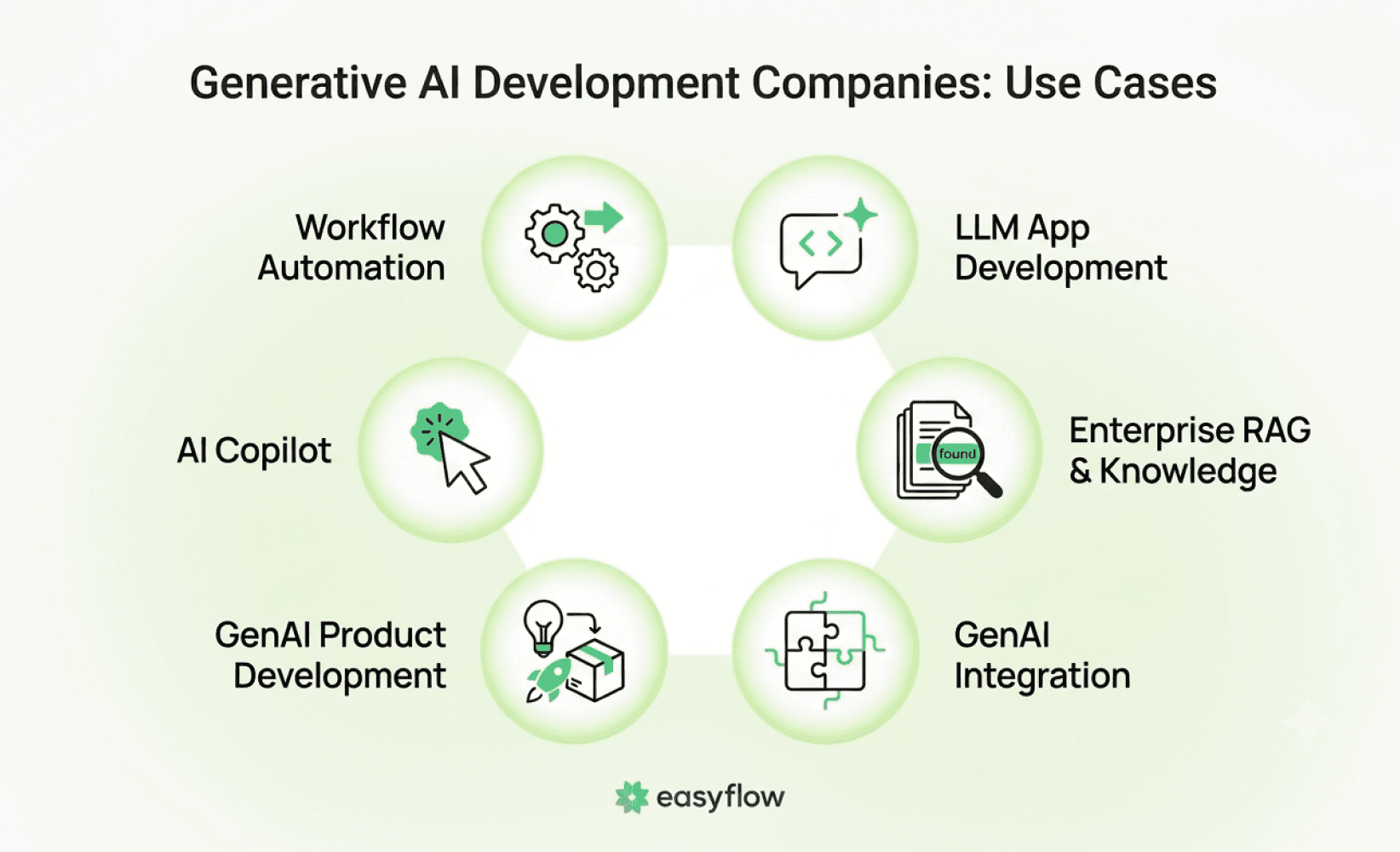
Generative AI workflow automation: Easyflow, for end-to-end process redesign with embedded agents, and Chetu, where the buyer already has clear requirements.
LLM application development: Markovate and LeewayHertz, both with production LLM platforms in their portfolios.
Enterprise RAG and knowledge assistants: N-iX and Simform, given their depth in retrieval pipelines, data engineering, and governance.
AI copilot development: Easyflow and Globant for copilots embedded into existing products and workflows.
Generative AI product development: Easyflow and MobiDev for MVPs and shipping AI-native products.
GenAI integration with business tools: Easyflow and Persistent Systems, for wiring generative AI into CRM, ERP, and internal systems.
What Do Generative AI Development Companies Actually Build?
The category covers a wide spread of work. Knowing the pieces helps you scope an engagement before you start calling vendors.
Generative AI Strategy and Consulting
Spotting and prioritizing use cases, then building a roadmap with an ROI model attached to each one. This is where operating partners separate from pure execution shops, because a strategy with no execution just becomes a slide deck nobody acts on.
LLM Application Development
Building applications on top of large language models: copilots, summarization engines, content tools, and domain-specific assistants, plus the evaluation and guardrail work that keeps them trustworthy.
Retrieval-Augmented Generation / RAG Development
Wiring a model into an organization's own data through embeddings, vector databases, and retrieval pipelines so answers come from current source material instead of the model's training data.
AI Copilot Development
Putting generative assistance directly inside the tools people already use, so they get drafts, suggestions, and answers without switching context.
Custom GPT and AI Assistant Development
Purpose-built assistants tuned to a function, brand voice, or knowledge base, often rolled out across support, sales, or internal operations.
Generative AI Integration with Existing Software
Connecting generative AI into CRM, ERP, ticketing, and communication tools so it runs inside live workflows rather than off to the side.
Prompt Engineering and LLM Optimization
Designing, testing, and versioning prompts, plus the evaluation harness that measures output quality and catches regressions before users hit them.
Fine-Tuning and Model Customization
Adapting a base model to domain language, format rules, or task-specific behavior when retrieval alone won't get you there.
AI Agent and Workflow Automation
Single-purpose autonomous workflows that run a defined process end to end, from data extraction through validation to system updates and reporting.
GenAI Monitoring, Maintenance, and Support
Observability, drift detection, cost monitoring, and ongoing tuning that keep a live system accurate and affordable as data and usage shift.
When Does It Make Sense to Hire a GenAI Development Company?
Some situations call for a specialist partner rather than an internal build or an off-the-shelf tool.
You Need to Build an LLM-Powered Product
When generative AI sits at the core of a product you're shipping, you need production engineering discipline, not a prototype that buckles under real traffic.
Your Team Works with Large Volumes of Unstructured Data
Documents, transcripts, tickets, and emails are exactly where generative AI earns its keep, but pulling reliable value from them takes retrieval and evaluation skills most internal teams haven't built yet.
You Need a Knowledge Assistant or RAG System
An assistant that stays accurate as your data changes is a retrieval and governance problem first. A specialist has solved that before and won't learn it on your budget.
Your Existing Automation Tools Cannot Handle Context
Once Zapier or Make hit their ceiling on conditional logic, unstructured data, or exceptions, a generative AI development company can build the custom layer those tools can't.
You Need Secure GenAI Integration into Business Workflows
Putting generative AI into live CRM, ERP, and communication systems under real security and compliance constraints is exactly where specialist experience pays off.
How to Pick the Right GenAI Development Partner
Choosing from a list of top generative AI development companies is a structured decision, not a coin flip. Six steps cut the risk.
1) Start from the Business Problem
Lead with the outcome. A vendor who asks what you're trying to achieve before recommending an architecture is worth more than one who shows up with a fixed stack hunting for a place to use it.
2) Check Case Studies in Your Domain
Look for case studies in your sector with named results. A retail personalization engine tells you little about a firm's fitness for a regulated compliance assistant, so relevance beats sheer volume.
3) Pressure-Test LLM, RAG, and Integration Expertise
Ask how the firm handles retrieval quality, hallucinations, evaluation pipelines, and integration with your existing systems. The answers tell you fast whether they've shipped production work or only built demos.
4) Probe Data Privacy, Security, and Governance
Confirm how they handle your data, where it's processed, and how they monitor model behavior. Since data readiness and integration are the main reasons pilots fail, governance isn't a checkbox; it's part of what makes the system work at all.
5) Run a Proof of Concept First
A scoped PoC tests both the approach and the working relationship before you commit a full budget. The same MIT research found that buying from specialist vendors and building real partnerships works far more often than going it alone internally, so a small, well-scoped PoC is a cheap way to learn which side of that line you're on.
6) Pin Down Support and Optimization After Launch
Settle who owns the system once it's handed over. A firm that vanishes at delivery leaves you with software that quietly degrades and nobody to fix it.
How Much Does Generative AI Development Cost?
Generative AI development pricing swings widely with scope, complexity, and engagement model. The ranges below reflect what's common in 2026.
What Drives the Price
The main cost drivers are the number of integrations, how ready your data is, how much governance the work demands, whether fine-tuning is in scope, and the level of ongoing support. A single-task agent with one integration sits at the low end. A multi-system enterprise RAG platform with compliance requirements sits far higher.
Common Pricing Models
Model | Typical Range | When It Fits |
|---|---|---|
Fixed-scope audit / strategy | €7,500+ | Defining and prioritising use cases before building |
Single AI agent (scoped) | €2,000–€25,000+ | A defined process automated end-to-end |
Implementation sprint | €15,000–€50,000+ | Building 1–3 processes or a production system |
Dedicated engineering squad | €10,000–€30,000+/month | Ongoing production delivery as an embedded team |
Governance / optimisation retainer | €2,000–€8,000/month | Monitoring, support, and continuous improvement |
Why a GenAI PoC Lowers Your Risk
A proof of concept caps your early exposure to a defined scope while it tests the technical approach and the partnership at the same time. With most pilots stalling, a fixed-scope PoC tied to a clear success metric is the most dependable way to commit budget without betting it on a system that may never reach production.
Easy project estimation
Easyflow starts every engagement with a ROI-modeled roadmap, with no obligation to proceed.
Warning Signs When Hiring a GenAI Development Company
A handful of signals reliably tell a durable partner apart from an expensive lesson.
Only time-and-materials billing. If a vendor won't offer a fixed scope for work that can be scoped, all the scope risk lands on you.
No production references. Demos prove nothing. Named clients with measurable outcomes prove delivery.
Strategy with no execution, or execution with no strategy. Either half alone tends to produce stalled projects.
No clear answer on governance or data handling. A vague response here predicts trouble at the audit.
Disappears at handover. If post-launch support is an afterthought, the system will drift and nobody will own it.
A fixed stack hunting for a problem. A partner who picks the architecture before understanding the outcome is selling a product, not solving your problem.
Final Thoughts: Choosing Your Generative AI Development Partner
The top generative AI development companies in 2026 span a wide range of engagement types, from operating partners through specialist engineering firms to team-augmentation providers. The leading names this year include Easyflow, N-iX, LeewayHertz, Markovate, Master of Code Global, Simform, Globant, MobiDev, Chetu, and Persistent Systems. What matters is fit for your specific engagement, not the rank number beside a name.
With 95% of pilots stalling, the partner decision is the lever you control most directly. The firms that consistently get work into production tend to share a habit: they start from the business problem, build governance in from the first sprint, and stay accountable through handover and beyond.
Posted by

Kateryna Shykula
Content Producer
What are the top generative AI development companies in 2026?
The top leading generative AI development companies in 2026 include Easyflow, N-iX, LeewayHertz, Markovate, Master of Code Global, Simform, Globant, MobiDev, Chetu, and Persistent Systems. Each suits a different engagement type, from operating-partner transformation through specialist conversational AI to enterprise integration. The right choice comes down to your problem, your sector, and whether you need strategy, execution, or both. Match the firm to the shape of the work rather than the rank position alone.
What should you look for in a generative AI development company?
Look for production experience first: named case studies with measurable outcomes, not just a service page listing GenAI. Beyond that, check depth in RAG and LLM systems, a clear approach to data privacy and governance, proven integration with tools like CRM and ERP, and a defined plan for monitoring and optimization after launch. Transparent commercials matter too, so favor firms that offer a fixed scope for work that can be scoped. The best partners own the outcome through handover rather than disappearing at delivery.
Which generative AI company is best for RAG systems?
For enterprise RAG and knowledge assistants, N-iX and Simform are strong fits thanks to their depth in retrieval pipelines, vector databases, data engineering, and governance. Easyflow is a good choice when the RAG system is part of a broader transformation that also touches workflow and team enablement. The right pick depends on whether you need a standalone knowledge assistant or RAG woven into wider operations. In every case, ask how the firm handles retrieval quality and evaluation, since that's what keeps a RAG system accurate over time.
Which generative AI company is best for workflow automation?
For generative AI workflow automation, Easyflow is the strongest fit, since it redesigns the process end to end and embeds agents into live operations rather than bolting automation onto a broken workflow. Chetu suits buyers who already have clear requirements and want execution capacity to build it. The difference is whether you want a partner to define and own the redesign or a team to execute a defined spec. For automation that spans several systems with real exception handling, prioritize firms with production agent experience.
How much does generative AI development cost?
Generative AI development costs range from a few thousand euros for a single scoped agent to €50,000 or more for a multi-system enterprise build, with dedicated engineering squads running from €10,000 a month. Pricing depends on integrations, data readiness, governance requirements, and whether fine-tuning is involved. A fixed-scope audit or proof of concept is the most reliable way to size an investment before committing. It caps your exposure while testing both the approach and the partnership.
What is the difference between generative AI development companies and AI development companies?
AI development companies cover the full breadth of artificial intelligence, including computer vision, predictive analytics, and traditional machine learning. Generative AI development companies focus specifically on systems built on large language models and generative architectures: LLM applications, RAG, copilots, and content generation. The line is one of focus rather than a hard boundary, and many of the top generative AI development companies deliver both. For a generative AI product, a firm with deep LLM and RAG production experience is the safer choice.
Should I build a GenAI solution in-house or hire a development company?
MIT's research found that buying from specialist vendors and building partnerships succeeds far more often than internal builds do. In-house makes sense when generative AI is core intellectual property and you already have production LLM experience on staff. For most companies, a specialist partner gets work to production faster and with less risk. A hybrid approach, where the partner builds and transfers knowledge so your team can run the system, captures the upside of both.