Why AI Experiments Never Become AI Strategy (and How to Fix It)

Walk through most Series A or Series B companies today and you'll find the same picture: ChatGPT open on a dozen laptops, an engineer who wired up a Zapier flow, a weekend proof-of-concept a product manager never shipped. That's a lot of AI experiments. Almost none of them ever become a strategy.
The difference matters more than it sounds. Experiments prove a tool can work. A strategy decides which ones are worth keeping, who owns them, and how they reach production. MIT's 2025 State of AI in Business report discovered that approximately 95% of enterprise generative AI pilots have no impact on the bottom line, not because the models were ineffective but because they never moved beyond the pilot phase. This is the experiments-versus-strategy gap, and it is the reason why many companies have a abundance of AI experiments but no real business impact.
Key takeaways
Most companies have several AI experiments instead of a strategy. Scattered pilots with no owner rarely reach production.
The failure is organizational, not technical. RAND found the top causes of AI project failure are unclear goals, missing ownership, and weak data, not the models.
The fix is fewer pilots. Run your experiments as a portfolio: cap work in progress, give every pilot a standing verdict, and kill the ones without an owner or a metric.
You can tell strategy from experiments in three questions, further down.
What Separates an AI Experiment From an AI Strategy
An AI experiment answers one question: "Can this work?" A strategy answers three: "which of these is worth keeping, who owns it, and how does it reach production?" One produces activity. The other produces a result you can show to your board.
The two look similar from the outside and behave nothing alike. A stack of experiments generates motion: new tools, new demos, a sense of progress. A strategy generates change in how the business runs, lower cost per task, faster cycles, capacity freed without new headcount. Here's how they differ in practice.
Dimension | Just experiments | A real strategy |
|---|---|---|
Purpose | Prove a tool can work | Decide which work is worth keeping |
Ownership | No clear owner | A named owner for each initiative |
Selection | Whatever a team finds interesting | Ranked against business goals |
End state | Pilots stall after the demo | Pilots have a route to production |
Knowledge | Lives in one person's head | Captured as a reusable pattern |
Board answer | "We're trying a few things" | "Here's what shipped and what it returned" |
None of this needs a 90-page document. The point is direction plus accountability: a short list of pilots worth pursuing, an owner and a metric for each, and a path from demo to daily work. The mechanism that gets you there is the one most companies skip: running those pilots as a managed portfolio, not an ever-growing to-do list.
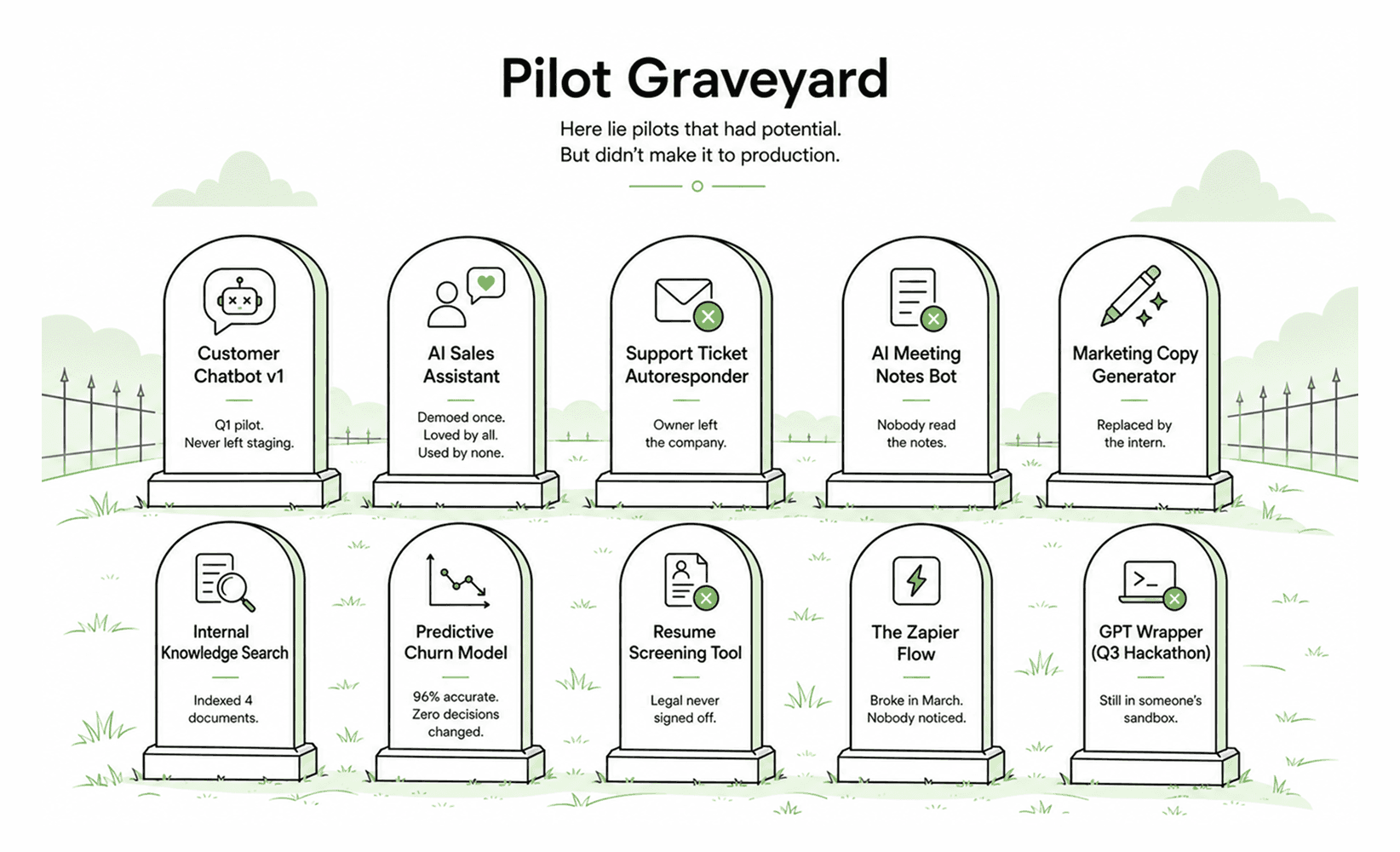
Why Most AI Pilots End Up in the Pilot Graveyard
The technology rarely fails. When RAND studied why AI projects fall short, it found more than 80% of them fail, roughly twice the rate of non-AI IT projects, and the leading causes were organizational: the wrong problem chosen, no agreement on what success means, weak data. Below are the four patterns behind why AI pilots fail to become a strategy, and end up in the graveyard instead.
No one owns the pilot
In most 50- to 300-person companies, AI is nobody's job. There's no Chief AI Officer, or the role sits on a CTO or VP of Ops who already has a full plate. So a pilot runs while one curious person has time for it, and stalls the moment they don't. Without an owner accountable for the outcome, no one decides whether to kill it or push it into production.
Fragmented tools and disconnected PoCs
Each team runs its own proof-of-concept in isolation. Marketing tests one tool, support another, finance builds a macro that calls an API. Each might work alone, but none connect or share standards, so they never add up to a capability the company owns. Six months later: five demos, zero systems in production, and a stack of overlapping subscriptions nobody is tracking.
Budget fragmentation and wrong entry points
If your company has a customer-facing chatbot being discussed at the C-suite while a twenty-hour-a-week process in Finance Dep goes unchallenged, you have the wrong budget allocation for AI pilots. MIT found that over 50% of enterprise generative AI spending is being allocated to sales and marketing, while the most significant ROI opportunities are in automating back-office processes. Ten small pilots with no clear path to production will fail while one boring pilot that will pay for itself ten times over languishes.
The pilot-to-production gap
This is where most experiments die. A demo impresses a meeting, everyone agrees it's promising, and then nothing changes about how the team actually works. Moving a pilot into production takes integration, ownership, a metric, and someone to maintain it on a Thursday afternoon when it breaks. Most companies never budget for that last mile, so the pilot stays a pilot.
The 3-Question Test: Strategy or Just Experiments?
You don't need an audit for a rough read. Three questions tell you which side of the line you're on.
If I named our top three AI pilots, could I say who owns each and what number it's meant to move? A name and a metric for all three is the start of a strategy. "A few people are trying things" is a portfolio of experiments.
Has any pilot permanently changed how a team works? Not a demo that impressed a meeting, but a workflow that runs differently today and would keep running if its builder left. If nothing has crossed into standard operations, your experiments haven't converted.
Could I show a board member the business result, not the activity? Hours saved, cycle time cut, cost per task reduced. If the only evidence is tool usage or a list of things you tried, you're measuring motion.
Three "yes" answers mean you have a foundation to build on. Mostly "no" means experiments, which is a fine starting point, as long as you stop calling it a strategy.
Manage Your AI Experiments as a Portfolio
This is a life hack that turns experiments into a strategy: stop treating pilots as a to-do list and start running an AI experiment portfolio. A to-do list only grows. A portfolio is a small, managed set of bets, and at any moment every bet is on its way to production, awaiting a decision, or being killed. The teams that get results from AI are not the ones running the most experiments. They run the fewest, with the clearest verdicts.
Three habits below make a portfolio work.
Cap your work in progress
Set a hard limit on active pilots, two or three for a growth-stage company, and refuse to start a fourth until one graduates or dies. A work-in-progress cap forces the decision most teams avoid: which pilot actually matters right now. Ten half-owned experiments produce nothing, while two funded ones reach production. Scarcity is what makes the portfolio real.
Give every pilot a standing verdict
No pilot gets to drift. At any moment each one carries an honest tag: Promote, Decide, or Kill. Promote means it has an owner, a metric, and a path to production. The Decide pile is for pilots missing one of those, each with a deadline to fix it or fall off. Anything that duplicates another tool, lacks an owner, or shows no near-term return gets killed now, not eventually. Triage on the same signals every time.
Pilot signal | What it tells you | Verdict |
|---|---|---|
Serves a ranked goal, owner willing, clear metric | Real candidate | Promote |
Works in the demo, but no owner or metric | Orphan pilot | Decide: owner and metric, or kill |
Duplicates another team's tool, no unique value | Redundant | Kill or consolidate |
Exciting, but low feasibility and no near-term return | Science project | Kill or park |
Review the portfolio on a cadence
Once a month, put every pilot on one page and re-issue its verdict. A pilot that looked promising in January and has not moved since is the clearest sign of a portfolio that stopped being managed. The review is short and unsentimental: what shipped, what is stuck, what dies today.
The discipline is in the killing. Every pilot you keep alive but without an owner or metrics is a drain on the attention span of your one truly promotable pilot. A portfolio of two funded, owned bets headed for production is better than ten experiments, and it is the difference between a company that does AI and one that only talks about it.
Closing the Pilot-to-Production Gap
Turning the surviving pilots into a strategy is less about frameworks than about finishing one thing. The sequence is short.
Start by auditing what's already running: list every pilot, who champions it, and the goal it was meant to serve. Kill the orphans and duplicates. From what remains, pick the single highest-value, most feasible pilot, usually a back-office task, not the flashy customer-facing build, and give it one named owner and one metric agreed up front. Then take that one pilot all the way into daily operations before starting the next. Production is where value shows up, not the demo. Getting people to actually use what ships is a separate challenge, and we cover the people side of AI adoption in its own article.
Once the first pilot is transitioned to production, document the process sufficiently for it to serve as a template for the rest. That is when turning the portfolio of tests into a strategy happens, and it is recognized by the ability to accelerate through the iterations. The first pass at anything takes time and effort; getting the second one right is usually faster because there is already a reference implementation. The first pass through this, auditing the portfolio and getting one pilot to production, usually takes about 30 days.
Where an AI Partner Fits
Plenty of companies do this in-house. Others move faster with a partner, usually when pilots keep dying before production, tools are fragmented, or the board wants ROI they can't yet show. There's evidence the model matters: MIT found AI tools bought from specialized partners reached success about twice as often as internal builds.
Easyflow serves as your operating partner for AI Transformation, not a consulting shop that disappears after the slides. Every engagement starts with a fixed-scope audit that triages your pilot portfolio, assigns an owner to each surviving initiative, and attaches an ROI model, then embeds a team to take one to production while training yours to run it. If a pilot doesn't deserve to survive, we say so.
The Final Thoughts
Experiments show that AI can work. They do not deliver working AI for your company. The difference is found in the portfolio management of pilot projects, specifically a commitment to reduce the number of simultaneous initiatives, establish a standing review for each, kill the unpromising ones, and accelerate one promising pilot toward production while your team learns how to manage the rest. Companies that institute this discipline at an early stage will find themselves out-competing those that continue to experiment intensively five years later with no better understanding of what to do next. Run through the three questions with your own management team. If you found more negatives than positives, you may not have a strategy, but you do have a beginning.
Stop making more pilots.
Easyflow's audit triages your pilot portfolio, assigns owners, and gets one use case to production in 30 days, fixed scope, no lock-in.
Posted by

Shykula Kateryna
Content Producer
What is the difference between an AI experiment and an AI strategy?
An AI experiment tests whether a tool can work for a task. A strategy decides which experiments are worth keeping, assigns an owner and a metric to each, and moves them into production. Experiments produce activity and demos. A strategy produces measurable business results. A company can run dozens of experiments and still have no strategy if none of them are owned, prioritized, or shipped.
What is the pilot-to-production gap?
It's the distance between a working demo and a workflow that runs in daily operations. Crossing it takes integration into real systems, a named owner, a success metric, and someone to maintain the tool when it breaks. Most companies budget for the pilot but not for that last mile, so promising pilots stall after the demo and never change how the team works.
How many AI pilots should a company run at once?
Fewer than most do. Most growth-stage companies can properly own and push one or two pilots to production at a time, not ten. Running many experiments feels like progress but spreads attention and budget too thin, so nothing reaches production. A small, actively triaged portfolio beats a long list of open pilots.
Who should own AI experiments in a company?
Each pilot needs one accountable owner with the authority to decide and the mandate to follow through, often the COO or a dedicated Head of AI rather than a committee. That person prioritizes the portfolio, kills pilots that don't earn their place, and pushes the survivors into production. Shared ownership across several people usually means no one owns it, which is how pilots end up in the graveyard.