Inside an AI Development Engagement: What You're Paying For

Many AI proposals list an audit, a consulting phase and a build on the same page. Few spell out where one stops and the next starts, so the question usually comes up later, when the first invoice lands and the system someone expected to see running is still a slide deck.
If you're a CTO, COO or CEO putting together a vendor shortlist, the names on it won't tell you much. One firm calls itself an AI agency, another a consultancy, a third an AI software development company, and all three may be selling the same three stages in a different order. What actually separates them is what you have in hand at the end of each stage. That's what we'll go through here: what each stage is for, what it should give you, and when it's fine to skip it.
Quick Answer: What Are You Paying For in an AI Development Engagement?
Across a full engagement, you pay for three different things. The audit buys a reduction in uncertainty, consulting buys a decision about what to build and how, and the build buys a working system your team can run. Each stage should end with named artifacts you can hold the vendor to: a ranked opportunity roadmap, then a scoped design with acceptance criteria, then code, evaluations, monitoring and a handover. If a vendor can't name a stage's outputs before it starts, you are paying for time.
Key Takeaways
Audit, consulting and build answer three separate questions: where AI pays off, what exactly to build, and whether it works in production.
You can skip a stage when its question is already answered. Validation, evaluation and ownership planning are the exceptions.
Every stage should end in artifacts that are named in the contract before the stage begins.
Scope decides what an engagement includes, and data readiness, integrations, autonomy and compliance move it more than the vendor's label does.

An AI development engagement is scoped work with an external partner that covers one or more stages from identifying an AI opportunity to putting a working system into production. Depending on what's already known, it may include an audit, consulting and solution design, development, or a mix. So what does an AI development company do inside it? It assesses, designs, builds, tests, integrates and hands over. A pure consultancy usually stops after the design.
Why It Is Not Just a Development Sprint
A normal software sprint assumes known requirements and deterministic behavior: the button submits the form or it doesn't. AI systems work on probabilities. The same input can produce different outputs, quality drifts as the data underneath changes, and "done" has to be defined by an evaluation set rather than a feature checklist. There's a second difference, and it's the one buyers feel on the invoice: a lot of the work has to happen before any code exists. In 2024, Gartner predicted that at least 30% of generative AI projects would be abandoned after proof of concept by the end of 2025, naming poor data quality, inadequate risk controls, escalating costs and unclear business value as the causes (Gartner, 2024). (We go through the full list of blockers in why AI projects fail.)
What Buyers Usually Misunderstand Before Signing
Three assumptions come up again and again when Easyflow runs early discovery calls:
That the audit buys a build plan. It buys a ranked list of where to look. The build plan comes out of consulting.
That a working demo means most of the work is done. Integration, evaluation and monitoring often take longer than the demo did.
That code ownership is automatic. It depends on the contract, and on whether prompts, evaluation sets and pipeline configs count as "code" in it.
AI Audit vs AI Consulting vs AI Build: What Is the Difference?
The short version of AI audit vs consulting vs build: an audit tells you where to look, consulting tells you what to build, and a build gives you something that runs. The first two stages produce decisions; only the third produces software, which is the real line between what a consultant recommends and what an AI development company builds. On any given invoice, you should know which one you're paying for.
| AI Audit | AI Consulting | AI Build |
|---|---|---|---|
Core question | Where can AI create value here, and is the data ready? | Which use case first, built how, and should we buy instead? | Does it work in production, with our systems and data? |
Main output | Ranked opportunity roadmap, data readiness assessment | Solution design, architecture, scoped backlog | Working system, evaluation suite, monitoring, handover |
Typical buyer situation | "We have an AI mandate but no agreed first use case" | "We know the use case but not the approach" | "We know what to build and need it shipped" |
Risk it removes | Funding the wrong problem | Building the wrong thing, or building what you could buy | A demo that never reaches production |
Gate question at the end | Is there a use case worth funding? | Can we build it at a scope we'll commit to? | Does it meet the acceptance criteria, and can our team run it? |
Why Vendors Often Blur These Stages
Sometimes it's commercial, sometimes honest confusion. A firm that mostly sells advisory work has a reason to stretch discovery; a firm that mostly sells engineering hours has a reason to skip it. Vendor labels are unreliable in AI: Gartner has even warned about "agent washing" in the agentic AI market (Gartner, 2025). For buyers, named deliverables are a better comparison point than category labels.
The Three-Stage AI Engagement Model
Most engagements follow this order even when vendors rename the stages. The gate questions in the last row of that table are what turn it into a model rather than a sequence of invoices: at the end of each stage, you decide whether to continue based on what the stage actually produced.
Stage 1: AI Audit, Paying to Reduce Uncertainty
The audit is the cheapest point in the whole engagement to find out an idea won't work. It maps the workflows that eat the most time or produce the most errors, and checks whether the data they need is accessible and legally usable. Then it separates real AI candidates from problems that ordinary automation or a process fix would solve, and asks who inside the company would own the result. That last question gets skipped a lot. It shouldn't, and in Easyflow audits it's the first one we ask. The output is a short ranked list you can fund or reject, and a long catalogue of possibilities is a sign the audit didn't finish its job.
Stage 2: AI Consulting, Paying for Direction and Scope
Consulting is where a priority becomes a plan. It picks the first use case and says why, decides whether to build or buy (the Easyflow build vs buy framework for AI agents covers it), sketches the target architecture, and sets the risk controls: access permissions, human approval steps, audit trails. The AI agent governance guide covers them in detail. The output should let engineers start building on day one of Stage 3 without re-running discovery.
Stage 3: AI Build, Paying for Working Software
This is where custom AI development services sit: agents, retrieval systems, internal tools, AI features inside your own product. A build has six parts, and a proposal that leaves one out is quoting for a demo.
Build component | What you should get | Go deeper |
|---|---|---|
Prototype or proof of concept | A narrow version that tests the riskiest assumption on your real data, with success criteria agreed upfront | |
Production build | Error handling, permissions, security, retries and a usable interface | |
Integrations | Read and write connections to your CRM, helpdesk, HRIS or ERP | |
Evaluation and quality testing | A test set from real cases with pass thresholds, run before every release | |
Monitoring, logging and cost controls | Logs of inputs, outputs and actions, drift alerts, usage limits | |
Handover and knowledge transfer | Documentation, runbooks, credentials and a trained internal owner |

AI Development Deliverables: What You Should Receive at Each Stage
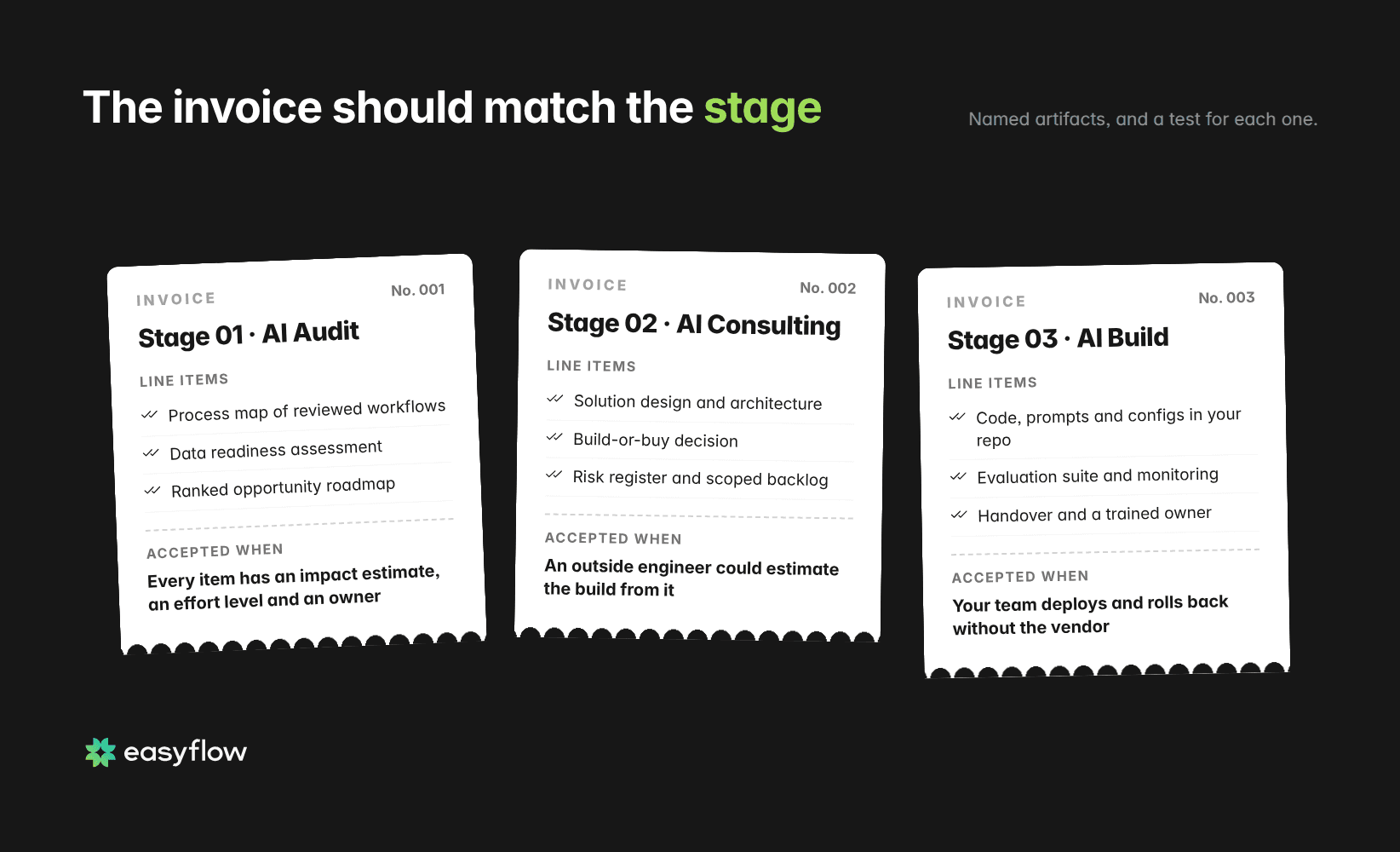
The stage descriptions above say what each stage does; a contract needs something firmer. Use the table below when you review a statement of work. Each of these AI development engagement deliverables should appear by name in the contract, and each comes with a quick test for whether it's real.
Stage | Artifact | How to tell it's real |
|---|---|---|
Audit | Process map of the reviewed workflows | Your operations lead recognizes it as accurate |
Audit | Data readiness assessment | It names specific systems, fields and gaps |
Audit | Ranked opportunity roadmap | Every item has an impact estimate, an effort level and an owner |
Consulting | Solution design and architecture diagram | An engineer outside the vendor could estimate the build from it |
Consulting | Build-or-buy decision | It names the off-the-shelf options that were considered |
Consulting | Risk register, success metrics with acceptance criteria, scoped backlog | Every high-risk action has a named control, and the thresholds are numbers |
Build | Code, prompts and configuration in your repository | Your team can deploy and roll back without the vendor on the call |
Build | Evaluation suite and monitoring dashboards | Pass thresholds and alert thresholds are written down |
Post-launch | Handover, maintenance calendar, named owner | The owner has run the system unassisted at least once |

What You're Not Paying For
Knowing what you're actually paying for in AI development also means knowing what shouldn't show up on the bill.
You are not paying for | Why | What you should get instead |
|---|---|---|
A generic AI strategy deck | If it could apply to any company in your industry, it isn't an audit output (why that happens) | Artifacts that name your systems, data and people |
Model access alone | Anyone with a credit card can call a model API | Data preparation, integration, evaluation and controls around the model |
A demo that can't reach production | Sample data says little about your data, volume and security rules | A written definition of what separates the demo from production |
Vendor lock-in | Rebuilding from scratch to leave means the contract failed | Code, prompts, eval sets and pipelines in your own environment |
When Can You Skip Audit, Consulting, or Build?
Both tables assume you buy all three stages, and not every company needs to. Paying for a stage whose question you've already answered is waste, and a vendor who insists on the full sequence every time is selling hours.
Stage | Skip it when | Keep it when |
|---|---|---|
Audit | You can name the workflow, measure its baseline in hours or errors, point to the data and name an owner | Leadership wants "an AI plan" and nobody can name the first workflow, or earlier pilots stalled for unclear reasons |
Consulting | The use case is prioritized and the design is conventional: a known pattern, few integrations, low autonomy | Data sits in several unmapped systems, or the workflow touches regulated decisions like hiring or credit |
Build | The consulting gate says no, or the process isn't stable enough to automate yet | The gate says go and the process runs the same way across teams |
One rule sits outside the table: validation, evaluation and ownership planning never get skipped, whichever stages you drop. That's where AI projects fail quietly. A system without an evaluation set can't be changed safely, and a system without an owner slowly degrades until someone switches it off. The Build row deserves a word too, since an unstable process is a common reason to hold. If a workflow changes every month, or two teams run it two different ways, AI will simply automate the inconsistency.
How Scope Changes What an Engagement Includes
Even once you've settled which stages you need, their size varies, and there's no standard package. There's also no meaningful AI development price without a defined scope. Two engagements for the "same" AI support agent can differ widely in effort, and the difference usually comes down to six variables, which decide what the engagement contains long before they decide what it costs.
Scope driver | Lighter engagement | Heavier engagement |
|---|---|---|
Data readiness | FAQ content in one maintained knowledge base | Customer records split across three systems with mismatched IDs |
Number of integrations | Read-only access to one helpdesk | Read-and-write access to CRM, ERP and email |
Workflow complexity | One linear path with few exceptions | Rules that branch by region, product or client tier |
Autonomy and human approval | Drafts replies for a person to send | Issues refunds or updates records on its own |
Security and compliance | Internal data, no personal data | Personal data, regulated decisions, audit trail required |
Evaluation and monitoring | Periodic spot checks against a small test set | Evaluation on every release, drift alerts, sign-off per change |
Data readiness is usually the biggest single driver, and it should be scoped upfront rather than discovered halfway through the build. Compliance can move scope on its own too: under the EU AI Act, AI systems used for recruitment or candidate selection are classified as high-risk (Regulation (EU) 2024/1689, Annex III). For timelines by complexity, see Easyflow's breakdown of how long it takes to build an AI agent.
How Easyflow Works as an AI Operating Partner
We hold our own engagements to the standard described above. Some companies come to Easyflow looking for an AI software development company, others for an AI transformation partner. Either way, the work runs through the same three stages, and we run all three ourselves, from the first audit workshop to the system the client operates on its own. That continuity is what we mean by an operating partner, and it has taught us a few habits worth copying whichever vendor you choose:
What we do | Why it matters |
|---|---|
Bring the person who will own the system into the audit, well before handover | Ownership gaps show up while the scope can still change |
End the audit with a ranked roadmap that carries an ROI estimate per item | Leadership can fund one item, or none, based on numbers |
Fix the scope and the deadline before the build starts | Everyone agrees on what "done" means before code exists |
Work inside the client's standups and code reviews | The internal team sees how the system is built, not just the result |
Roll out in phases, one point of friction at a time | Each phase proves itself before the next one is scoped |
Treat handover as complete only after the client's team runs the system without our engineers in the room | Documentation gets tested instead of assumed |
We also say no. If AI isn't the right answer for a workflow, it's better to hear that during the audit than halfway through a build.
The first working system is rarely where the work ends, though. In McKinsey's 2026 State of AI survey, nearly three-quarters of AI high performers report fundamentally redesigning workflows because of AI, compared with about a quarter of other respondents (McKinsey, 2026). That's why Easyflow's AI transformation work usually continues past the first build, into process changes and training for the people who'll run what was built. The RemoFirst engagement is a typical example: it started with documenting the onboarding workflow end to end alongside the HR and payroll team, then moved to connected AI agents delivered in phases, and the work carried on into the next phase of automation.
Questions to Ask Before Starting an AI Development Engagement
Whichever vendor you're considering, Easyflow included, six questions separate them quickly. Put them to every shortlisted firm before an AI development partner engagement is signed, and compare the answers side by side.
Question | A good answer includes | Red flag |
|---|---|---|
What will we have in our hands after each stage? | Named documents, code and test sets per stage | "Clarity," "alignment," or a list of workshops with no outputs |
Which stage do you think we can skip? | A reasoned answer based on what you've told them about your data and use case | Every stage is always required |
What will you refuse to build? | Real limits (no usable data, unstable process, too much autonomy for your controls) and an example | They'll build anything |
How will you measure whether the system works? | An evaluation set, numeric thresholds, a baseline from today's process | Quality judged by a demo |
Who owns the code, prompts, data flows and evaluation assets? | You do, in writing, stored in your repositories and cloud accounts | Ownership terms missing or sold as an extra |
What happens after launch? | Named people for monitoring and fixes, and a clean exit path | Support is vague and there's no exit plan |
One more warning sign: a proposal that calls everything "AI transformation." It's a fair goal, and Easyflow uses the word for its own work, but the word on its own defines no scope. If it replaces stages, gates and artifacts, ask what the first stage delivers and how you'll know it's done.
Final Thoughts: The Invoice Should Match the Stage
An audit invoice should buy a ranked, owned list of opportunities. A consulting invoice should buy a design an engineer can build from. A build invoice should buy software running in production, with tests, monitoring and a team that can operate it. Once each invoice maps to one stage and its artifacts, the question of what do you pay for in AI development has a concrete answer, and vendor comparisons get a lot simpler.
Whether a vendor calls it an AI project engagement, a sprint or a transformation program, the test stays the same. And it matters more now that adoption itself isn't the hard part. In McKinsey's 2026 survey, nearly nine in ten respondents report regular AI use in at least one business function, yet 44% say AI is scaling across their enterprise (McKinsey, 2026). A good share of that gap, in Easyflow's experience, comes down to how the work was scoped, staged and handed over.
Posted by

Shykula Kateryna
Content Producer
What is included in an AI development engagement?
A full engagement covers three stages: an audit that ranks where AI can create value, consulting that turns the top opportunity into a scoped design, and a build that ships a working system into production. The build itself includes a prototype, production engineering, integrations, evaluation, monitoring and handover. Not every engagement needs all three stages. What should never be missing is a list of named deliverables for each stage you do buy.
What is the difference between AI consulting and AI development?
AI consulting produces decisions and documents: a solution design, an architecture, a scoped backlog. AI development produces working software that runs on your data and connects to your systems. A consultant recommends. A development team builds, tests, deploys and hands over. If you need a system in production, consulting alone won't get you there.
Do we need an AI audit before development?
Not always. If you can already name the workflow, measure its baseline, access the data and name an internal owner, a short scoping step can replace the audit. If any of those four is missing, an audit is usually the cheaper place to find out. It's much easier to drop a weak idea at the audit stage than after engineers have started.
What should an AI build deliver?
A working system in production, plus the assets to run it without the vendor: source code, prompts and configurations in your repository, an evaluation suite with pass thresholds, monitoring with alerts, deployment runbooks and documentation. It should also leave you with a named internal owner who has operated the system on their own. If your team can't deploy, roll back and evaluate a change without the vendor on the call, the build isn't finished.