AI Operating Model: Framework, Types and Ownership for AI Agents

Most companies want to use AI that can think for itself soon, but not many have a good plan in place to control it. A survey by Deloitte found that almost 75% of companies plan to use this kind of AI within two years. However, only about 20% of them have a mature plan to govern these autonomous agents. This is a big issue, as another survey by MIT Sloan Management Review and BCG found that many companies that use this type of AI expect big changes in how they operate and what roles people will have. In fact, 66% of the companies that use a lot of AI like this think their operating model will change, compared to only 42% of companies that don't plan to use it. This shows that companies need to start thinking about how they will manage these new AI systems.
When companies decide how to use AI, they have to make some big choices about who's in charge, how to handle risks, and how work gets done. These choices, not the type of AI they pick, have a bigger impact on the numbers. This guide breaks down the basics: what happens after AI systems make decisions, what kind of setup works best, how to measure success, and what can go wrong. It's all about finding the right framework and making it work for your company.
Quick Answer: What Is an AI Operating Model?
An AI operating model is basically a plan that decides who's in charge of the work, the risks, and the outcomes when AI takes over some tasks. It outlines what tasks are handled by agents, who gives the okay on exceptions, how performance is tracked, and how things can be adjusted. This model acts as a bridge between the overall AI strategy, which provides direction, and AI governance, which sets the rules and controls. It's all about defining how AI works within an organization.
Key Takeaways
An operating model decides who owns work, risk and results; strategy sets direction and governance sets controls.
When someone takes action on their own instead of just helping out, the person in charge of the process is held responsible for what happens. This is because they gave the agent the authority to act in the first place.
Every agent needs a named business owner, a named exception approver and a written list of actions it can't take alone.
Pick the structure by use cases, skills and regulatory load, then track override and escalation rates to learn whether it works.

How the Operating Model Differs From AI Strategy, Governance and Transformation
People use the four terms interchangeably, but each answers a different question.
Concept | Question it answers | Typical owner |
|---|---|---|
AI strategy | Where will AI create value? | Executive team |
AI governance | Which rules and controls apply? | Risk, security and compliance |
Operating model | Who owns the work once AI is involved? | Process owners with technical partners |
AI transformation | How does the organization change around the model? | Sponsor and change leads |
Strategy picks the destination and governance sets the guardrails, but neither says who picks up the phone when an agent closes the wrong ticket. The operating model does. Controls live in Easyflow's AI agent governance guide; this article stays on ownership.
Core Components of an Operating Model for AI Agents
That leaves the operating model itself. It has eight parts, and the right column shows what each one decides once agents execute work.
Component | What it decides for agents |
|---|---|
Strategy and value | Which processes agents take on |
People, roles and accountability | Who owns each agent and who approves its exceptions |
Processes and workflows | Which steps agents execute and which stay with people |
Data and knowledge | What the agent may read, and who keeps it current |
Technology and platform | Shared identity, logging, tooling |
Governance and risk | Risk tiers, approval rules and audit requirements |
Adoption and change | How teams are trained |
Measurement | What is tracked, who reviews it and how often |
Nothing on that list is exotic; what's new is that every row now has to say something about agents. An AI operating model framework for a single workflow fits on one page, because it only has to answer five questions per agent:
Mandate: what may the agent do alone, and what needs approval?
Owner: who is accountable for the outcome, and who for the agent's behavior?
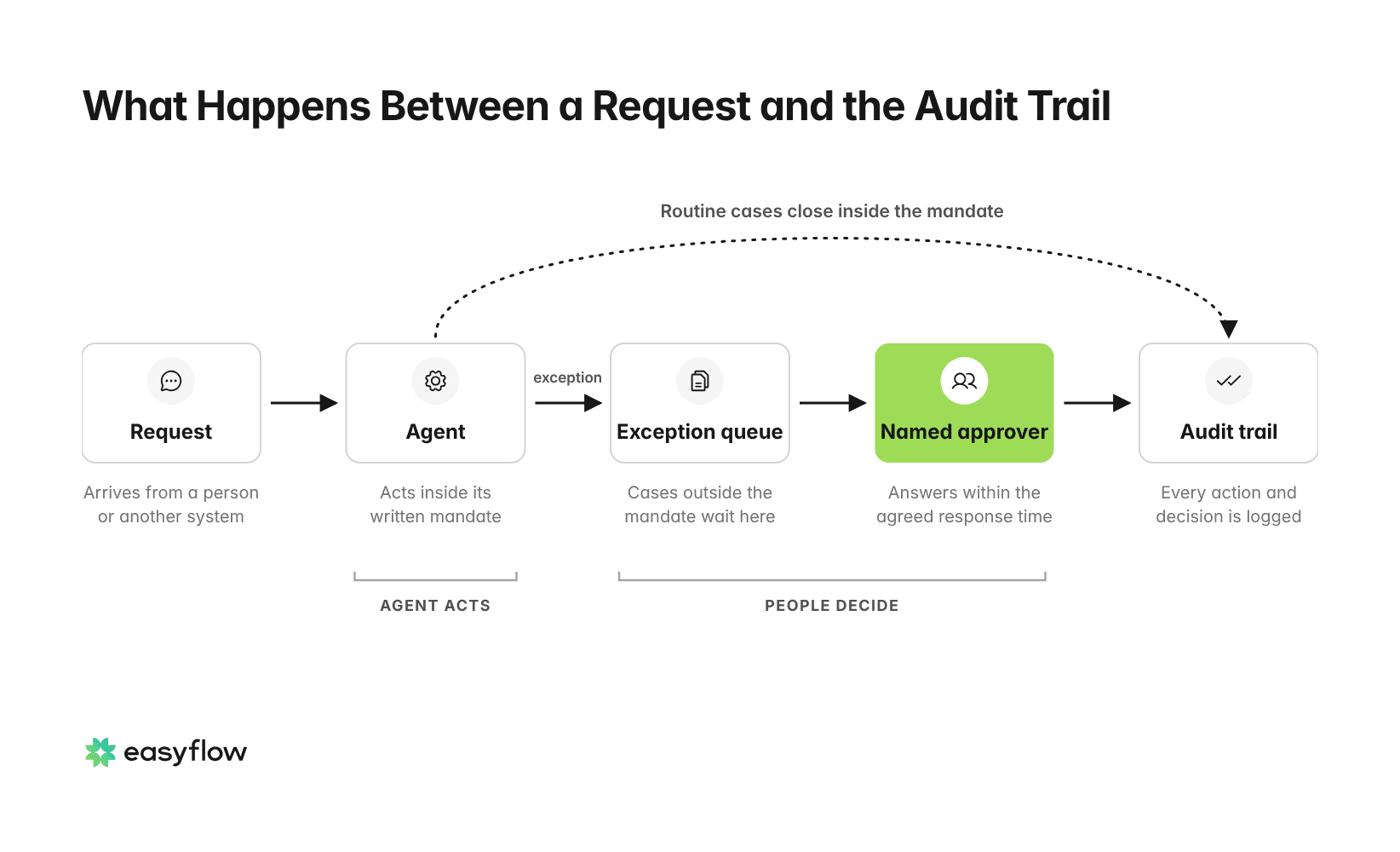
Exceptions: where does an escalated case go, who answers, and how fast?
Evidence: what is logged, measured and reviewed, and how often?
Change: who approves a new tool, a model update or a wider mandate?
The World Economic Forum argues for the same discipline with an "agent card", a résumé covering seven dimensions, among them an agent's function, autonomy and authority. Write the answers before go-live and have the process owner sign the page. In AI operating model consulting, this agent charter is the first document worth producing.
AI Assists vs AI Executes: The Shift That Changes Ownership
The charter matters most once an agent stops suggesting and starts acting. An assistant drafts and a person decides; an executing agent classifies the alert, closes the ticket, writes the record into payroll. The technology gap is small, but the operating gap is large, because the person who used to make every call no longer sees every call. Executives sense it: 76 percent in the MIT Sloan Management Review and BCG survey view agentic AI as more like a coworker than a tool.
Dimension | AI assists | AI executes |
|---|---|---|
Who acts | A person, using AI output | The agent, inside a defined mandate |
Who reviews | The person, before every action | A person, on exceptions and samples |
What an error looks like | A weak draft someone catches | A completed action in a live system |
Accountable owner | The employee using the output | The process owner who granted the mandate |
What you manage | Tool adoption and training | Scope, permissions and exception queues |
Main metric | Time saved per user | Override and escalation rates |
The last two rows are where teams slip: they keep managing adoption when the job is now scope and queues.
What AI Agents Can Do for Business Operations
What can AI agents do for business operations? Less than vendors suggest, but still plenty: triaging requests, extracting data from emails, routing cases, compiling shift reports. Easyflow's AI agent catalogue and AI's impact on business operations show the range.
What Changes in the Operating Model When Agents Run Processes
The process owner supervises a mandate. Rather than managing people, the owner reads exception queues, samples closed cases and decides when the mandate widens. Put that time in the calendar, or supervision decays into an inbox nobody opens.
The metrics move from activity to exceptions. Hours saved makes a good headline and a weak control; how often people overrule the agent says more. The measurement section has the numbers.
The workflow gets redesigned. Deloitte found that only 30 percent of companies are redesigning key processes around AI. An AI first operating model starts there: design around what the agent does well and what people decide, then assign owners. Skip that, and the agent creates an exception queue nobody planned.
Capacity shifts toward exceptions. Hours an agent absorbs move into reviewing escalations and fixing rules. In the night-operations agent Easyflow built for IOPS.TEAM, critical incidents still reach engineers with context attached. Who answers when the agent gets one wrong?

Who Is Accountable When an AI Agent Makes a Mistake?
The organization that deployed the agent is accountable, and inside it, accountability has to land on a named role. A mistake with no owner turns into a week of messages asking whose agent it was.
NIST's AI Risk Management Framework agrees: GOVERN 2.1 requires documented, clear roles and responsibilities for managing AI risk, and GOVERN 3.2 separates the people who oversee an AI system from those who use it. In operations, that comes to five roles.
Role | Owns | Should not own |
|---|---|---|
Process owner (business) | Workflow outcome, the agent's mandate, scope changes | Model tuning and infrastructure |
Agent owner (technical) | Behavior, permissions, monitoring, updates, kill switch | Business decisions on what the agent may decide |
Exception approver | Escalated cases, within a documented response time | Re-checking routine cases |
Risk and compliance | Risk tiers, audit needs, review of material changes | Day-to-day approvals |
Executive sponsor | Priority, budget, conflicts between teams | Individual exceptions |
Imagine a situation where a payroll agent accidentally assigns a bonus to the wrong employee. In this case, the person in charge of the process has to decide whether to cancel the transaction. Meanwhile, the agent's supervisor tries to figure out what went wrong with the mapping rule that caused the mistake. The risk and compliance team also gets involved to determine if this type of error requires a human review to prevent it from happening again. Without clear roles and responsibilities, things can get messy - people start arguing about what to do first, and then they try to find a solution.
Here's what you need to know about Easyflow's governance. It's got controls like scoped permissions and audit trails to keep everything in check. If you're wondering about identity questions, we've got a separate guide for that - it's called Security for AI Agents.
Operations Agents in Practice: Four Examples and the Ownership Question Each Raises
Roles look tidy on paper. The four agents below come from delivery work published on the Easyflow site, with figures as reported there. The last column is a question to ask, not a description of how each client runs things.
Agent | What it does | Reported result | Ownership question |
|---|---|---|---|
Night-shift incident agent for IOPS.TEAM (cloud DevOps) | Classifies incidents, closes routine ones, escalates critical ones | 60% fewer manual triage tasks; classification in under 5 minutes; 100% audit trail | Who owns an incident the agent closed alone? |
Payroll intake agents for RemoFirst (employer of record) | Read payroll emails, extract data, generate contracts | 3 agents, 2 HR platforms integrated, deliverables on schedule | Who verifies extracted data before documents go out? |
Email intake and finance insight agents for Jome (real estate platform) | Classify client emails, draft replies, flag finance patterns | 70%+ less manual email triage | Who approves a drafted reply, and when can that become sampling? |
Onboarding agent (HR and IT) | Starts at offer acceptance, creates profiles, assigns tasks | Up to 3 hours per hire cut to 30 minutes | Who owns the task list when an assignment stalls? |
Easyflow's night-shift case shows the pattern: the question moves from "who does triage" to "who audits the routine closures." A named reviewer sampling auto-closed incidents is one answer.
Operating Model Types: Which Structure Fits Your Company
Naming an owner settles one agent. Across a company, the next question is where those owners sit. Companies tend to land on one of five structures; the last column shows what to track.
Type | How it works | Fits when | Main risk | Metrics to track |
|---|---|---|---|---|
Siloed | Teams run their own pilots | A few early experiments | Duplicate tools, no path to production | Pilot-to-production rate, agents outside the inventory |
Centralized center of excellence | One central team builds and runs agents | Few use cases, scarce skills | The team becomes a queue | Time from idea to production, backlog size |
Hub-and-spoke | Hub sets standards; builders sit in functions | Many functions need common standards | Hub and functions disagree on priorities | Share of agents in the inventory under shared standards |
Federated | Functions build inside central guardrails | Mature teams with local expertise | Standards drift between functions | Policy-compliance rate, audit-log completeness |
Embedded | AI skills in every function, little central oversight | Engineering-led companies | Duplicate work, uneven risk control | Incidents and time to respond, by team |
The rows run from tight central control to wide local freedom. The metrics come from Microsoft's agent scorecard guidance; matching each to a structure is our reading. Revisit the structure when the agent count doubles, a new regulation applies or incidents cross team boundaries.

How to Choose the Right AI Operating Model
Which of the five fits comes down to a few factors. Start more central than feels comfortable, then loosen as skills spread. In the table, "central" means a center of excellence or hub-and-spoke and "local" means federated or embedded.
Factor | Leans central | Leans local |
|---|---|---|
Use cases | A handful, similar in kind | Many, specific to each function |
Skills | Scarce, in one team | Present in business functions |
Regulatory load | High, or payroll and customer records involved | Low, internal processes |
What agents do | Execute in live systems or face customers | Assist, draft and recommend |
Company structure | One business, common processes | Several units, different processes |
The same risk and regulation signals apply to Microsoft's guidance for agent centers of excellence, but there are three more: Maturity: the lower, the better for a centralized home for scarce expertise; the higher, the better for federation. Readiness: federation requires business teams to be able to own the entire agent lifecycle, not just build them. Speed against control: a central queue that's stalled is a signal to federate, and quality that varies between teams is a signal to centralize. Often the mixed answer is a hub-and-spoke.
Beyond one team is where an enterprise AI operating model becomes relevant, as there must be an owner of the common layer: agent inventory, a standard charter, common identity and logging, and a review cadence. Hub-and-spoke is often appropriate for an AI operating model in a large enterprise, as it keeps standards in one place while process ownership is local. AI operating model consulting often begins with an analysis of the current structure a company operates under, and the one it will need to adopt.
How to Measure Whether Your AI Operating Model Works
A structure is a bet until the numbers say otherwise. To understand how the operating model is performing, measure two levels.
Structure level metrics: the pilot to production rate (the percentage of pilots that make it to production), time from idea to production and the number of agents in production outside the inventory. A high number of pilots and a low rate of them entering production indicate a problem with the structure, not the agents.
Agent level: NIST's MEASURE 2.4 calls out monitoring in production, including human review of unexpected outputs. Here are five numbers to track.
Metric | What it shows | Warning sign |
|---|---|---|
Override rate | How often a person corrects the agent | Falls while exception age rises |
Escalation rate | Share of cases handed to a person | Near zero, or climbing steadily |
Exception age | How long escalations wait for an answer | Waits past the agreed response time |
Agent-resolved share | Cases closed with no later rework | Closures rise, and rework rises with them |
Incident count | Errors that reached a customer, payment or record | The same incident class twice |
A falling override rate with a rising exception age can mean people stopped reviewing, not that the agent improved. Read the five together. Logins say little; Easyflow's piece on why AI adoption stalls on people covers adoption metrics.
Use the override rate as the gate for giving an agent more room: widen a mandate only when the rate sits below a threshold the process owner set in advance. Caution is earned, since a Capgemini Research Institute survey of 1,500 executives found that confidence in fully autonomous agents fell from 43 percent to 27 percent in a year.
NIST asks for production monitoring and ISO/IEC 42001 for management review at planned intervals; neither sets a frequency, so pick one and write it down. Microsoft's operating rhythm is a documented example: a weekly loop for monitoring and intake, a monthly steering review with the sponsor that covers the scorecard and risk posture, and a quarterly call on what to scale, sustain or retire.

Common AI Operating Model Mistakes
Measurement shows problems after they happen. Six mistakes are worth checking for by name beforehand, and none of them is about the technology.
Mistake | What it looks like | Fix |
|---|---|---|
Center of excellence turns into a bottleneck | Requests queue behind one team, so business units build agents on the side | Publish standards; let functions build inside them |
Treating AI as an IT-only function | IT carries blame for outcomes it doesn't control; no business owner is named | Name a process owner before the build |
Centralizing technology, not accountability | A shared platform nobody answers for when results slip | Platform team owns tooling, process owner owns results |
Measuring usage, not outcomes | Logins climb while rework stays hidden | Track overrides, escalations and resolved share |
Automating the old workflow | An exception queue nobody planned for | Redesign the process, then assign the agent |
Leaving knowledge with the vendor | The team can't explain or change the agent after handover | Require written charters; train internal champions |
Every fix starts with a named person or a written page. Control-level mistakes, such as over-broad permissions, are in Easyflow's governance guide.
AI Operating Model Readiness Checklist
These fixes constitute a checklist. Before the next agent release, for each statement below, decide if it is true.
Every workflow touched by the agent has an identified process owner
The agent has a technical owner who can turn it off
A documented charter defines what the agent may do autonomously
Exception approvers are identified with agreed-upon response times
Override, escalation, and exception-age baselines are in place
Responsibilities for the shared layer (inventory, charters, identity, logging) are assigned
Risk and compliance have approved the charter
The team has clarity on retained decision rights and the pilot has a review date
Address more than two gaps before the next release; the agent may wait. Focus on per-workflow readiness rather than per-company: a team may be prepared to triage incidents but not yet for payroll.
AI Operating Model Consulting: What It Should Produce
AI operating model consulting is one way to close those gaps. A useful engagement produces:
A map of the workflows agents will touch, each with a named owner
A charter per workflow and a decision-rights matrix for the five roles
Exception paths, metrics and a review cadence
Training for process owners and exception approvers
Easyflow's AI transformation work opens with a strategy and audit phase: document the processes, rank the opportunities, calculate the return, deliver a ranked roadmap. Easyflow delivery then runs as an embedded team, with escalation paths and audit trails built into the agent.
Judge any AI operating model consulting engagement, ours or someone else's, on whether your team can run the arrangement alone. We certify internal champions who keep momentum after we step back, and Easyflow's working principles say it bluntly: we train your people as we go, and we tell you if AI isn't the right answer before you spend time or money on it.
Final Thoughts: AI at Scale Is an Operating Model Problem
If you go back through this guide and read it carefully, you will notice that only a very small portion of it actually deals with technology. The roles people play, the way the team is structured, the metrics used to measure success, and the mistakes that get made all ultimately trace back to a single question: who owns the work, and who is accountable when something goes wrong. These are questions that existed long before agents ever came along. What has changed is that agents now operate inside live systems, which means the gaps that a human team used to quietly absorb and cover up now surface as real incidents.
Taking ownership takes longer than the actual build, and it is what determines whether an agent makes it through its first bad week.
The next step is a small one: draft the one-page charter for a workflow you already have in mind, then see whether a process owner is willing to sign it. Good AI operating model consulting begins from that same page, and the Easyflow team will gladly walk through yours with you, with no build attached.
Posted by

Shykula Kateryna
Content Producer
What is an AI operating model?
An AI operating model is the set of decisions that define who owns work, risk and results when AI does part of the work. It names the roles, decision rights, approval paths and metrics around each AI system. For agents that execute tasks, it also states what the agent may do alone and who answers when it escalates. Strategy and governance feed into it, but neither replaces it.
Who evaluates whether an AI operating model is working?
Evaluation sits at several levels. Process owners review outcome metrics such as override rate, escalation rate and exception age on a regular schedule. Agent owners review behavior and drift. Risk and compliance review incidents and material changes, and an independent reviewer such as internal audit should look at higher-risk agents. The executive sponsor decides whether to expand, hold or stop based on those reviews.
What operating model does enterprise AI need once agents run processes?
It needs named ownership for every agent, written limits on what each agent may do alone, and exception paths with response times. It also needs shared standards so teams don't build conflicting versions of the same agent. Finally, it needs measurement that goes beyond usage, with override and escalation rates reviewed on a fixed cadence. The details vary with risk, since a payroll agent needs tighter gates than an internal reporting agent.
What capability monitors and manages AI to keep it trustworthy?
Monitoring and runtime governance do that work. Every agent action is logged against a unique agent identity, behavior is compared with a baseline to catch drift, and alerts route to a named owner. A tested kill switch lets the owner revoke access quickly. Our AI agent governance guide and guide to security for AI agents describe these controls in detail.