Top AI Agent Development Companies in 2026

Agentic AI has moved past the pilot stage, and the demand for development partners who can actually deliver in production has moved with it.
Gartner expects 40% of enterprise applications on track to include task-specific agents by the end of 2026, up from less than 5% a year ago. Yet many companies face a similar challenge: broad interest, but execution remains the harder part.
Choosing the right development partner is a consequential decision in that process, because the quality of the initial build shapes whether agents scale or stall.
This guide covers the top companies developing AI agents in 2026, what each one is built for, how to evaluate them, and the questions worth asking before committing to an engagement.
What Is an AI Agent Development Company?
An AI agent development company builds software systems that can plan, decide, and act across connected tools, rather than simply respond like a chatbot.
An AI agent takes a goal, breaks it into steps, calls the tools it needs, handles exceptions, and delivers an outcome, often without requiring human intervention at each decision point.
The distinction matters practically when scoping a project. While a chatbot answers questions within a defined knowledge framework, an agent completes tasks across connected systems.
For example, a customer support chatbot routes a ticket; an AI agent resolves it, updates the CRM, sends the follow-up email, and escalates only when it cannot proceed without human judgement.
Development companies in this space typically combine LLM integration, tool orchestration, workflow design, and production engineering. Many also bring governance frameworks because autonomous agents operating inside live business systems create operational and security considerations that go beyond technical monitoring alone.
How We Evaluated the Best AI Agent Development Companies
Before examining individual companies, here is the framework that shaped this list.
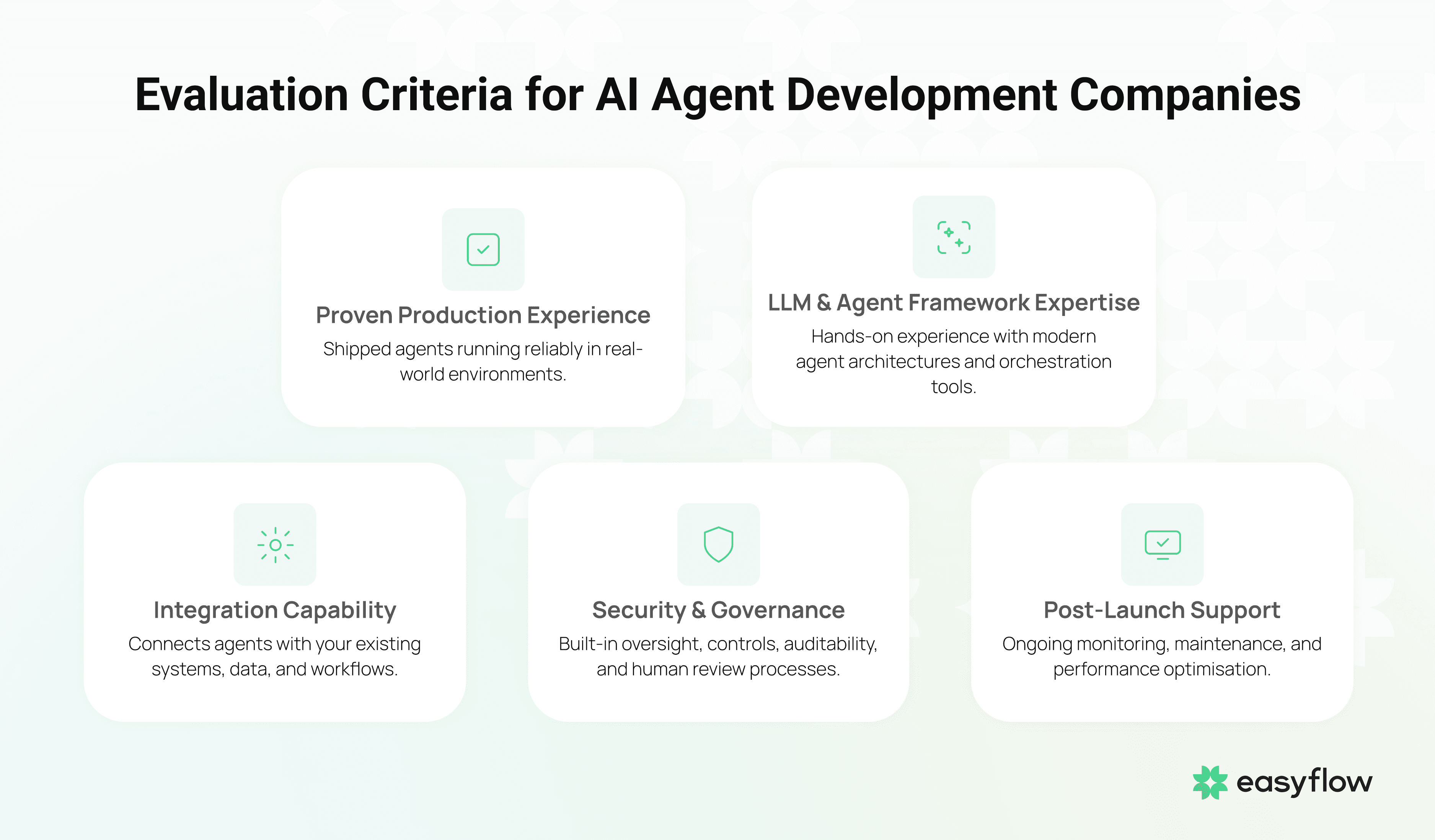
Proven Track Record Beyond Demos
The key question is whether the company has shipped agents that run in production and handle real workloads consistently, rather than proof-of-concept demos that never encounter the complexity of live enterprise systems.
Technical Depth with LLMs and Orchestration Frameworks
Agent development draws on a distinct set of engineering skills. Look for hands-on experience with agent orchestration frameworks, retrieval-augmented generation (RAG), tool integration, memory management, and multi-agent systems.
Integration Capability with Your Existing Stack
Agents deliver value when they can connect to the systems your business runs on, like CRM, ERP, communication platforms, internal APIs, and databases. A vendor's integration history is one of the more reliable signals of the engineering complexity they can manage.
Security, Governance, and Human-in-the-Loop Design
Gartner's June 2025 analysis found that over 40% of agentic AI projects are at risk of cancellation by the end of 2027, with unclear governance and inadequate risk controls among the leading causes. Shiping durable agents requires building oversight into the design from the start, defining escalation paths, audit logs, and failure modes before writing agent logic.
Post-Launch Support and Optimization
Agents degrade over time as the underlying models, APIs, and real-world inputs change. Most organisations are still in the process of developing the necessary knowledge to handle the maintenance tasks on their own. Therefore, while assessing an engagement, consider continual monitoring and optimisation.
Company | Best For | Key Capabilities | Industries | Engagement Model |
|---|---|---|---|---|
Easyflow | Operations-heavy mid-market, end-to-end delivery | Custom agents, multi-agent systems, AI transformation, engineering | Financial services, SaaS, logistics, professional services | Fixed-price catalog; custom scoped; retainer |
LeewayHertz | Enterprise multi-agent orchestration | ZBrain platform, RAG, LangChain, multi-agent coordination | Finance, manufacturing, logistics, e-commerce | Project-based, enterprise scoping |
Neurons Lab | FSI and regulated industries | Compliant agentic systems, AWS Advanced Tier, LangOps | Banking, insurance, wealth management | Strategy + implementation, retainer |
Master of Code | Customer-facing and internal workflow agents | Conversational AI, AI agent development, NLP, CRM integration, GenAI workflows | Retail, telco, financial services, healthcare | Project-based |
OpenKit | Regulated and document-intensive industries | Custom AI agents, multi-step workflow automation, multi-model orchestration, RAG | Healthcare, insurance, legal, financial services, education, recruitment | Project-based |
SoluLab | Mid-market custom AI | Generative AI, agent development, blockchain | Healthcare, finance, supply chain | Project-based |
Markovate | AI product development and MVPs | RAG, NLP, custom model integration | Healthcare, retail, finance | Sprint-based |
N-iX | AI engineering squads | LLM integration, agent development, data engineering | Telecom, finance, retail | Dedicated teams |
Azilen | Enterprise workflow automation | LLM agents, ERP, CRM, API integrations | Enterprise SaaS, manufacturing | Project-based |
Devcom | Agent integration into legacy stacks | AI-first delivery, LLM backends, prompt orchestration, RAG | Financial services, enterprise | Project-based |
Top AI Agent Development Companies in 2026
To help narrow the field, we've compiled a list of top agentic AI development companies, drawing on factors like technical depth, industry track record, and the ability to deliver production-ready systems.
1. Easyflow

Easyflow is an AI transformation agency that builds production-ready AI agents for operations-heavy companies.
The AI agent catalog offers transparent pricing by complexity tier for common use cases and a custom build option for specific workflows. The catalog spans sales, recruitment, retail, HR, and marketing, with documented deployments for companies in HR tech and DevOps.
Agents are delivered with full ownership transfer: source code, architecture documentation, deployment runbook, and a 30-day support period included. For teams that prefer ongoing management, Easyflow also offers a retainer model where a dedicated squad handles maintenance, monitoring, and iteration month to month.
Best for: Mid-market companies with operational complexity, multiple tools to integrate, and a leadership team ready to move from experimentation to production.
2. LeewayHertz

LeewayHertz is a San Francisco-based AI and engineering company. Its proprietary ZBrain Builder platform converts business requirements into structured agent architectures, with over 200 prebuilt data connectors and built-in evaluation suites. Their work concentrates on multi-agent system design for complex, data-rich environments where ERP and CRM integration is the primary engineering challenge.
Best for: Mid-to-large enterprises in finance, manufacturing, and logistics needing orchestrated multi-agent systems with deep integration requirements.
3. Neurons Lab

Neurons Lab is a UK and Singapore-based agentic AI consultancy focused on financial institutions. With 500+ engineers and an AWS Advanced Tier partnership, they have delivered compliant agentic systems for organisations including HSBC, Visa, and AXA. Knowledge transfer is built into their delivery model so internal teams can maintain what was built.
Best for: FSIs, banks, insurers, and wealth management firms that need compliant, scalable agentic systems with specific governance requirements.
4. Master of Code Global

Master of Code Global is a company that develops custom AI solutions, with over 1,000 delivered projects for clients. Their AI agent work spans both customer-facing and internal workflows: conversational agents for customer service and support automation and enterprise agents for internal data collection, process automation, and workflow coordination.
Best for: Companies that need AI agents across both customer-facing and internal operations, with strong NLP, CRM integration, and enterprise deployment experience.
5. OpenKit
OpenKit is a Cambridge-based AI development company specialising in custom AI agents for regulated and document-intensive industries. They build agents that connect to existing enterprise systems, including CRMs, ERPs, and databases, handling multi-step workflows with human-in-the-loop options built in from the start.
Their industry focus covers healthcare, insurance, legal, financial services, education, and recruitment.
Best for: Mid-sized organisations in regulated industries that need secure, compliant AI agents with strong document analysis and workflow automation capability.
6. SoluLab

SoluLab offers generative AI and agent development across mid-market industries, with additional capability in blockchain and Web3. They are typically selected for builds where requirements span AI agent logic and broader software development work.
Best for: Companies in healthcare, finance, or supply chain that need custom AI integrated with broader application development.
7. Markovate

Markovate focuses on AI product development and MVPs, with a sprint-based model that supports faster feedback cycles. This is useful for companies that want to validate an agent use case before committing to a full-scale build.
Best for: Organisations in healthcare, insurance, finance, manufacturing, legal, and e-commerce looking to test agent concepts with a defined path to production.
8. N-iX

N-iX provides dedicated AI engineering squads on an ongoing basis, covering LLM integration, agent development, and data engineering. They suit clients that want consistent team capacity over time rather than a fixed-scope project.
Best for: Product-led companies in telecom, finance, and retail that need ongoing AI engineering capacity.
9. Azilen

Azilen focuses on developing AI agents for enterprises with a strong emphasis on integration across existing systems, including ERPs, CRMs, data platforms, and APIs. Their work covers multi-agent orchestration, workflow automation, and production deployment, with documented clients in legal technology, manufacturing, and enterprise SaaS.
Best for: Enterprise teams with complex SaaS stacks who need agents that operate across multiple connected tools.
10. Devcom

Devcom is a custom AI agent development and integration company focused on complex business environments. Their services cover the full development cycle from AI strategy and agent design through to deployment, system integration, and ongoing monitoring. They work with both modern cloud-based systems and environments where agents need to operate alongside existing infrastructure.
Best for: organisations that need end-to-end custom agent development with a structured approach to integration, security, and post-launch optimisation.
What Services Do AI Agent Development Companies Provide?
Capabilities vary across firms. The full service range typically includes the following:
Custom AI Agent Development
Building agents scoped to a specific business process: a procurement agent that handles vendor communications or a recruiting agent that sources candidates. The work involves LLM selection, tool configuration, orchestration design, and production deployment.
AI Workflow Automation
Connecting multiple process steps into a single agent-driven flow. AI workflow automation handles exceptions, ambiguous inputs, and multi-step decisions where the right action depends on context that must be retrieved and evaluated at runtime.
Multi-Agent System Design
Complex operations may require multiple agents working in coordination: one reading incoming data, one making decisions, one executing downstream actions, and one monitoring for anomalies. Designing this kind of system requires coordination logic, escalation paths, and testing at the system level.
LLM Integration and Agentic Infrastructure
Selecting and integrating the right foundation model for a specific task, setting up retrieval-augmented generation where the agent needs access to private or frequently updated data, building tool-use frameworks, and creating memory architecture that allows agents to maintain context across interactions.
Integration with Business Systems
Agents deliver operational value when they work inside your actual systems. CRM, ERP, communication tools, internal databases, and custom APIs all require specific integration work, and the depth of that integration affects whether an agent can operate autonomously or requires constant human oversight.
Human-in-the-Loop Design
According to Deloitte's 2026 State of AI in the Enterprise report, only 21% of organisations deploying AI agents have a mature governance model in place. Well-designed agents should define which actions require human approval, how escalations are triggered, and how agents hand off at the edge of their appropriate decision scope.
Monitoring, Optimization, and Ongoing Support
Production agents require monitoring of completion rates, error rates, latency, and behaviour under edge cases. To help clients maintain performance over time, vendors should include structured processes for identifying degradation and responding to it as part of their engagement model.
How AI Agent Development Differs from Chatbots and Automation Platforms
A chatbot answers questions within a defined response framework and does not take autonomous actions or connect to external systems without explicit integration. It is effectively a UI layer over a knowledge base or pre-defined workflow.
A no-code automation platform like Zapier or Make handles linear, rule-based workflows reliably and cost-effectively when every step is known in advance and the process handles clean, structured inputs. These tools are appropriate for a large category of automation work.
An AI agent is suited to cases that fall outside those categories: processes with variable decision paths, processes that require reasoning over unstructured context, and processes where the right action depends on information that must be retrieved, synthesised, and evaluated at runtime. If a workflow currently requires a human to exercise judgement, an agent is a reasonable starting point for automation.
Generative AI development companies form a related but distinct category, primarily focused on content creation, summarisation, and language model fine-tuning. If the goal is autonomous process execution rather than content generation, a firm with specific agentic AI development experience is likely a better fit.
How to Choose the Right AI Agent Development Partner
Choosing an AI agent development partner involves variables such as process complexity, integration requirements, and how much internal capability you want to build through the engagement.
Define the Process Before Choosing a Vendor
The more clearly we document a process before the first vendor call, the more accurately we can scope and price the engagement. A useful starting point is mapping out the current steps, who makes which decisions, what data is referenced, and where the process creates manual overhead or error today.
Verify Whether You Need an Agent or Something Simpler
If the process follows fixed rules and handles predictable, structured inputs, a workflow automation tool may be faster and cheaper to implement. The process characteristics that tend to justify an agent are variable decision paths, unstructured inputs, and actions that span multiple systems without a predetermined sequence.
Review Case Studies by Process Type
Industry labels on case studies are less informative than those for process types. An agent that automates document review in legal services uses similar architecture to one that automates contract exception handling in procurement. Seek evidence that the vendor has solved problems that are structurally similar to yours in terms of orchestration complexity, integration depth, and governance requirements.
Assess Integration Experience Specifically
Ask which tools they have integrated with and at what depth. Reading data from a system is simpler than writing back to it or operating inside a legacy system with undocumented behaviours. The more complex your stack, the more important this question becomes.
Establish Governance and Security Expectations Early
During scoping, ask specifically how the vendor handles incorrect agent actions, what audit logging is in place, and how the agent is scoped to prevent unauthorised access. Governance controls are typically difficult and expensive to add after deployment, so how a vendor responds to these questions early on is a useful signal.
Start with a Scoped Proof of Concept
A well-scoped PoC limited to a single process with defined success metrics reduces project risk. The PoC phase also tests the working relationship: whether the vendor communicates clearly, challenges unrealistic assumptions, and holds up technically when their approach meets your actual data and systems.
AI Agent Development Cost in 2026
Pricing follows the complexity of the work. Here is the realistic range based on current market data.
Pricing by Complexity
Simple agents built on low-code platforms for well-defined, narrow tasks typically run from $5,000 to $15,000. These handle high-volume, predictable workflows with limited decision-making and minimal integration requirements. Companies can test a specific use case before committing to custom development.
Mid-complexity agents covering custom development with LLM integration, RAG pipelines, and multiple system integrations typically fall in the $20,000 to $80,000 range. This category covers most first-generation business process agents for mid-market organisations. The range reflects variation in integration depth and orchestration complexity.
Enterprise-grade agentic systems with multi-agent coordination, compliance requirements, and deep enterprise stack integration range from $80,000 to $300,000 or more.
According to KPMG's Q1 2026 Global AI Pulse, US organisations are now projecting average AI spending of $207 million over the next twelve months, nearly double the figure for the same period in 2025.
Annual maintenance typically runs 15 to 25% of the initial build cost.
Why Starting with a PoC Reduces Total Risk
Many of the cost surprises in AI agent development occur in the transition from prototype to production, where edge cases and integration constraints often surface. Starting with a PoC scoped to a single process with clear success metrics can generate verified evidence before you commit to a full deployment budget.
Red Flags When Evaluating Top AI Solutions Companies For Agent Development 2026
Several patterns are worth watching for during a vendor evaluation.
Agents are recommended for every use case
Any vendor that proposes agentic AI before understanding your specific process, data quality, and integration environment may not be making a recommendation based on technical fit.
No production case studies
Demo-quality proof of concepts and production deployments are different in character: the latter handle real load, real edge cases, and real failure modes at scale. Ask specifically for examples of agents running in production environments with measurable outcomes.
Governance as a post-launch consideration
Agents operating inside live systems require audit trails, escalation paths, access controls, and defined failure behaviours. When vendors defer these conversations until after scoping, the governance work is typically added later under time pressure and at higher cost.
No defined post-launch support model
Production agents require ongoing attention as the volume and variety of inputs change. A vendor without a structured support model is leaving the client to manage those changes independently.
Vague integration claims
Statements about integrating with all major platforms carry no specific information. Ask about your stack, the depth of integration in each case, and where similar integrations were delivered.
Easyflow AI Agent Catalog: Examples
Easyflow maintains a catalog of production-ready agents covering sales, recruitment, retail, HR, and marketing, priced by complexity tier. Each agent can be deployed from the catalog as-is or customised to fit specific workflows. A custom build option is also available for processes that fall outside the catalog scope.
Candidate Evaluator (Recruitment)
The candidate evaluator reads incoming CVs and LinkedIn profiles, extracts skills, experience, and qualifications, and matches them against the requirements of an open vacancy. It scores each candidate for fit, ranks the shortlist, and pushes results directly to the ATS so the pipeline reflects current status without manual data entry. It is suited to teams handling high application volumes across multiple roles.
Sales Follow-Up Generator (Sales)
This agent monitors lead activity on a defined schedule, analyses each lead's interaction history and engagement patterns, generates personalised follow-up messages in line with the company's tone of voice, and queues them for delivery. It also tracks responses and updates engagement status for each contact. It is relevant for sales teams managing a large number of active leads where response timing is a factor.
Competitor Pricing Analyser (Retail)
The competitor pricing analyser runs on a scheduled or on-demand basis, pulling pricing data from external market feeds and web sources to monitor competitor price movements across a defined product set. It identifies gaps where a company's pricing is significantly above or below market average, models how price adjustments could affect sales volume and margin, and delivers a structured report recommending which products to reprice, hold, or use as competitive anchors.
HR Monitoring Summariser (Human Resources)
The HR monitoring summariser collects 360-degree feedback from managers, peers, and self-assessments at each review cycle, structures the raw data, identifies patterns and risk indicators, and delivers a formatted report with specific recommendations for each employee reviewed. It is designed for HR teams running regular performance or development cycles across multiple departments.
Choosing the Right AI Agent Development Partner
According to Grand View Research, the global AI agents market is projected to grow at a CAGR of 45.8% from 2025 to 2030, reaching $50.31 billion. Companies are now treating agent deployment as an operational priority.
The distance between experimentation and production often depends on governance quality, integration depth, and whether the development partner is accountable for operational outcomes.
If you are assessing what an AI agent could do for a specific process in your organisation, book a discovery call with the Easyflow team to evaluate the scope, integration requirements, and realistic ROI.
Posted by

Viktoriia Pyvovar
Content Writer
Can you provide top 5 AI solutions companies for agent development?
The top AI agent development companies in 2026 include Easyflow, LeewayHertz, Neurons Lab, Master of Code Global, and OpenKit, alongside a growing number of specialised firms shaping the space. The right choice depends on your industry, the orchestration complexity of the workflow you want to automate, your integration requirements, and whether you need a single-agent build or an engagement that covers broader operational change.
How is an AI agent different from an AI chatbot?
A chatbot responds to questions within a defined scope and does not take autonomous actions or connect to external systems without explicit integration. An AI agent is goal-directed: it receives an objective, determines the steps required to achieve it, uses available tools to execute those steps, handles exceptions, and delivers an outcome. Processes where humans currently exercise judgement are a common starting point for agent development, while processes with well-defined inputs and predictable outputs are often better served by simpler tools.
How much does it cost to build an AI agent?
Development costs range from $5,000 for simple low-code implementations to $300,000 or more for enterprise-grade agentic systems with multi-agent coordination and compliance requirements. Annual maintenance typically runs 15 to 25% of the initial build cost. To manage cost and scope risk, many start with a well-scoped proof of concept before deploying.
Should I build an AI agent in-house or hire a development company?
Building in-house makes sense when AI engineering is core to the business or when the team already has specific expertise in production agent deployment. For organisations that are still developing this capability, a common approach is to work with an external firm for the first one or two agents and structure the engagement to include knowledge transfer. The key variable is the capability gap and how long it would take to close it independently versus with external support.