AI Use Cases in Retail: Practical Applications That Drive Results

In retail, meeting customer expectations and managing costs are both strategic imperatives — and retail artificial intelligence has emerged as the tool that addresses both.
The operational reality for retailers competing in today's market is that AI is no longer experimental. An industry survey shows that 89% of retailers reported an increase in annual revenue attributable to AI.
Why does AI automation work for retailers? Modern AI agents, intelligent systems that can act autonomously, handle routine and complex tasks with greater consistency and speed than manual methods. This includes predicting which products customers will purchase, adjusting prices, managing inventory levels, and leveraging conversational AI to engage shoppers.
Customer expectations are driving adoption even more so than products and prices. AI is changing how consumers make purchasing decisions: personalised recommendations and predictive suggestions can shorten the consideration process and, in some cases, guide shoppers toward products without requiring active searches. While the traditional marketing funnel still exists, AI is making it more dynamic and responsive to individual behaviours.
In this article, we take a closer look at how AI helps retailers boost revenues, improve efficiency, and create better customer experiences.
Benefits of AI in Retail
Artificial intelligence is delivering measurable value across the retail value chain. The most successful implementations focus on concrete business outcomes:
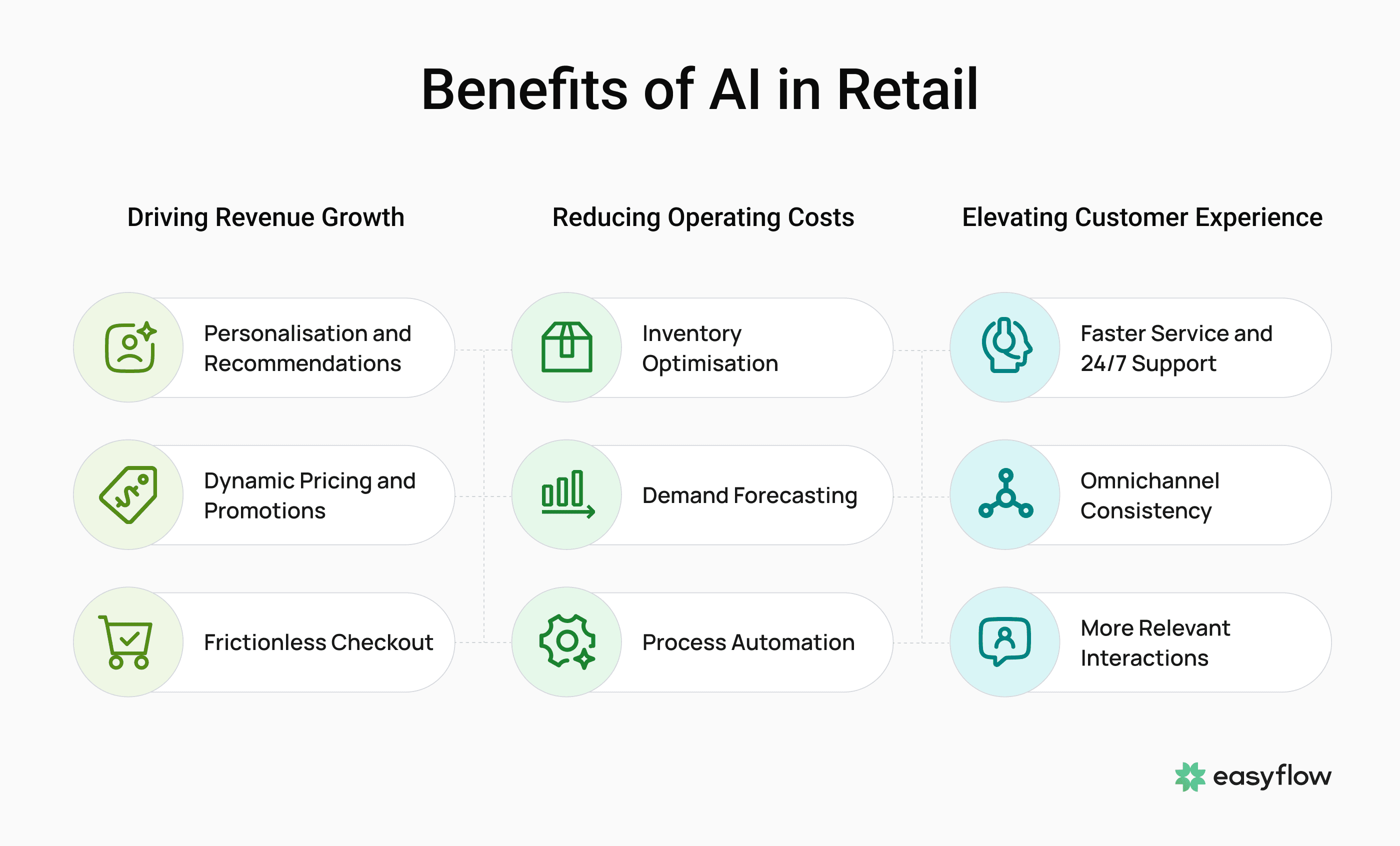
Personalisation and Recommendations
Personalised product recommendations guide shoppers toward items they are more likely to purchase, increasing conversion rates and average order value.
Dynamic Pricing and Promotions
Dynamic pricing and promotions allow retailers to respond to changes in demand, inventory levels, and customer behaviour in near real time, helping maximise margins without sacrificing competitiveness.
Frictionless Checkout
Frictionless checkout experiences reduce cart abandonment by removing unnecessary steps and delays at the point of purchase.
Inventory Optimisation
Inventory optimisation ensures the right products are available in the right quantities, reducing both overstocking and lost sales due to stockouts.
Demand Forecasting
More accurate demand forecasting improves planning across merchandising, supply chain, and logistics by minimising waste and unnecessary markdowns.
Process Automation
AI-driven process automation also reduces manual effort across pricing updates, catalogue management, customer enquiries, and internal operations. By automating routine tasks, retailers can lower operational expenses while allowing teams to focus on higher-value work.
Faster Service and 24/7 Support
Faster service and 24/7 support ensure customers can get answers and assistance whenever they need it, without long wait times.
Consistent Omnichannel Experiences
Consistent omnichannel experiences connect online, mobile, and in-store interactions into a single journey, reducing friction and confusion.
More Relevant Interactions
More relevant interactions, informed by customer behaviour and preferences, help shoppers discover products faster and feel understood rather than overwhelmed.
The result is a smoother, more personalised experience that builds loyalty and long-term brand value.
Wharton marketing professor Barbara Kahn suggests that AI's impact on retail can be understood through a time framework: applications either add valuable time through personalisation and engagement or reduce wasted time through efficiency and friction reduction.
Understanding AI through this lens highlights where retailers should focus their efforts: on initiatives that drive the greatest returns in both engagement and efficiency.
AI Use Cases in Retail
Here are the most impactful AI retail solutions our Easyflow team has deployed to help our client transform operations and engage customers more effectively.
Customer Experience & Sales
AI-Powered Shopping Assistants
Retailers can deploy AI shopping assistants that guide customers through their entire purchase journey. They answer product questions, compare options, and help complete transactions in real time. For example, a home improvement retailer's AI assistant can help a customer choose the right paint finish for their bathroom by asking about moisture levels, lighting, and desired look, then recommending specific products.
Personalised Product Recommendations
AI recommendation agents can analyse browsing patterns, purchase histories, and contextual signals to show each customer which products are most likely to match their needs. When a customer purchases running shoes, the system identifies logical next purchases based on context—perhaps moisture-wicking socks or a GPS watch if they previously browsed fitness technology.
Instant Customer Engagement via Messaging
AI messaging agents engage customers instantly across business messaging channels such as chat, social DMs, and inboxes. When a customer messages at 11 PM asking, "Do you have this dress in size 8?", the system checks real-time inventory and responds instantly with availability and hold options. During Black Friday, these systems can handle 10x normal inquiry volumes without additional staffing.
Automated Review Response Management
Rather than leaving customer reviews unanswered or overwhelming teams with response requirements, AI feedback agents can analyse sentiment and generate brand-appropriate responses for review and approval. For example, a customer leaves a 3-star review saying, "Great shoes but ran small." The AI drafts a response acknowledging the feedback, offering sizing guidance for future purchases, and thanking them for their input.
Many of these customer experience capabilities are particularly powerful in digital environments. Learn more in our comprehensive guide to AI automation for e-commerce.
Inventory Management
Intelligent Inventory Management
AI for inventory management continuously tracks inventory movement across all locations and alerts teams to potential stockout or overstock situations before they impact sales. Store managers receive notifications when specific SKUs need attention, enabling proactive reordering or redistribution.
Inventory Analytics
Inventory analysers help identify unusual patterns that humans might miss. These insights support smarter planning decisions and help merchandising and supply chain teams respond quickly to demand shifts.
Procurement & Finance Operations
Procurement Process Automation
Document-flow agents extract data from invoices, purchase orders, and shipping documents, validate information against existing systems, and route approvals automatically. The system catches discrepancies like a supplier billing for more units than received, flags the issue, and routes it for resolution before payment is made.
Automated Business Reporting
Instead of manually pulling data from multiple systems to build reports, reporting automation solutions generate accurate performance dashboards on demand. Retail teams gain faster access to performance insights, improving financial oversight and decision-making.
Pricing Optimization
Dynamic Competitive Pricing Intelligence
AI can monitor competitor pricing to identify opportunities and threats and recommend optimal price positioning to help retailers stay competitive. During peak events like Prime Day, the system can track hundreds of competitor promotions, enabling timely pricing decisions at scale.
Marketing & Merchandising
Content Marketing Automation
AI content planners help align marketing campaigns with inventory to promote products that are in stock and performing well. For example, if a planned email campaign features winter boots but the system detects that sizes 7-9 are nearly out of stock, it automatically substitutes alternative styles with full inventory.
Product Description Generation
Using generative AI in retail simplifies content creation. Rather than manually writing descriptions for every SKU variation, AI product description generators create content automatically based on product specifications. This approach can help you preserve brand voice and incorporate relevant marketplace keywords for better discoverability.
Workforce & Operations
Automated Retail Hiring & Screening
Hiring agents can screen candidates and advance top-qualified individuals to interviews, reducing operational overhead. This is especially valuable during high-volume periods like holiday hiring, when retailers face an influx of seasonal applications.
The Future of AI in Retail
AI is set to transform retail, with industry analysts predicting that AI agents could drive up to a quarter of global e-commerce transactions by 2030. Key trends shaping the future include:
Agentic Commerce: AI shopping on behalf of customers for faster, personalised purchases.
Fully Autonomous Inventory: Zero-touch replenishment systems that optimise stock automatically.
Predictive Shopping: Anticipating customer needs before they ask.
Sustainability Optimisation: Reducing waste and tracking carbon footprints automatically.
Voice & Visual Commerce: New interfaces for intuitive, image- and voice-driven shopping.
Bias Awareness: Understanding algorithmic versus human biases in purchasing decisions.
Intelligent systems that anticipate, optimise, and personalise the shopping experience will define the next decade of retail.
Get the Retail AI Automation Guide
For retailers still in the research phase, we have prepared an automation guide showcasing our agentic solutions for specific processes. You get:
Detailed PDF guide on retail AI automation
Use case deep-dives with agent examples
Real efficiency gains in each use case
Conclusion
AI is changing retail on a deeper level, influencing both customer engagement and decision-making processes. From smart product recommendations to automated inventory systems, AI helps retailers move faster, cut waste, and scale customised experiences.
With ongoing advancements, AI use cases in retail will only expand, advancing audio and visual AI for retail, enabling agents to shop on behalf of users and even helping retailers meet sustainability goals. If you want to embrace these capabilities thoughtfully, start by reviewing your current operations. Our AI opportunity audit can help identify the areas where AI can create the most impact.
Posted by

Viktoriia Pyvovar
Content Writer
How does conversational AI for retail work?
Conversational AI for retail enables natural language interactions between customers and AI systems through chat, messaging apps, or voice interfaces. These systems process customer questions, access inventory and product data, and provide accurate responses.
What AI tools for retail businesses are available today?
AI tools for retail include recommendation engines, inventory management systems, pricing intelligence platforms, computer vision systems, chatbots for customer service, demand forecasting tools, and automated reporting systems. Our AI tool marketplace can help you discover and compare solutions designed to integrate with your existing systems.
What is gen AI for retail?
Gen AI (generative AI) for retail refers to AI systems that create original text, images, or recommendations tailored to specific contexts. This may include product descriptions, marketing copy, personalised emails, social media posts, and customer service responses.
How do AI retail pricing strategies work?
AI retail pricing strategies use algorithms that monitor competitor prices, inventory levels, and consumer demand to recommend the best prices. This approach replaces manual pricing reviews that can't keep pace with market changes.
How quickly can AI be implemented in the retail industry?
Implementation timelines depend on the complexity and scope. Simple applications like chatbots or automated review responses can be deployed in weeks. More complex systems, like demand forecasting or comprehensive personalisation engines, typically require 2–4 months for integration, data preparation, and testing.
What results can I expect from implementing AI for retail stores?
Retailers implementing AI typically report reduced stockouts through better inventory predictions, increased conversion rates from personalised recommendations, lower customer service costs, improved margins from optimised pricing, and faster time-to-market for new products.